
Practical working guides written by a moulder. They teach the questions we would want answered if we were the customer — from the standard engineering literature and from the floor of our own plant, sources named, no mystery. Read them before you specify, quote them back to us, and put numbers on your own part with the calculators.
No guide matches that yet — try another word, or ask an engineer directly.
Start here
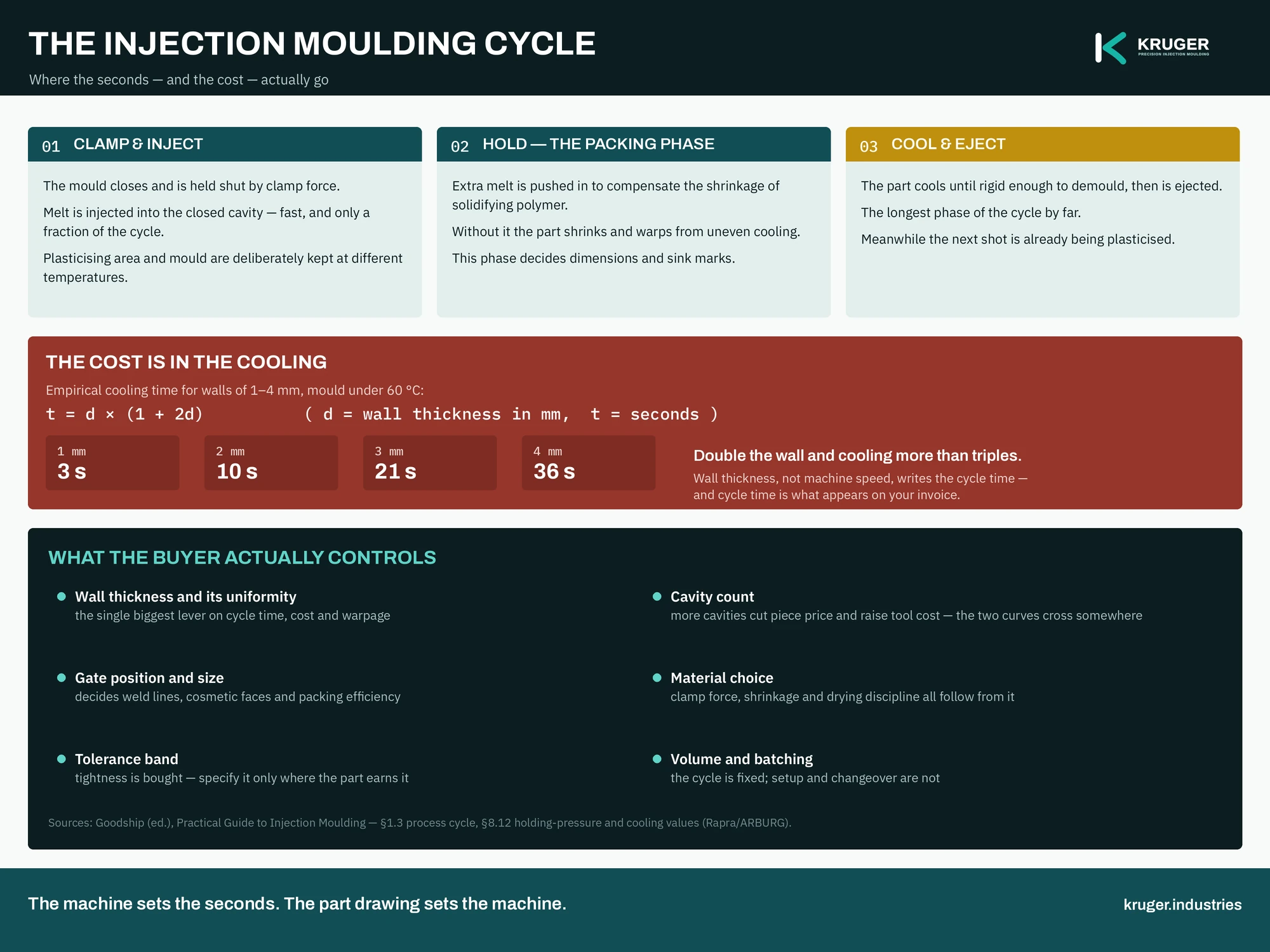 The spine guideThe Injection Moulding ProcessClamp, inject, hold, cool, eject — and the arithmetic that turns wall thickness into your piece price.
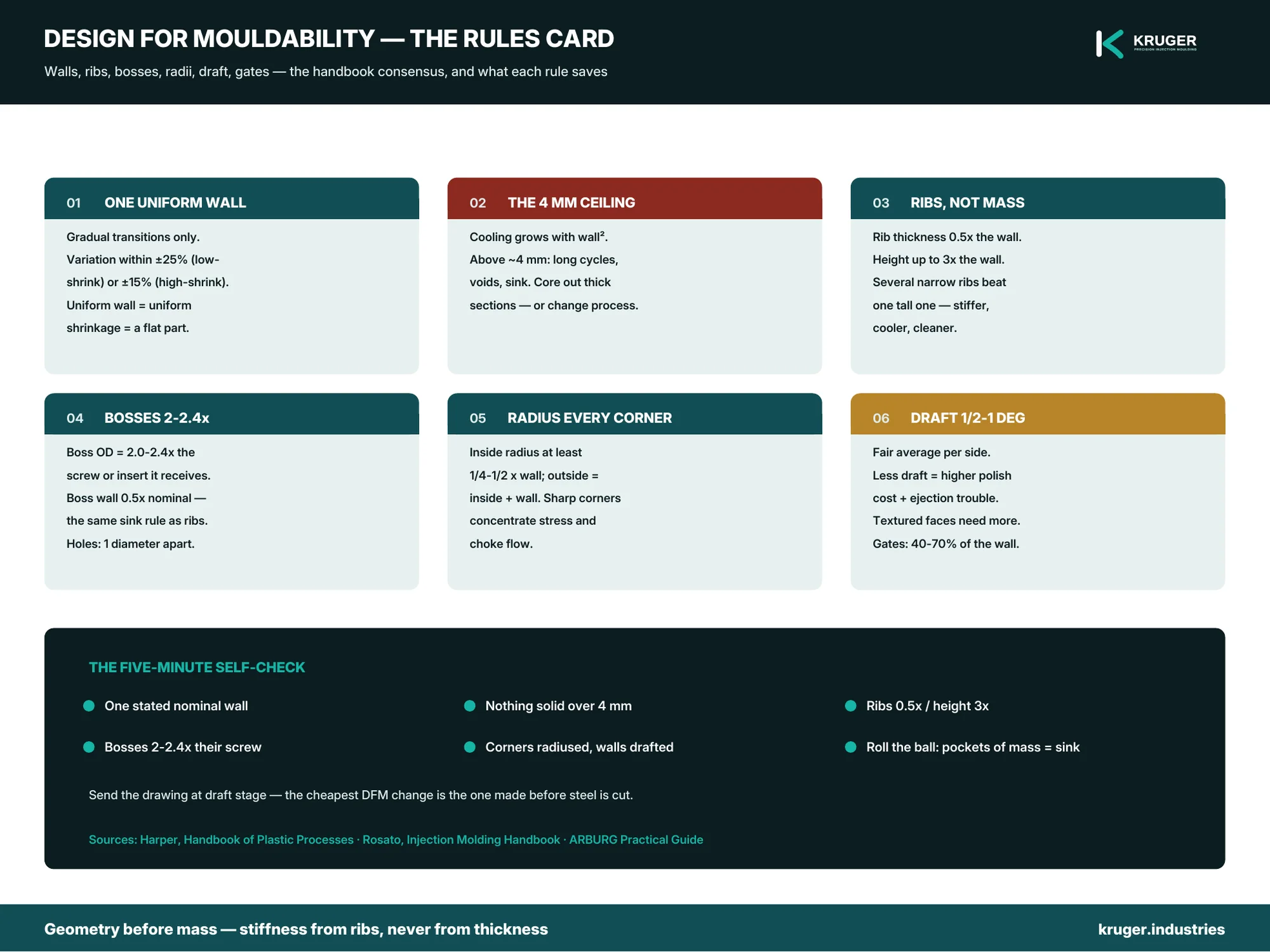 Before you quoteDesign for MouldabilityWalls, ribs, bosses, radii, draft and gates — the handbook rules that decide part cost, each one priced.Free, no sign-upNine Engineering CalculatorsShot size, clamping force, cycle time, part cost, residence time, shrinkage, draft, gate shear and tooling break-even. Each states its formula and its source.
Choosing and running a moulding partner
SourcingHow to Qualify a Moulding Supplier in IndiaAn auditor’s checklist — and the ten questions to email before you fly.SourcingBattery Containers, Judged ProperlyWhat a life of acid, load and heat demands of a moulded box — and five questions for any container moulder.SourcingLarge Part Injection Moulding“Large” is three numbers — footprint and clamp, flow length, shot weight — and an honest machine window.SourcingThe Injection Moulding RFQWhat to send to get a quote worth having — and how to judge the ones that come back.SourcingSpare Moulding CapacityCapacity is open hours on the right tonnage band — the three ways to buy it and seven questions that expose a hollow offer.ToolingInjection Moulding ToolingAnatomy, steels, runners, cavity arithmetic, ownership and indicative costs.ToolingWhat Does an Injection Mould Cost?The six drivers — and why two quotes for one part can differ threefold.EconomicsWhat Does a Moulded Part Cost?Material times waste, cycle over cavities times the machine rate, the tool over its volume — divided by yield. How to rebuild any quote.ToolingTypes of MouldTwo-plate, three-plate, hot runner — how the mould opens decides where your gate can be.SourcingMoving Your Mould to IndiaThe transfer playbook: documentation, trials, risks, and how a transfer lands well.SourcingThe Offshore Moulding PartnerWho owns the steel, what the price includes, how a part is approved across an ocean — and eight things to get in writing before the tool is cut.QualityThe Quality Paper TrailCertificates, FAI, in-process records and a machine-health audit with real pass bands.QualityMoulding Defects, DecodedThe defect families, the flash myth retired, and the question that reveals a quality system.
Designing the part
DesignDesign for MouldabilityThe handbook rules that decide part cost — walls, ribs, bosses, radii, draft, gates.DesignWall ThicknessThe square law, the uniformity bands, the 4 mm ceiling — and reading sink marks before the tool exists.DesignInjection Moulding GatesThe gate families, the five location rules, the weld-line count — approve the plan while it still costs a conversation.DesignSprue, Runner & GateThe delivery system you pay for on every shot — cross-sections, balance, and the cold-versus-hot runner trade.DesignOvermoulding & Insert MouldingThe three routes, what actually makes two materials bond, and the questions that test a supplier.DesignSnap Fits & Living HingesThe assembly you never pay for — moulded-in fasteners and hinges, and the opposite material rules each demands.DesignInjection Moulding TolerancesPreferred and tight bands by material, in millimetres — what widens them, and how to spend tightness only where it earns it.DesignSurface Finish & TextureSPI grades instead of adjectives — the polishing cost curve and the callouts that prevent disputes.EconomicsHow Many Cavities?The two curves that cross, machine fit, and what high cavitation quietly costs.
Materials
MaterialsInjection Moulding MaterialsThermoplastics, thermosets, alloys, blends and composites in one working guide.MaterialsHow to Read a Plastics DatasheetWhat the numbers promise — and what they don’t. Test bars are not your part.MaterialsPolymer Composites & Filled PlasticsWhat glass fibre buys in stiffness — and the three costs nobody mentions.MaterialsPolymer Blends & AlloysWhen mixing two plastics beats either one — and when it quietly beats neither.MaterialsBlend vs CompositeOne mixes polymer into polymer, the other adds load-bearing fibres — the fork in the road, priced honestly.MaterialsThermoplastics vs ThermosetsMelt again, or cure once — the fork that decides process, machine, scrap economics and service temperature.MaterialsThermosetting PlasticsCure, not melt — and how to tell whether your part actually needs one.MaterialsThermoplasticsAmorphous or semi-crystalline — the divide that quietly sets your shrinkage, tolerance and warp.MaterialsThermoplastic Compounds & GradesThe word on the drawing is a family; the bag is a recipe — what each additive buys and costs, moulding grade versus extrusion grade, and how to specify one nobody can swap.MaterialsABS Injection MouldingThe workhorse terpolymer — what each monomer trades, the grade trap, drying discipline and five buyer questions.MaterialsThe Basics of PolymersMonomers, chains and MFI — why chain length is money, and where moulding discipline comes from.MaterialsColour in Injection MouldingCompound, masterbatch or pigment — and how to specify it so every batch matches.ReferenceTemperature & Drying ChartMelt, mould and drying values for the common thermoplastics, on one page.
Process and discipline
ProcessThe Injection Moulding ProcessPhase by phase — and why cooling, not injecting, writes your piece price.MachinesThe Injection Moulding MachineClamp, shot capacity and the four dimensions that decide whether your mould fits.MachinesToggle Clamps & Clamping ForceHow a machine holds a mould shut: amplification up to 50:1, self-locking — and how clamp force is really measured.ProcessInjection PressureThe gauge is not your part — where pressure is lost between barrel and cavity, and how much machine a part really needs.ProcessCooling TimeThe part of the cycle you pay for — the square law, why set cooling time understates the real one, and five checks for a quoted cycle.DisciplineDrying Plastics Before MouldingWet granules make brittle parts: splay you can see, hydrolysis you can’t.DisciplineRegrind — Settle It in WritingWhy regrind isn’t virgin, the handling rules, and the clauses to put in the order.DisciplinePurging & ChangeoversThe between-jobs discipline: twenty timed cycles, the right agent — and the pairs that must never meet.ProcessISBM vs Injection MouldingWhich process your part actually needs — with an honest note on which of them we run.ProcessMoulding Processes ComparedInjection, extrusion, blow, rotational, thermoforming, compression — which one your part needs by shape and volume, and which of them we run.ProcessAdvantages & Disadvantages of Injection MouldingWhat the process buys, what it costs, and when it is simply the wrong answer.
Put numbers on your part
Shot-size calculatorPart weight, cavities and runner → shot weight and the machine window it needs.Clamping-force calculatorProjected area and material → required tonnage.Cycle-time estimatorWall thickness and material → cooling time, cycle and parts per hour.Part-cost calculatorMaterial price, cycle and machine rate → honest cost per part.Residence-time estimatorHow long your material sits in the barrel — and whether it survives.Mould-shrinkage calculatorTarget part dimension → the tool-steel dimension.Draft-angle calculatorAngle to offset and back, with minimum-draft guidance.Gate shear-rate calculatorIs your gate burning the material?Aluminium vs steel mouldThe tooling break-even point, in parts.
When the reading turns into a partSend the drawing and the duty. An engineer replies with a design-for-moulding review against the same rules these guides teach — within 48 hours on working days.Request a quote