
/ KNOWLEDGE · MATERIALS
Polymer blend vs composite — which does your part need?
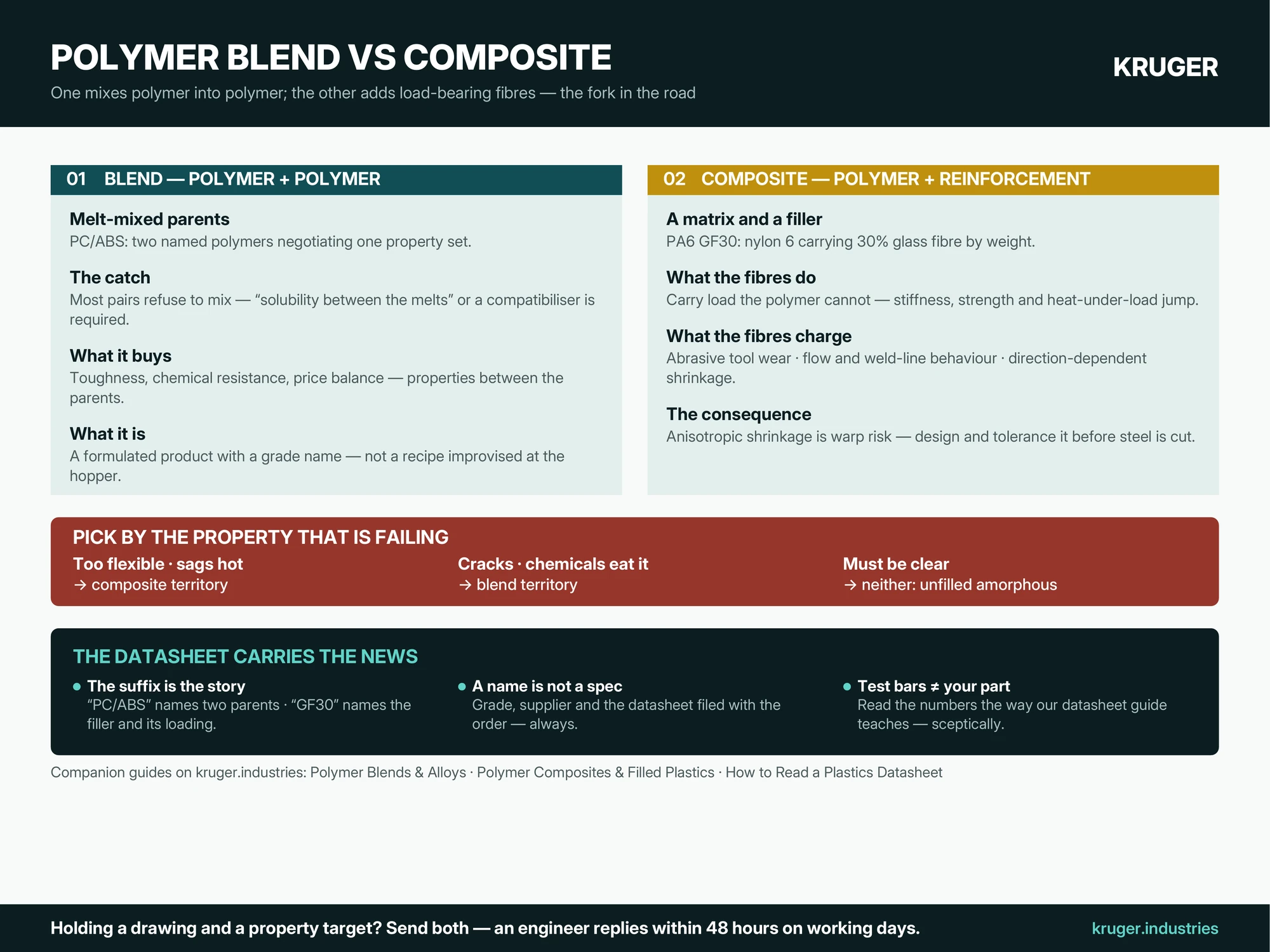
A blend mixes a polymer into another polymer; a composite mixes something that is not a polymer — most often glass fibre — into a polymer. That one sentence settles most of the confusion, because the two routes solve different problems. A blend negotiates between two sets of polymer properties: toughness from one parent, chemical resistance or price from the other. A composite changes category: the fibres carry load the polymer cannot, so stiffness, strength and heat-under-load jump in a way no unfilled thermoplastic can match. Each has a full guide on this site — blends and alloys, composites and filled plastics — this page is the fork in the road.
What a blend is — and the catch inside the word
A blend is two (occasionally more) thermoplastics melt-mixed into one working material — the trade often says “alloy” when the pairing is engineered to behave as a single material. The catch is that most polymer pairs do not want to mix: a stable blend needs “high compatibility, or solubility between the melts” (Goodship/Arburg), and where nature does not provide that, formulators add compatibilisers to broker the marriage. This is why a blend is a formulated product with a grade name, not a recipe you improvise — and why the blends guide spends its time on when mixing beats either parent and when it quietly beats neither. What the long molecules are doing in there is the basics of polymers story.
What a composite is — and what the fibres charge for their work
A composite (in injection moulding, usually a “filled” or “reinforced” grade) keeps one polymer as the matrix and adds a non-polymeric phase — chopped glass fibre above all, also mineral fillers, glass beads, carbon fibre — that carries load and resists heat. The gain is real and immediate: a glass-filled polypropylene often does an engineering job on a commodity backbone, the exact trade our thermoplastics guide prices out. But the fibres charge for their work, and the composites guide itemises the bill honestly: abrasive wear on tooling and machine, flow and weld-line behaviour that must be designed for, and shrinkage that differs along and across flow — which is warp risk, and why filled parts deserve the shrinkage calculator and an honest look at the tolerances guide before steel is cut.
Pick by the property that is failing
- Part too flexible, creeps, or sags hot? That is a stiffness and heat-deflection problem — composite territory. No blend of unfilled polymers will buy you what fibres buy.
- Part cracks on impact, or the chemical environment is eating it? Property-balance problem — blend territory, where one parent donates toughness or resistance the other lacks.
- Cost too high for the property set? Both routes compete: mineral-filled grades stretch material; blends stretch an expensive polymer with a cheaper partner. Ask for both quotes.
- Must be transparent? Fibres scatter light and most blends are opaque — you are choosing an unfilled amorphous thermoplastic instead; see the materials guide.
- Dimensions critical? Unfilled amorphous is the calm option; glass-filled is stiff but anisotropic. This is a conversation, not a checkbox — have it before the drawing hardens.
The words on the datasheet
The suffix carries the news: “PC/ABS” is a blend of two named parents; “PA6 GF30” is a composite — nylon 6 matrix, 30 per cent glass fibre by weight. Neither name is a specification by itself: grade, supplier and the datasheet filed with the order, always — and how to read a plastics datasheet shows you which of its numbers to trust, remembering that test bars are not your part.
Five questions before you choose
- Which single property is the part actually failing on? Name it; the fork above does the rest.
- Has anyone quoted the unfilled base polymer? Sometimes wall geometry, ribs and the DFM rules solve stiffness for free.
- If filled: has tooling been told? Glass changes steel choice, gate wear and maintenance intervals — a tooling conversation, not a footnote.
- If blended: what does the compatibiliser story look like from the supplier? A formulated alloy has documentation; an ad-hoc mix has excuses.
- What does the regrind policy say for this material? Filled and blended materials each behave differently on reprocessing — settle it in writing, per the regrind guide.
If you are holding a drawing and a property target and the fork still is not obvious, send both to us — an engineer replies with a material shortlist and its honest consequences, within 48 hours on working days.