
/ KNOWLEDGE · TOLERANCES
Injection moulding tolerances — what to specify, what to pay for
A tolerance is not a wish; it is a price. Every tightening of a dimension on your drawing buys real things downstream — better steel, slower cycles, more measurement, sometimes fewer cavities — whether or not the function needed it. This guide explains why moulded dimensions vary, what the standard and tight bands actually are for the common materials, and how to spend tightness only where the part earns it.
Why a moulded dimension varies at all
The mould is machined to microns; the part is not, because the part shrinks on the way out of it. Bryce puts the whole problem in one sentence: “it is not possible to manufacture a product to the exact dimensions placed on a product drawing” — conditions change, tools wear, people and machines vary. Shrinkage depends on the material (semi-crystalline materials shrink more, and less predictably, than amorphous ones; glass fibre shrinks differently along and across flow — the thermoplastics guide explains the divide), on the wall (our wall-thickness guide is half a tolerance lesson in disguise — non-uniform walls shrink non-uniformly), and on the process. Rosato is direct about which of the three matters most: “the greatest variation in part dimensions is introduced by the molding operation itself”, and to attain high dimensional reproducibility “it is essential to mold on a fully repetitive cycle”. A tolerance, then, is a promise about how well material, design and process are controlled, shot after shot. That control is what you are pricing.
The bands, in numbers
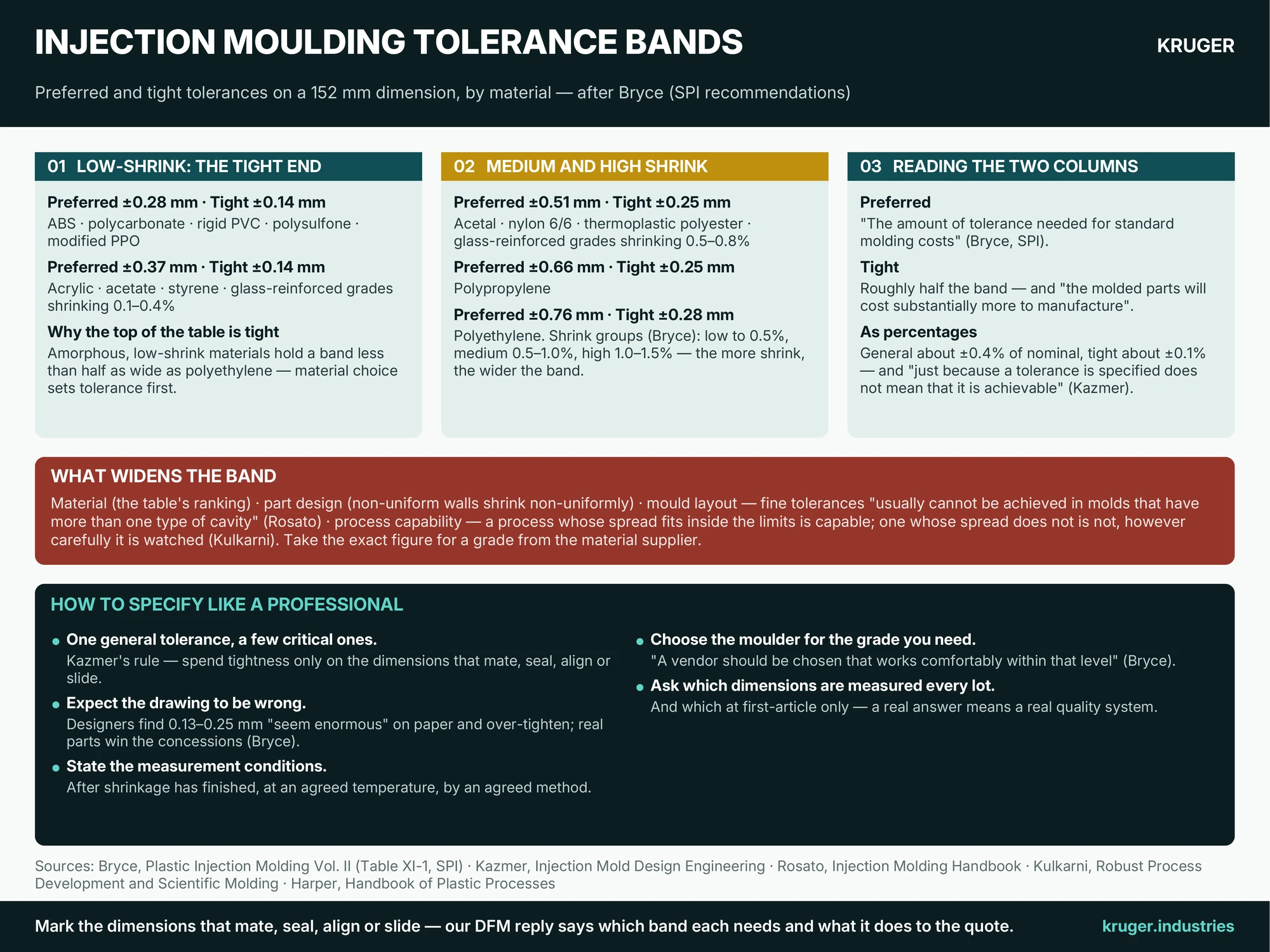
Bryce’s second volume reproduces the Society of the Plastics Industry’s recommended tolerances for a 152 mm dimension, in two columns: preferred — “the amount of tolerance needed for standard molding costs” — and tight, at which “the molded parts will cost substantially more to manufacture”. Read them as a ranking of materials as much as a set of numbers.
| Material | Preferred (±) | Tight (±) |
|---|---|---|
| ABS · polycarbonate · rigid PVC · polysulfone · modified PPO | 0.28 mm | 0.14 mm |
| Acrylic · acetate · styrene · glass-reinforced grades shrinking 0.1–0.4% | 0.37 mm | 0.14 mm |
| Acetal · nylon 6/6 · thermoplastic polyester · glass-reinforced grades shrinking 0.5–0.8% | 0.51 mm | 0.25 mm |
| Polypropylene | 0.66 mm | 0.25 mm |
| Polyethylene | 0.76 mm | 0.28 mm |
Three things to notice. The amorphous, low-shrink materials at the top hold a band less than half as wide as polyethylene at the bottom; that is the material choice quietly setting your tolerance before any moulder is involved. Bryce groups shrinkage into low (up to 0.5%), medium (0.5–1.0%) and high (1.0–1.5%) and states the rule plainly: “The greater the shrink factor, the more difficult it is to control the dimensions… Thus, greater tolerances would need to be employed” — the shrinkage calculator shows what each group does to the steel dimension. And the tight column is not free: it is roughly half the preferred band, bought with better steel, closer process control and more measurement. Kazmer gives the same picture as percentages, which travel better across part sizes: a typical general tolerance of about ±0.4% of the nominal, a tight one of about ±0.1% — and his warning that “Just because a tolerance is specified does not mean that it is achievable”, because designers commonly over-specify. The plastics handbooks also carry a three-grade vocabulary — ideal (minimum care), commercial (reasonable care), precision (“possible with difficulty and added cost”) — which Harper prints for rotational moulding; the words are useful on any drawing, but the injection-moulding numbers are the ones in the table above.
What widens or narrows the achievable band
- Material choice — the table’s ranking: stable amorphous grades hold tighter bands than high-shrink semi-crystalline ones; filled grades change the picture again, direction-dependent.
- Part design — uniform walls shrink predictably; every DFM rule broken is a tolerance eaten.
- Mould layout — Rosato warns that fine tolerances “usually cannot be achieved in molds that have more than one type of cavity”: a family mould filling different parts from one runner cannot be balanced for all of them. Even identical cavities differ slightly through their runners and gates, so a precision feature pushes toward fewer cavities — a piece-price decision too (see how many cavities?).
- Process capability — Kulkarni’s scientific-moulding text draws the four possible run charts of a dimension: a process whose natural spread fits inside the tolerance limits is capable; one whose spread does not is not, however carefully it is watched. The product engineer sometimes “does have the flexibility to open up the tolerances”; when that is not acceptable, the process must be made robust — and that is where a supplier’s quality system stops being paperwork and becomes your dimension (the quality paper trail lists what to ask for).
How to specify like a professional
Tolerance the function, not the drawing. Kazmer’s advice is the drawing-office version: state one general tolerance that governs most dimensions, and add “only a few tighter tolerances on specific dimensions that are critical to product function” — the ones that mate, seal, align or slide. Bryce adds a lesson from prototyping: designers find tolerances of a tenth or a quarter of a millimetre “seem enormous” on paper “and therefore may make them excessively tight”, and it is usually the first real parts in hand that win the concessions — so if the tolerance conversation is happening on a drawing alone, expect to revisit it. State the measurement conditions (a moulded part is measured after it has finished shrinking and at an agreed temperature — dimensions move for hours after ejection). Agree the method: the same feature measured by callipers, CMM and optical comparator gives three conversations. Choose the moulder for the grade you actually need — Bryce’s rule is that “a vendor should be chosen that works comfortably within that level”, and a shop that lives at precision grade will price your commercial-grade part accordingly. And ask your moulder one revealing question: which of these dimensions will you measure every lot, and which at first-article only? A supplier with a real answer has a real quality system.
Send the drawing with the tight ones marked
Tell us which dimensions truly matter and why — our DFM reply will say which band each one needs, what holds it there, and what it does to the quote. Often the honest answer makes the part cheaper. Request a quote.
Sources quoted: C. A. Harper (ed.), Handbook of Plastic Processes (Wiley, 2006); D. V. Rosato, D. V. Rosato and M. G. Rosato, Injection Molding Handbook, 3rd ed. (Kluwer Academic, 2000); D. M. Bryce, Plastic Injection Molding, Vol. II (Society of Manufacturing Engineers, 1997); D. O. Kazmer, Injection Mold Design Engineering (Hanser, 2007); S. Kulkarni, Robust Process Development and Scientific Molding, 2nd ed. (Hanser, 2017).