
Battery containers and lids
Battery container manufacturer: cell and monobloc containers and lids in polypropylene copolymer
Cell and monobloc containers and lids moulded to your drawing, or from the BS and DIN container moulds we already run, for battery manufacturers and pack assemblers, not a retail battery-box shop. Kruger has moulded every container and cover for the Microtex Group’s industrial batteries since 2004 and supplies battery makers outside the group from the same machines. Where a size is already tooled, samples come from the existing mould; where it is not, a container mould is commissioned for you against your committed volume, owned by you or amortised in the piece price. Madhusudhan, our Head of Production, replies with DFM feedback within 48 hours on working days.
/ DOCUMENTS · PDF
Material certificates for the grades we run, certificates of conformance, inspection reports and the NDA come with the offer; ask with your enquiry.
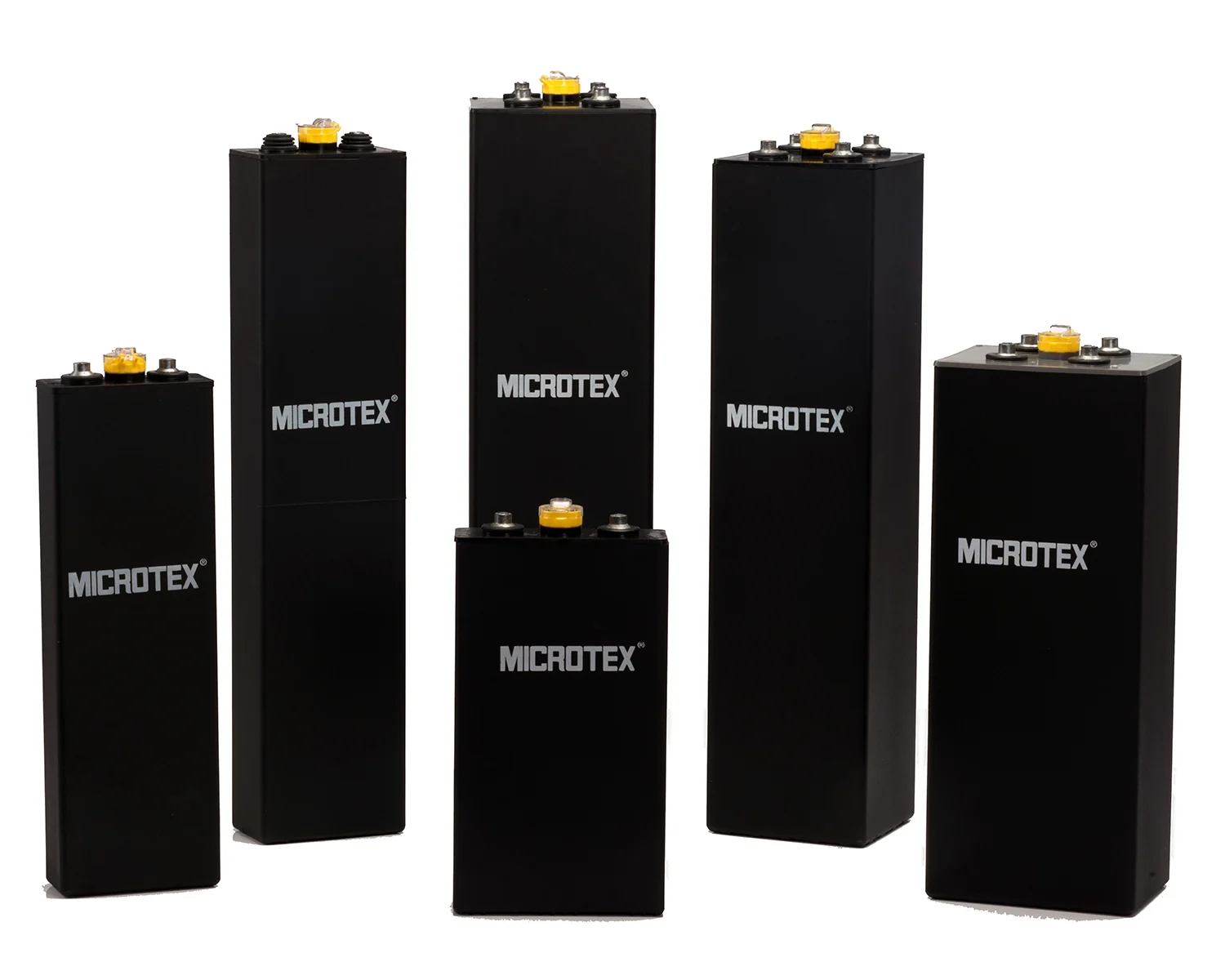
What we mould, on which machines and in what material
In thermoplastics only:
- 2V cell containers in BS and DIN sizes, for VRLA, traction and railway cells
- 12V monobloc containers
- Lids and covers with insert-moulded bushes, two per cover
- Vent plugs and small parts to your drawing
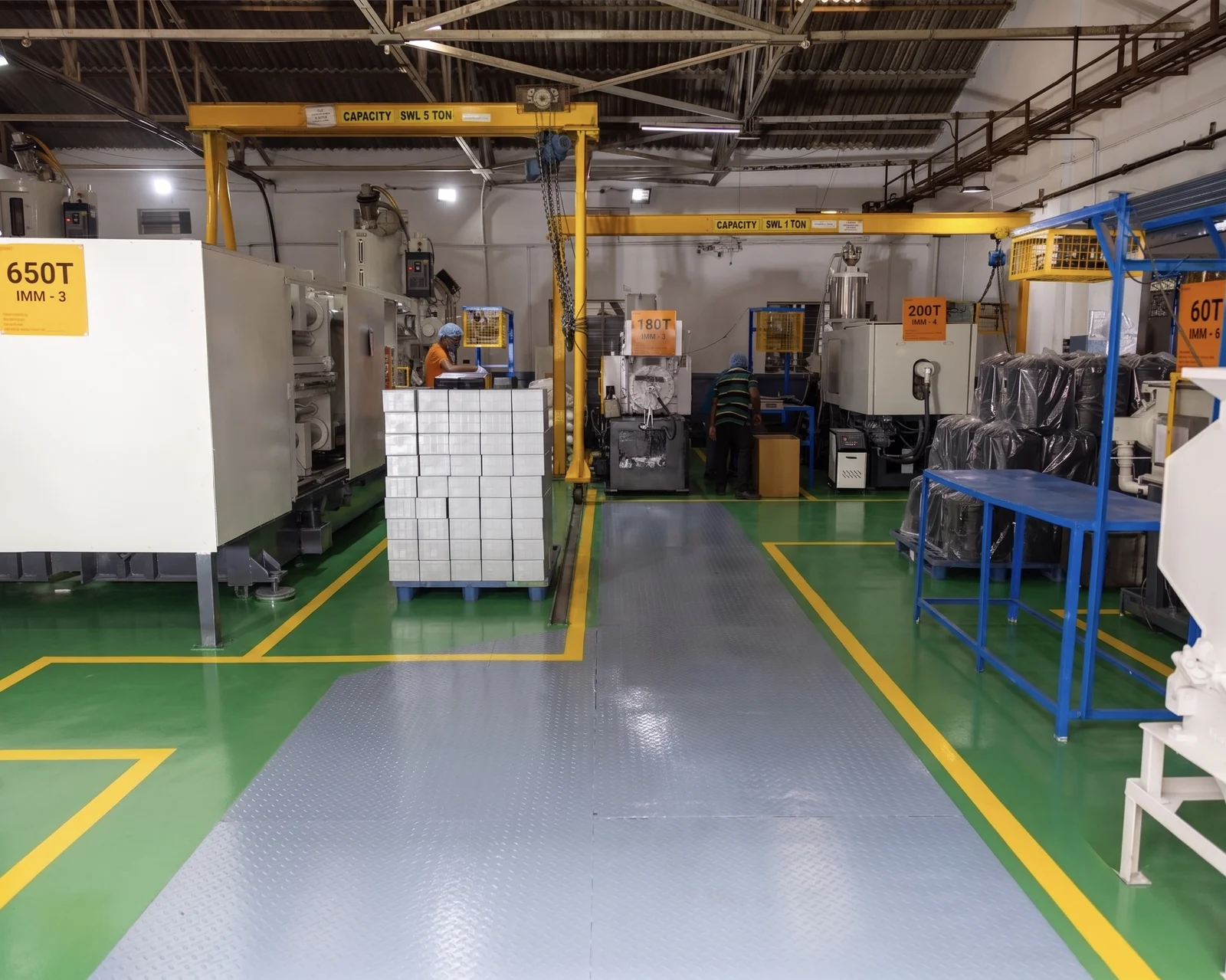
Containers run on the 480 to 850 tonne machines and covers on the 180 to 200 tonne machines; housings too big for the 850 go to the 1300. Nine injection moulding machines from 60 to 1300 tonnes with servo drives and SCADA, for parts from 10 g to 5.2 kg. The capabilities page lists them.
The material is polypropylene copolymer, PPCP, because it resists sulphuric acid and holds its dimensions under the sustained load of the plate group. Container and lid are moulded in one named grade, so the lid joins by platen heat-sealing or ultrasonic welding on your line; tell us which method you use and the sealing-face dimensions go on the drawing review. One flame-retardant grade runs here today: a UL 94 V-2 polypropylene copolymer, used for VRLA containers and covers. We do not claim a V-0 rating; a V-0 grade is trialled on your part with the resin maker’s certificate on file before it is quoted. See our UL 94 guide.
Second source for a container you already buy? Send the drawing and your lid; we check the flange fit before quoting. We do not make steel BESS containers or enclosures; this page is about moulded thermoplastic cell and monobloc containers and lids.
Annual volumes we quote for
A container mould is commissioned per customer and managed through our partner toolrooms, so it has to spread over enough parts to give you a sensible piece price. Our usual minimum for this product family, in parts a year:
- Lids and covers of 250 g to 1 kg: about 25,000 a year
- Containers of 1 kg to 3 kg: about 12,000 a year
- Containers over 3 kg: about 6,000 a year
Prototypes and first samples are quoted on the way to such volumes, not on their own. Below these figures you may still write; where a size is already tooled, a smaller run can sometimes be fitted in. The full ladder by part weight is on our minimum order quantity guide.
Specified and tested in the vocabulary of IS 1146
Indian battery specifications call up IS 1146, the Bureau of Indian Standards specification for rubber and plastics containers for lead-acid batteries, single-cell or monobloc; the Bureau issued a third revision in 2026 that replaces the 1981 edition, so check which edition your specification cites. The 1981 text asked four things of a plastics container: the wall must hold off a high-voltage test without breakdown; the container must survive a drop-ball impact set by its wall thickness; it must not yield more than a set deformation under load; and it must come through immersion in sulphuric acid with limited change in mass and volume and no blistering or warping. Dimensions come from your battery specification, not from the standard; traction cells follow IEC 60254-2, German-series stationary cells DIN 40736-1 and British-series cells BS 6290. Tell us which clauses your specification calls up and the test plan goes into the offer. More in our guide to battery containers by injection moulding and our guide to what a container drawing must carry.
The certificate and the documents you can have today
Kruger Industries holds ISO 9001:2015, certificate NVT 147210, valid to 14 March 2027; the PDF is in the documents bar above. Material certificates for the grade run, certificates of conformance and inspection reports come with the shipment where your order asks for them. Incoming, in-process and final inspection are documented per part, process parameters are monitored at the machine through SCADA, and batches are traceable where you require it. NDA on request before drawings move.
Terms, Incoterms and lead time
We quote FCA Chennai or FCA Nhava Sheva by default, DAP where costed, never DDP into the United States or the United Kingdom. First export orders run on letter of credit or advance payment; open account follows once an ECGC buyer limit is in place; new accounts open on payment terms of 45 days or less. Battery containers and covers are declared under HS heading 8507.90, parts of electric accumulators; confirm the national line with your broker. A certificate of origin goes with export shipments where your country needs one.
Where a size is already tooled, samples come from the existing mould and the production lead time is stated in the offer. A new size needs a new mould, commissioned for you against your committed volume and owned by you or amortised in the piece price; a customer-funded or transferred tool stays the customer’s property and is held here under bailment terms. The four published tooling cost bands are on the tooling cost guide.
Who trusts Kruger, by sector
Part of the Microtex Group, founded in 1969. Batteries are designed and built by our sister company Microtex Energy Private Limited; Kruger’s work is the plastics around them. Battery makers outside the group deal with a dedicated Kruger sales contact. Beyond batteries, a global filtration OEM buys 20 per cent glass-filled polypropylene air-filter housings, supplied continuously since 2010 and shipped to six of its plants, and our first United States order is in production.
Proof
Every container and cover inside the Microtex Group’s industrial batteries since 2004 was moulded here. Other battery makers’ names appear once written permission is received.
Lithium pack housings and components
The same machines suit stationary, telecom, UPS and BESS pack parts in thermoplastics: cell holders, module end plates, busbar supports and covers, BMS enclosures and cable ducts, from 100 g to 2 kg on the 180 to 480 tonne machines. Flame-retardant grades are sourced to your specification, with no V-0 claim until the grade has run here with the certificate on file. The Union Ministry of Heavy Industries has projected India’s advanced chemistry cell demand at about 236 GWh by 2032, as of its 2026 statement.
Quote in one message
Seven things in one email or WhatsApp message let Madhu quote without a second round of questions:
- A drawing, STEP or PDF, or a sample container and lid by courier
- Cell type: 2V BS or DIN cell, 12V monobloc, or a lithium module part
- Annual volume, in parts a year, and the first delivery you need
- Material: your named PPCP grade, or ours; flame-retardant or not
- Colour, against a master sample or a RAL number
- Heat-seal method: platen heat-sealing, ultrasonic welding or a glued lid
- Delivery port and your Incoterm preference
How fast an engineer replies
Send a drawing or a cell size. Madhusudhan, our Head of Production, replies with DFM feedback within 48 hours on working days. kruger@microtex.com is read throughout the day; WhatsApp and phone reach Madhu on +91 96864 48899. Visits to the Peenya plant in Bengaluru are by appointment.
Send the drawing. Madhusudhan, our Head of Production, replies with DFM feedback within 48 hours on working days.
Attach a STEP or PDF, say the annual quantity, the material if you know it, your country and your Incoterm preference. Madhu replies, not a bot. Your mould stays yours; NDA on request.
In ‘What do you need?’ choose Repeat production part. Files travel by email only and are not stored on this website; your enquiry details are kept in our enquiry log so that we can follow up.