
/ KNOWLEDGE · SOURCING
Spare injection moulding capacity — how to buy it without betting your programme on it
“We have spare capacity” is the easiest sentence in this industry to say and the hardest to verify. Every moulder has idle hours somewhere; the question is whether they are on the machine your tool actually needs, whether they will still be there when the moulder’s anchor customer has a good quarter, and whether the process that comes with them is documented well enough to survive a machine change. This guide is for the buyer who needs overflow production, a second source, or a home for an existing mould.
Capacity is hours on a tonnage band, not a count of machines
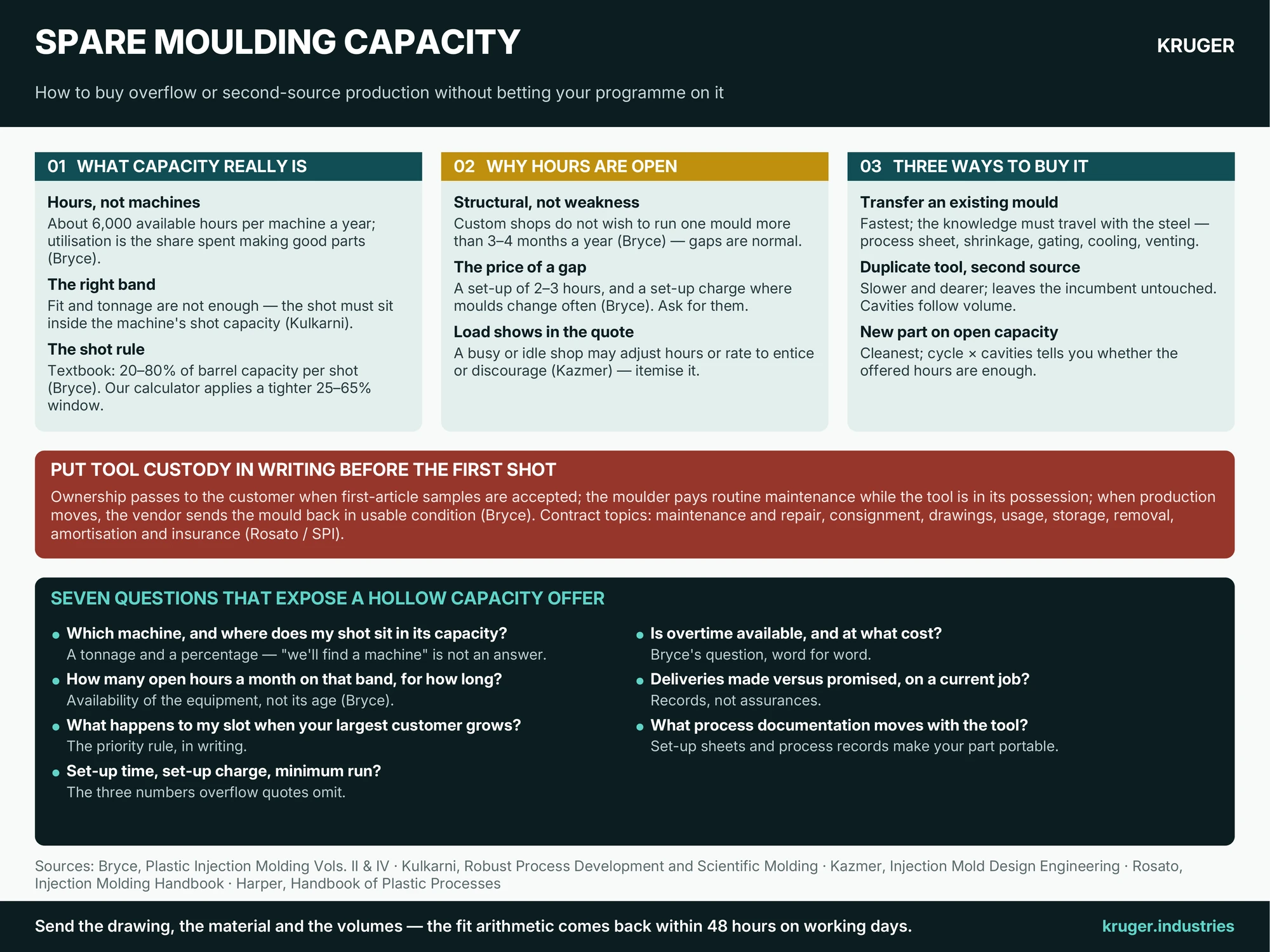
Bryce’s production arithmetic is the place to start. A plant running around the clock, five days a week, fifty weeks a year has about 6,000 available hours per machine; utilisation is the share of those hours spent producing good parts, so a machine moulding for 4,000 of them is at 67%, and everything else — mould changes, set-ups, repairs — is downtime. A moulder’s true spare capacity is therefore never “three machines free”: it is a number of open hours on a specific clamp-tonnage band, and your tool cares about the band, not the count. It must fit the platens, the clamp must hold it shut (the clamping-force calculator does that sum), and — the factor Kulkarni’s process text says is “often overlooked” — the shot must sit inside the machine’s shot capacity. Bryce’s textbook rule of thumb is to use “anywhere from 20 to 80% of the barrel capacity per shot”; below that band material degrades in the barrel, above it the shot runs short and unstable. Our shot-size calculator applies a deliberately tighter 25–65% window — run your part through it and you will know which of a moulder’s machines are genuinely candidates. Only then does “how many open hours on that band?” become a question with a checkable answer.
Why moulders have spare hours — and what it does to your quote
Spare capacity is structural in custom moulding, not a sign of weakness. Bryce notes that custom shops “do not wish to run a single mold more than about 3 to 4 months a year” — a plant built to run many customers’ tools in rotation always has gaps between runs, and a buyer with a steady part is exactly what fills them. The gaps have a price, though: every changeover costs a set-up of “2 to 3 hours” in Bryce’s average, and where moulds change frequently a set-up charge is usually levied. A moulder quoting overflow work without mentioning set-up, minimum run or changeover has not thought about your job yet. Kazmer adds the commercial truth buyers rarely hear: a shop that is “extremely busy or idle” may adjust hours or rate “to either entice or to discourage” you — a very keen price from an idle plant and a very high one from a full plant are both information about load, not about your part. Ask for the quote itemised into tooling, material and processing — Kazmer’s three cost drivers — and the load-driven part becomes visible; the RFQ guide shows what to send so that itemisation is possible.
The three ways to buy it
Transfer an existing mould. The fastest route: the tool moves, the receiving moulder trials it, first-article parts are approved, production restarts. Everything that can go wrong is in the mould-transfer playbook; the short version is that the knowledge must travel with the steel — Harper’s list of what accompanies a tool includes shrinkage factor, gate location, cooling layout and venting, and Kulkarni notes that a process controlled by cavity pressure is “machine-independent”, so a documented process sheet is what makes a transfer boring rather than heroic. Build a duplicate tool for a second source. Slower and dearer, but the only route that leaves the incumbent untouched; the economics are in what a mould costs and how many cavities. Place a new part on open capacity. The cleanest route: the machine guide explains the four fit dimensions, and the cycle-time calculator turns cycle and cavity count into the pieces per hour that decide whether the offered hours are enough.
Whichever route, put tool custody in writing before the first shot. Bryce’s model terms are the industry’s plain language: ownership passes to the customer when first-article samples are accepted; the moulder pays routine maintenance while the tool is in its possession; and when production moves elsewhere “the vendor must send the mold, in usable condition, to the customer.” Rosato’s list of what a moulders’ trade guide expects a contract to settle — maintenance and repair, consignment, drawings, usage, storage, removal, amortisation and insurance — is a ready table of contents for the annex.
Seven questions that expose a hollow capacity offer
- Which machine, exactly, and where does my shot sit in its capacity? A real answer names a tonnage and a percentage. “We’ll find a machine” is not an answer.
- How many open hours a month on that band — and for how long? Bryce’s advice is to be concerned “with the availability of the equipment”, not its age; a moulder who quotes hours has looked at the schedule.
- What happens to my slot when your largest customer’s demand rises? Ask for the priority rule in writing. Seasonal load conflicts are a documented way to lose a delivery.
- Set-up time, set-up charge and minimum run? The three numbers overflow quotes most often omit.
- Is overtime available, and at what cost? Bryce’s question word for word — the honest reserve behind any capacity promise.
- Show me deliveries made versus promised on a current job. Records, not assurances; a vendor with no explanation for missed dates is a warning.
- What process documentation do I get, and does it move with the tool? Set-up sheets and process records are what make your part portable — the quality paper trail lists what to expect.
Spare capacity bought from a qualified second source is insurance that pays every year, not just in the bad one — Kazmer’s observation is that buyers who keep a list of qualified suppliers get “faster turn-around, more uniform quality, and better pricing across multiple projects”. Kruger publishes its machine list — nine machines from 60 to 1300 tonnes — and answers the band question with hours, not adjectives. [RAVI — optional one sentence on current open capacity, e.g. “At the time of writing we have open hours on our mid- and high-tonnage bands.” Delete if you would rather not publish it.] Send the drawing, the material and the volumes — the form has a “tool transfer” option and an “urgent, production gap” timeline for exactly this — and an engineer replies within 48 hours on working days with the fit arithmetic done. For the full audit before you commit, take the supplier-qualification guide.
As of October 2026, about 40% of our machine hours are open — real hours on real tonnage bands, not a promise. And where a programme brings assured volumes, Kruger adds machines against them: that decision is taken immediately, not after a committee.
Sources quoted: D. M. Bryce, Plastic Injection Molding, Vol. II (Society of Manufacturing Engineers, 1997); D. O. Kazmer, Injection Mold Design Engineering (Hanser, 2007).