
/ KNOWLEDGE · MOULD COST
What does an injection mould cost? The six drivers
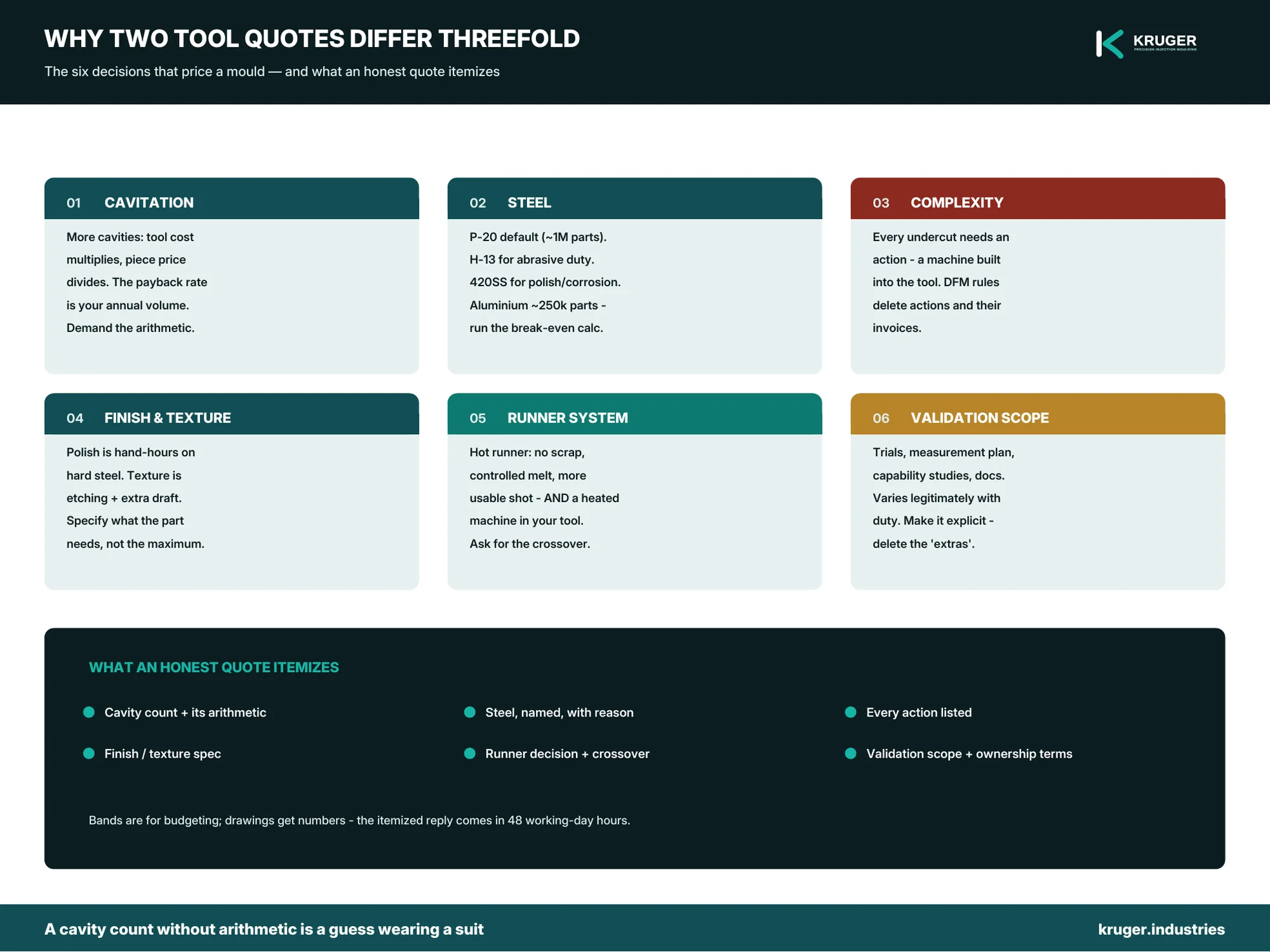
There is no honest single number — but there is an honest structure. Two quotes for the same part can legitimately differ threefold, and when they do, the difference lives in six decisions. Understand them and you can read any tooling quote like a moulder; ignore them and you will buy either the wrong tool cheaply or the right tool blindly.
Driver 1 — Cavitation
More cavities: more machining, more polishing, more fitting — the tool costs more. But every cycle then makes two, four, eight parts, and the moulding share of piece price divides accordingly. Cavitation is bought with tool money and repaid in piece price; the payback rate is your annual volume. A quote that names a cavity count without showing this arithmetic is a guess wearing a suit.
Driver 2 — Steel
Harder steels resist wear and polish better, and cost more to machine (Rosato). The practical ladder: pre-hardened P-20 for most tools — think of it, per Rosato’s life guide, as a million-part steel; H-13 and its hardened relatives where glass-filled or abrasive materials would eat P-20; 420 stainless where corrosion or optical polish demands it; aluminium where volumes are modest — roughly a 250,000-part material in the same guide — and speed matters. The break-even between an aluminium tool and a steel tool is pure arithmetic: run your volumes through the calculator.
Driver 3 — Part complexity
Every feature the opening direction cannot form needs an action — a slide, a lifter, an unscrewing core — and every action is a small machine built into the tool: designed, machined, fitted, maintained. Undercuts, side holes, internal threads: each one is real money. This is where design-for-mouldability pays twice — our DFM guide is, among other things, a list of ways to delete actions from your tool.
Driver 4 — Finish and texture
Polish is hand-hours on hard steel; texture is an etching process plus the draft to release it. A utilitarian internal bracket and a show-surface consumer housing can be the same geometry and a very different tooling invoice. Specify the finish the part needs, not the best finish imaginable — and remember from the DFM rules: textured faces need extra draft.
Driver 5 — The runner system
A hot-runner system buys real advantages — controlled melt delivery, no runner scrap, edge-gating of large parts, effectively more usable shot capacity (Arburg) — and it is a heated, instrumented assembly with its own controller, added to your tool’s price and its maintenance surface. The decision is volume arithmetic again: material saved per year versus system cost. Ask for the quote both ways and the crossover volume.
Driver 6 — Validation scope
A tool is not finished when it is assembled; it is finished when it is proven. The scope of proving — how many trials, how many dimensions measured, capability studies or not, documentation depth — is real toolroom and metrology time, and it varies legitimately with what the part must do. A medical-adjacent housing and a rugged industrial bracket deserve different validation bills. Make the scope explicit in the quote, and you have deleted the commonest source of “extras”.
Indicative bands, honestly labelled
| Tool class | Indicative range |
|---|---|
| Small single-cavity, simple part (about 5 grams) | ₹ 200,000 – 300,000 |
| Mid-size, 2–4 cavities, moderate complexity (about 5 grams) | ₹ 600,000 – 700,000 |
| Large tool (container-class) (about 1200 grams) | ₹ 3,500,000 – 4,000,000 |
| Hot-runner / high-cavitation programme (16 cavities)(about 10 grams) | ₹ 2,000,000 – 2,500,000 |
Bands are indicative for budgeting; the part decides. The full anatomy of the tool behind these numbers is in the tooling buyer’s guide.
What a tooling quote should itemize
- Cavity count, with the volume arithmetic that chose it
- Steel, named, with its reason
- Actions listed individually — every slide and lifter visible
- Finish/texture specification
- Runner system, and the crossover if hot was considered
- Validation scope: trials, measurement plan, documentation
- Ownership, storage and maintenance terms — in writing
The real number, in 48 hours
Bands are for budgeting; drawings get numbers. Send yours with the annual volume — the reply itemizes every line above. Request a quote.