
/ KNOWLEDGE · TOOLING, THE BUYER’S GUIDE
Injection moulding tooling — the buyer’s complete guide
The mould is the largest single invoice of your project and the only part of it you will own for a decade. Everything about your part — its tolerances, its finish, its piece price, its supplier flexibility — is cut into that block of steel. This guide explains what you are actually buying: the anatomy, the steel decision, the runner decision, the cavity arithmetic, who owns what, and what a tooling quote should itemize. Read it before you sign one.
What a mould actually is
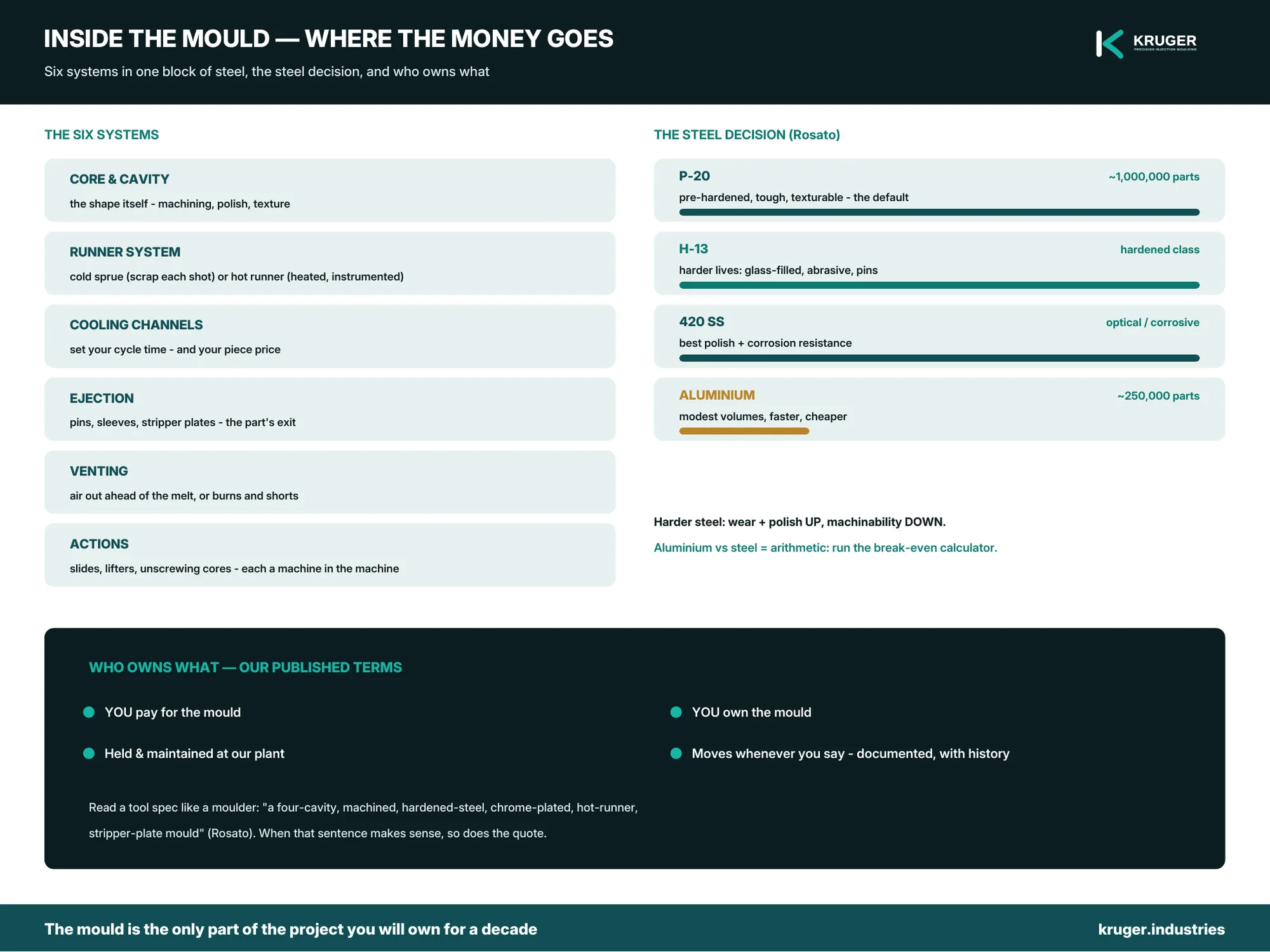
Six systems in one block: the core and cavity that shape the part; the runner system that delivers melt; the cooling channels that set your cycle time; the ejection system that gets the part out; the venting that lets air escape ahead of the melt; and the actions — slides, lifters, unscrewing cores — that form anything the mould’s opening direction cannot. Toolmakers compress all of it into one sentence; Rosato’s handbook gives the classic example: “a four-cavity, machined, hardened-steel, chrome-plated, hot-runner, stripper-plate mould.” When you can read that sentence, you can read a tooling quote.
The steel decision — and what it buys
Mould steels trade hardness against workability: harder steel resists wear, dents and scratches and takes a better polish — but machines and welds harder, which is toolmaker time, which is your money (Rosato). The working shortlist: P-20, the most commonly used — a high-grade forged steel, supplied pre-hardened, tough, texturable and polishable, the default for cavities and cores; H-13, usually the next most popular — for cavities, cores, inserts and ejector pins that must live harder lives, including abrasive glass-filled materials; and 420 stainless — the best polishability and corrosion resistance, the choice for optical finishes and corrosive resins. Beyond steel: copper alloys where a hot spot needs fast cooling, and aluminium where the volume is modest and the budget matters. Rosato’s life-expectancy guide makes the economics concrete: think of P-20 as a million-part tool and QC-7 aluminium as a 250,000-part tool — then run your own volumes through our aluminium-vs-steel break-even calculator.
Cold sprue or hot runner
A standard runner is machined into the mould plates; the melt path freezes with every shot and is ejected with the parts — simple, robust, and it produces runner scrap every cycle. A hot-runner system keeps the melt path molten between shots. The handbook advantages are real: finer temperature control on the melt entering the cavity, no sprue-gate witness to finish, no cold runners to scrap or rework in multi-cavity tools, edge-gating of large single-cavity parts with the tool still central on the platen, and an effective increase in usable shot capacity (Arburg §4.2.4.3). The honest other side: a hot runner is a heated, instrumented machine living inside your mould — it adds tool cost, needs its own controller, and adds a maintenance surface. The arithmetic that decides is volume × material saved vs system cost; ask for both quotes and the crossover volume.
How many cavities — the multiplication that divides
Every added cavity multiplies tool cost and divides piece price. One cavity is cheapest to build and slowest to produce; four cavities cost more than twice a single but cut the moulding share of piece price to a quarter. The deciding inputs are your annual volume, the machine the tool must fit, and how long you’ll run the programme — put your numbers into the part-cost calculator and compare scenarios. What matters at quote time: cavitation should be a calculated recommendation from your moulder, with the arithmetic shown — not a default.
Who owns what — our terms in plain sight
At Kruger the arrangement is published, not negotiated in the dark: you pay for the mould, you own the mould. It is held and maintained at our plant for production, it carries your identity, and if you ever choose to move it, it moves — documented, crated, with its history. We are NDA-willing before you send a drawing. Tooling itself is managed, not hidden: the steel is cut by specialist toolmakers under our management, to a design that has passed our mould-flow analysis and our DFM review, and the tool is proven on our machines before you see first parts. Our own qualification guide tells every buyer to ask who cuts the steel, not just where — we answer that question in the first meeting.
From order to first parts
The sequence is the same everywhere good tools are made: design and mould-flow → steel and standard components ordered → machining → first assembly → T1, the first trial — first shots, measured against the drawing → corrections (there are nearly always corrections; a T1 with zero findings usually means nobody measured) → T2 confirmation → sample approval against your criteria → production release. Indicative timelines for our programmes:
| Tool class | Indicative order-to-T1 |
|---|---|
| Small single-cavity, simple part | 6-8 weeks |
| Mid-size, 2–4 cavities | 6-8 weeks |
| Large tool (container-class) | 10-12 weeks |
| Hot-runner / high-cavitation | 8-10 weeks |
What tooling costs — indicative bands
Every buyer asks; almost no moulder answers in public. Bands, honestly labelled as indicative — the real number depends on the part, and the drawing gets you a real quote in 48 working-day hours:
| Tool class | Indicative range |
|---|---|
| Small single-cavity, simple part | ₹ 200,000 – 300,000 |
| Mid-size, 2–4 cavities, moderate complexity | ₹ 600,000 – 700,000 |
| Large tool (container-class) | ₹ 3,500,000 – 4,000,000 |
| Hot-runner / high-cavitation programme | ₹ 2,000,000 – 2,500,000 |
Why do two quotes for the same part differ threefold? The six drivers — cavitation, steel, complexity, finish, runner system and validation scope — get their own plain-language post: what does an injection mould cost?
The tooling conversation, without the fog
Send the drawing and the annual volume. The reply names the recommended cavitation with its arithmetic, the steel with its reason, the runner decision with its crossover, and the timeline to T1 — itemized, owned by you, held by us. Request a quote.