
Buyer’s guide
Injection moulding companies in India — how to qualify one: an auditor’s checklist
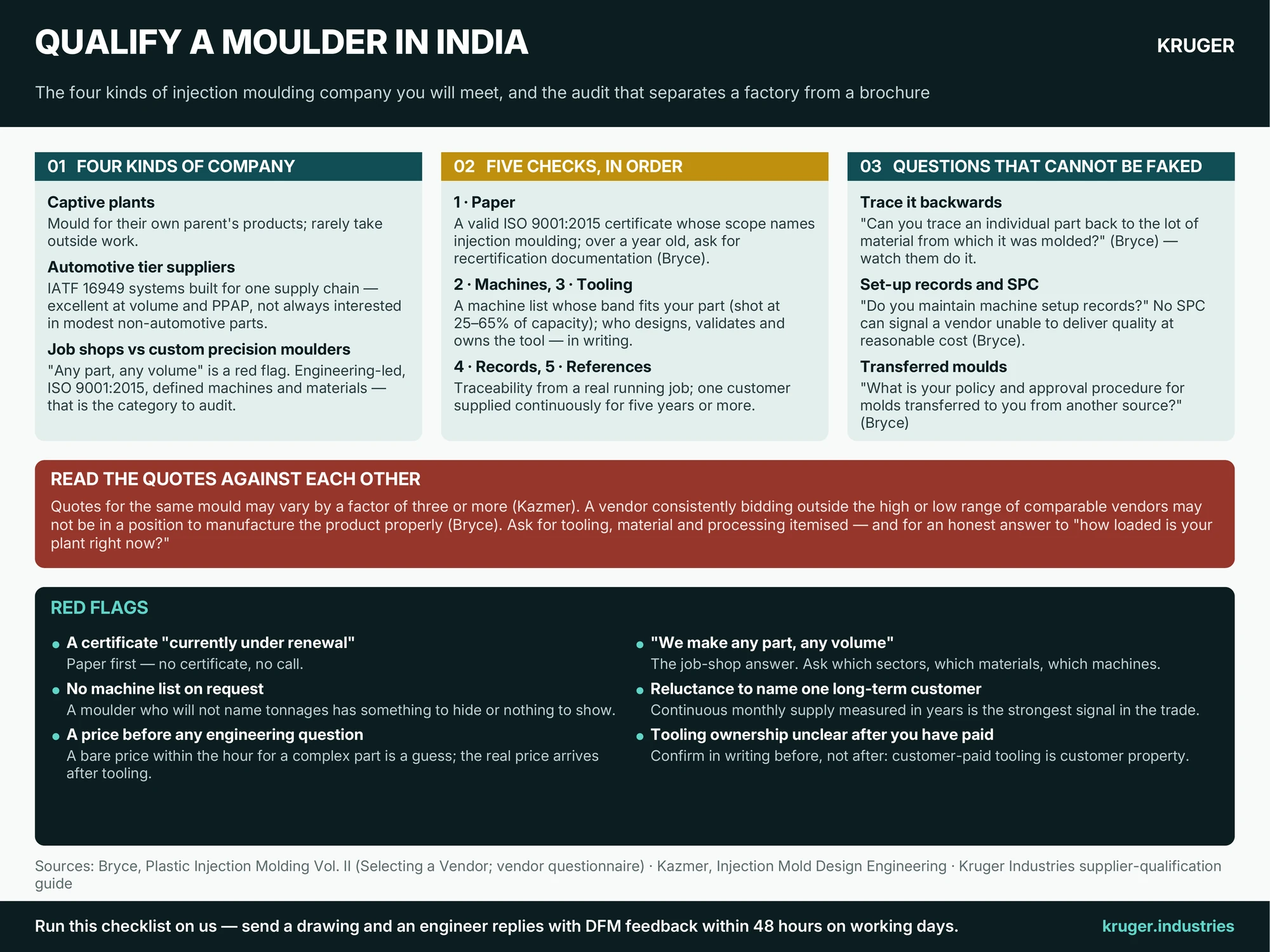
To qualify an injection moulding supplier in India, verify five things in this order: a valid ISO 9001:2015 certificate whose scope actually covers injection moulding; a machine list whose clamp-force range fits your part; clarity on who designs, validates and owns the tooling; inspection and traceability records pulled from a real running job; and at least one customer the supplier has supplied continuously for five years or more. Everything else — price included — is worth discussing only after these five pass.
This guide is written by a supplier, and that is exactly why it is useful: below is the audit we would want run on us. If you are moving work to India — as a first supplier or as a China+1 second source — this is the sequence that separates a factory from a brochure.
The kinds of injection moulding company you will meet in India
“Injection moulding companies in India” is a list of thousands, and a shortlist only becomes possible once you know which kind you are looking at. Broadly there are four. Captive plants mould for their own parent’s products and rarely take outside work. Automotive tier suppliers run IATF 16949 systems built for one supply chain — excellent at volume and PPAP, sometimes uninterested in a non-automotive part at modest quantities. General job shops take anything, which is precisely the problem: “we make any part, any volume” is in the red-flags box below for a reason. Custom precision moulders — engineering-led, ISO 9001:2015, running a defined range of machines and materials for several OEM sectors — are the category most industrial, electrical, robotics and export buyers actually need, and the category this checklist was written to test. The clusters follow the automotive and electronics belts — Bengaluru, Chennai, Pune, the National Capital Region and Gujarat — but geography is the least important filter: Kazmer’s engineering text observes that buyers who keep a list of qualified suppliers get “faster turn-around, more uniform quality, and better pricing across multiple projects” wherever those suppliers sit. Build the list with the eight checks below; the map comes second.
1. Start with the paper
Before any call: ask for the ISO 9001:2015 certificate and check three things — the expiry date, the certification body, and the scope line, which must name injection moulding (a trading company can hold a certificate for “supply of plastic goods”). Bryce’s vendor-qualification chapter adds the fourth: if the certificate is more than a year old, “ask to see their recertification documentation” — surveillance audits leave paper. Confirm the legal entity and GST registration match the name you’d contract with, and note how many years the company has actually run — not how long the domain has existed.
2. Match the machines to your part
Ask for the machine list with clamp forces. Your part needs a machine where its shot weight sits comfortably inside the machine’s capacity — as a working rule, between roughly 25% and 65% of it. Below that range you risk material degradation from residence time; above it, short shots and instability. A supplier who can discuss this rule against your part weight in the first conversation is running a process, not just machines. Ask also how process parameters are monitored — machine-level monitoring (SCADA/HMI) means drift gets caught by systems, not by rejects. Use our shot-size calculator to run this check on your own part.
3. Tooling: ask who, not just where
“In-house toolroom” sounds reassuring and often isn’t the real question. What matters: who runs mould-flow analysis before steel is cut, who holds design authority, who validates the tool, and who is responsible when it needs maintenance at 300,000 shots. Managed tooling through proven partner toolrooms — under the moulder’s design authority — is a perfectly sound model; vague answers about any of those four questions are not. Confirm in writing that the tool you pay for is your property, and ask to see a tool history card for any mould more than two years old. If you are bringing a tool with you, ask Bryce’s question from the standard vendor questionnaire: “What is your policy and approval procedure for molds transferred to you from another source?” — the answer should be a procedure, and our transfer playbook shows what one looks like.
4. Materials and traceability
Engineering polymers are hygroscopic; ask how material is dried and how drying is recorded. Ask whether material certificates ship with parts, and whether a batch of finished parts can be traced back to a resin lot. This is one question that cannot be faked on a factory walk: pick a box of parts and ask them to trace it backwards while you watch.
5. Quality evidence, not quality talk
Every serious moulder claims incoming, in-process and final inspection. Ask instead for a redacted inspection report from a current production job, and ask whether they welcome customer audits — the tone of the answer tells you as much as the content. Per-shipment certificates of conformance should be available on request, not presented as a favour. Two of Bryce’s questionnaire lines belong in every audit: “Do you maintain machine setup records?” and “Can you trace an individual part back to the lot of material from which it was molded?” — and his warning that a vendor not using statistical process control “can be an indicator that the vendor is reluctant, or unable, to provide the customer with the expected product quality level at a reasonable cost”. The quality paper trail lists the documents worth demanding.
6. References that cannot be faked
The single strongest qualification signal in this industry is continuous monthly supply to the same OEM, measured in years. Logos on a website are marketing; a customer who has reordered every month since 2010 is evidence. Ask: “Which customer have you supplied longest without interruption, and may we speak to them?” For export, ask for proof of actual shipments — packaging specs, export documentation, Incoterms familiarity — not intentions.
7. The communication test
Send a real drawing and time what comes back. You are measuring two things: speed, and substance. A reply within two working days that raises mouldability questions — draft angles, wall sections, gate position, material alternatives — is an engineering organisation talking. A bare price within the hour for a complex part, with no questions asked, is a guess; you will meet the real price after tooling. This one test predicts the next five years of the relationship better than any factory tour.
8. Commercial hygiene
Expect transparency on tooling cost versus part price (amortisation should be explicit, not buried), realistic minimum volumes, and an honest answer to “how loaded is your plant right now?” — a supplier at claimed 100% utilisation cannot absorb your growth; one who admits spare capacity is planning with you (how to test that claim is its own guide: buying spare moulding capacity). Read the quotes against each other, too: Kazmer notes that quotes for the same mould “may vary by a factor of 3 or more”, and Bryce’s rule is that a vendor “consistently bidding outside the high or low range of other comparable vendors may not be in a position to properly manufacture those products”. For India specifically: IATF 16949 matters only if your part sits in an automotive supply chain; for industrial, electrical and medical-device components (where device-level regulatory responsibility remains with the OEM), a well-run ISO 9001:2015 system with traceability is the working standard.
Red flags
A certificate “currently under renewal” · no machine list on request · a price before any engineering question · “we make any part, any volume” · reluctance to name one long-term customer · a factory walk that avoids the QC room · tooling ownership that only becomes unclear after you’ve paid for it.
Ten questions to email before you fly
- Please share your ISO 9001:2015 certificate (we will check scope and validity).
- Your machine list with clamp forces and year of servo/controller upgrades, if any.
- Who performs mould-flow analysis, and is it done before steel is cut?
- Who manufactures your tooling, and who holds design authority and validation responsibility?
- Confirm in writing: customer-paid tooling is customer property.
- Which materials do you run regularly, and do material certificates ship with parts?
- Can a finished batch be traced to a resin lot? Show us how.
- Your longest continuous OEM supply relationship — how long, and may we speak to them?
- Recent export shipments: packaging spec and documentation you provided.
- Here is a drawing (attach one): reply with your DFM observations and questions — take the time you need.
Run this checklist on us
Kruger Industries has moulded precision plastics in Peenya, Bengaluru since 2004: nine injection moulding machines from 60 to 1300 tonnes, ISO 9001:2015, batch traceability, managed tooling under our design authority, and OEM relationships measured in decades — including one supplied continuously since 2010. Question 10 is our favourite: send a drawing and an engineer replies with DFM feedback within 48 hours on working days. The certificate, machine list and references follow on request.
Sources quoted: D. M. Bryce, Plastic Injection Molding, Vol. II (Society of Manufacturing Engineers, 1997); D. O. Kazmer, Injection Mold Design Engineering (Hanser, 2007).