
PEENYA · BENGALURU
Injection moulding company in Bengaluru — Kruger Industries, Peenya
Kruger Industries is a precision injection moulder in Peenya Industrial Area, Bengaluru, moulding engineering thermoplastics for OEMs since 2004. Nine injection moulding machines from 60 to 1300 tonnes, parts from 10 g to 5.2 kg, ISO 9001:2015, batch traceability, and an engineer — not a bot — who replies to a drawing within 48 hours on working days. If you are shortlisting moulders in Bengaluru, this page gives you our facts in one place, and then the six checks we would want you to run on any moulder, including us.
What we mould, and for whom
Our work is drawn from five years of invoiced parts across six sectors: automotive and filtration (air-filter housings at OEM volumes, month after month, since 2010), railways (polycarbonate coach windows and nylon door guides), medical and robotics (enclosures and precision components for a surgical-robotics OEM), electrical and connectors (insert-moulded cable connectors on a vertical machine, enclosures, instrumentation parts), HVAC and refrigeration (glass-filled nylon fan blades and AC enclosures) and battery and industrial containers (2V BS/DIN and 12V monobloc containers in PPCP on the 480–1300 T machines, for the Microtex Group’s battery business). Beyond India: over 35,000 horticulture pots and trays moulded, packed and shipped to Kuwait, and our first United States order — polycarbonate exit signs, printed, assembled and individually packed — in production. Horticulture, safety products and building components sit alongside the six sectors; if the part is precision-moulded in a thermoplastic, it is our work.
The machines, the materials, the paperwork
| Machine | Clamp force |
|---|---|
| 1 | 60 T |
| 2 | 180 T |
| 3 | 200 T |
| 4 | 480 T |
| 5 | 650 T |
| 6 | 720 T |
| 7 | 850 T |
| 8 | 1300 T |
| Vertical machine | Insert moulding — cable connectors |
Materials we run regularly: polypropylene and PPCP, 20% glass-filled polypropylene, polycarbonate, nylon 6/66 unfilled and 15% and 30% glass-filled, ABS, HDPE and PET — engineering compounds dried, processed and documented to grade, with material certificates available with shipments on request. Tooling is manufactured by proven partner toolrooms under Kruger’s design authority and validated on our machines, after product design and mould-flow analysis; the tool you pay for is your property and stays here under your name. Value-added work — insert moulding, ultrasonic welding, pad and screen printing, sub-assembly and retail-ready packing — means parts can leave finished rather than loose. The capabilities page carries the detail; the tooling guide carries our published cost bands and lead times.
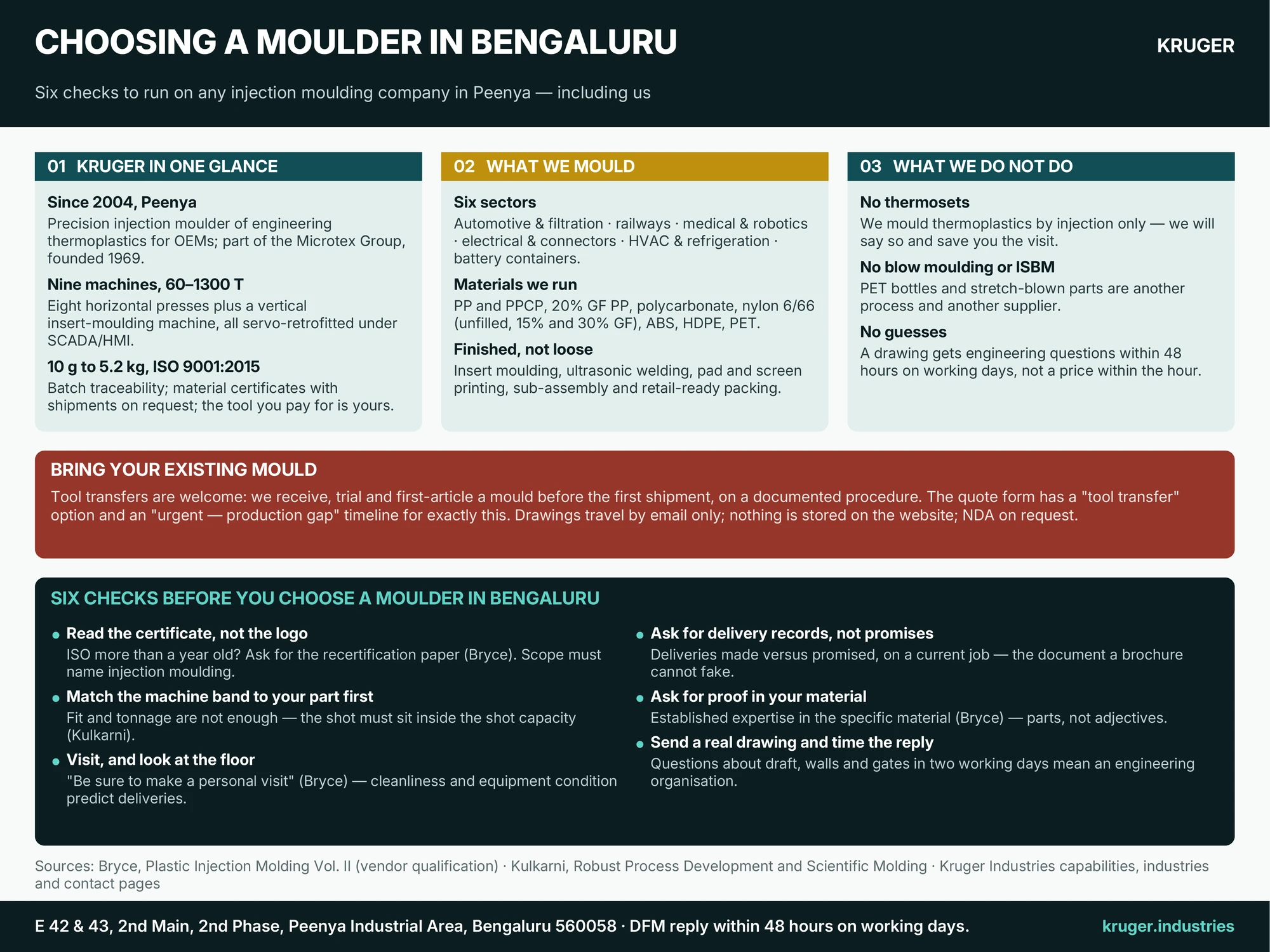
Six checks before you choose a moulder in Bengaluru — including us
Bryce’s textbook on the trade opens its vendor chapter with the plain instruction that a buyer of moulded parts “need[s] to have an organized way to select and qualify such vendors”. Peenya is one of the largest industrial estates in Asia and Bengaluru has more moulders than any buyer can visit, so the organised way matters more here, not less. Six checks, in the order that saves the most time:
- Read the certificate, not the logo. Bryce’s advice: if the ISO recognition is more than a year old, “ask to see their recertification documentation”. Check the scope line names injection moulding.
- Match the machine band to your part before you visit. Fit and tonnage are not enough — the shot must sit inside the machine’s shot capacity (Kulkarni calls this the factor most often overlooked). The shot-size calculator tells you which machines are candidates.
- Visit, and look at the floor. “Be sure to make a personal visit”, Bryce writes — cleanliness and the condition of the equipment predict deliveries and quality. Peenya is a short drive; there is no excuse for choosing from a website alone.
- Ask for delivery records, not delivery promises. “Records of deliveries made versus promised dates” on a current job — the one document a brochure cannot fake.
- Ask for proof in your material. A moulder “should be willing to show an established expertise with the specific material required” — parts, not adjectives.
- Send a real drawing and time the reply. Questions about draft, walls and gates within two working days mean an engineering organisation; a price within the hour with no questions means a guess.
The full audit — tooling authority, traceability, references that cannot be faked, commercial hygiene — is the supplier-qualification guide, written as the checklist we would want run on us.
Straight answers to the questions Bengaluru buyers ask us
Do you take small volumes? Yes, where the part is engineered — the form asks for annual quantity from under 10,000 upwards; tell us the truth and we will tell you whether the tooling makes sense. Will you run my existing mould? Yes — that is a tool transfer, and the transfer playbook sets out how we receive, trial and first-article a tool before the first shipment. Do you do thermosets, blow moulding or ISBM? No. We mould thermoplastics by injection only; if your part is a PET bottle or a thermoset housing, we will say so and save you the visit. Can we see the plant? Yes — in person, or book a video plant tour from the contact page. NDA? Available on request; drawings travel by email only and nothing is stored on this website. Who owns the mould? You do, from the day you pay for it.
Find us
Kruger Industries · E 42 & 43, 2nd Main, 2nd Phase, Peenya Industrial Area, Bengaluru 560058 · kruger@microtex.com · +91 96864 48899 · Part of the Microtex Group, founded 1969. Send a drawing — an engineer replies with DFM feedback within 48 hours on working days. Read about us first if you prefer to know who you are writing to.
Sources quoted: D. M. Bryce, Plastic Injection Molding, Vol. II (Society of Manufacturing Engineers, 1997); S. Kulkarni, Robust Process Development and Scientific Molding, 2nd ed. (Hanser, 2017).