
/ KNOWLEDGE · THE QUALITY PAPER TRAIL
The quality paper trail an OEM should demand
A moulded part’s twin is its paperwork. The part tells you what was made; the paper tells you whether tomorrow’s parts will match it. This guide lists the documents a serious programme generates, what each one actually proves, and the machine-health audit that separates process control from folklore.
The stack, bottom to top
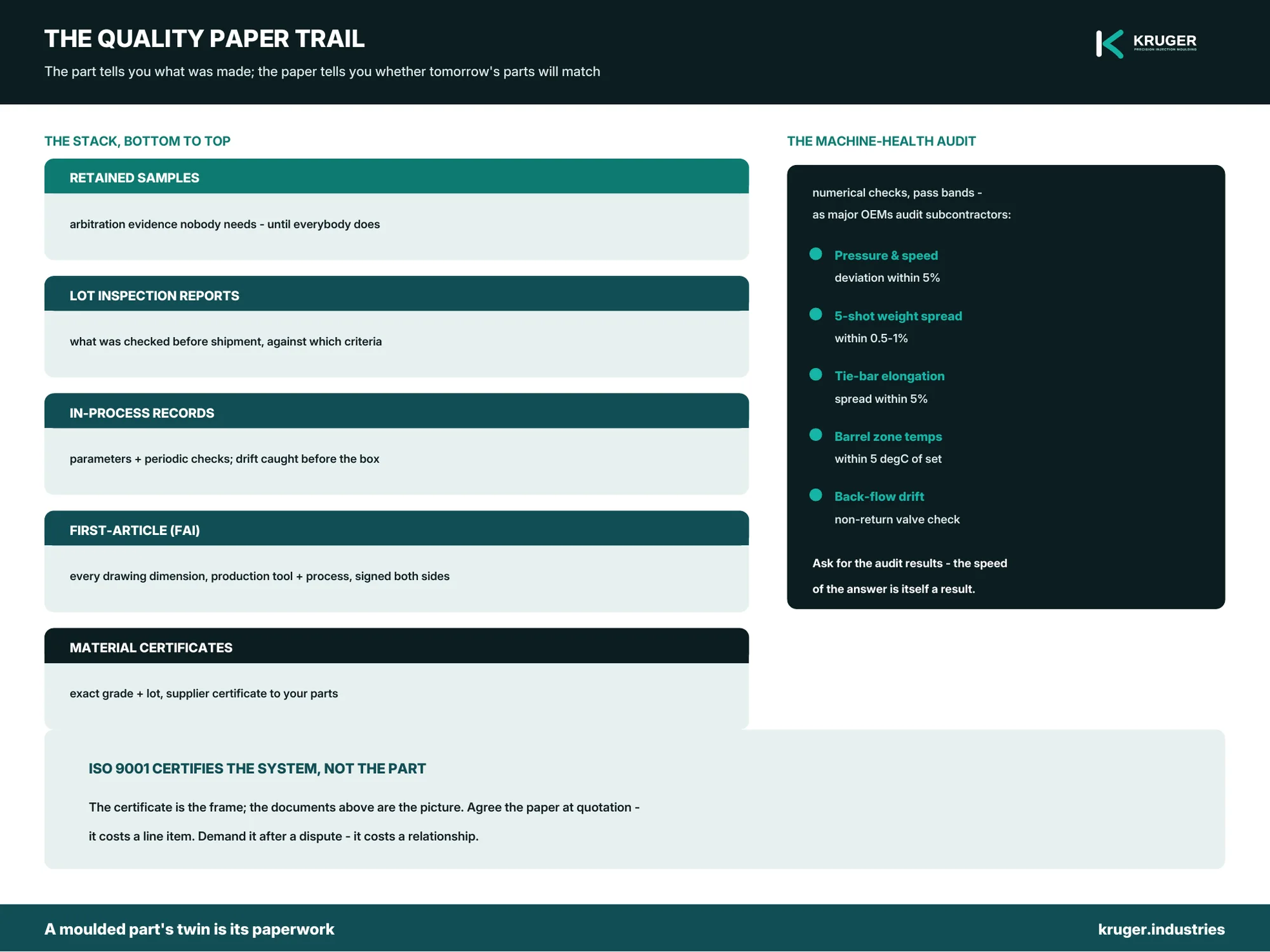
Material certificates — the resin’s grade and lot, traceable from the supplier’s certificate to your parts. The exact-grade discipline matters because “equivalent” grades shrink differently (the transfer playbook has the scars). The first-article inspection (FAI) — every drawing dimension measured on parts from the production tool and process, signed both sides: the programme’s baseline. Everything after is compared to this. In-process records — what the operator and the machine log each shift: process parameters, periodic dimensional checks on the dimensions that matter, and the discipline of reacting to drift before it reaches a box. Lot inspection reports — what was checked before shipment, against which criteria. Retained samples — physical parts kept per lot, the arbitration evidence nobody needs until everybody needs it.
The machine-health audit — the check most buyers never ask for
Parts are only as repeatable as the machine that made them, and machine health is measurable. The audit standard worth demanding mirrors what major OEMs use on their subcontractors — a short list of numerical checks with pass bands: injection pressure and speed deviation within 5% across repeated shots; shot-to-shot weight spread within 0.5–1% over five consecutive shots; tie-bar elongation spread within 5% (the clamp stretching evenly — an unevenly stretching clamp moulds flash on one corner); barrel-zone temperature deviation within 5 °C of setpoint; and a back-flow drift check on the non-return valve, the small part whose wear quietly changes every shot. Ask any moulder for their machine-audit results; the speed of the answer is itself a result.
What ISO 9001 does and does not prove
An ISO 9001:2015 certificate — we hold one — certifies the management system: that procedures exist, records are kept, and audits happen. It does not certify any part. The certificate is the frame; the documents above are the picture. A supplier who offers the frame without the picture has told you something useful.
How to ask for it without bureaucracy
Specify the paper in the same breath as the part: which dimensions the FAI must cover, which get measured per lot, what travels with each shipment, and how long records and samples are retained. Agree it at quotation — the validation-scope driver — and it costs a line item; demand it after a dispute and it costs a relationship.
Ask us for ours
Run this page on us: ask what we issue as standard, what our machine audits read, and how our FAI looks. The answers come from QA, not from marketing. Request a quote.