
/ KNOWLEDGE · SOURCING
Minimum order quantities in injection moulding: why the annual volume decides the price and the moulder
A custom moulder’s first question is not what the part is but how many you need a year, because that number decides the tool, the machine, the piece price and whether this moulder should make the part at all. A minimum order quantity is not reluctance; it is arithmetic. This page sets out that arithmetic, prints our published minimum by part weight and the routes below it; the piece price is built in our part-cost guide.
Set-up is paid per batch
A mould change takes much the same hours whether the batch is 500 parts or 50,000, so the small batch carries a hundred times the set-up on each part. Rosato’s handbook describes the small-series maker running lots of about a thousand to a few thousand: set-ups are long, the equipment share of each part’s cost is several times a long run’s, and conventional injection moulding, he concludes, is not price-competitive there.
The tool is paid once
Bryce’s manufacturing volume explains that amortised tooling is usually recovered over a committed first year’s production, and that if the run is a few hundred pieces each one can cost more than it could ever sell for. The same tool over ten times the parts is a tenth of the burden on each. The resin and machine minutes in a small part may be small change; the tool, from the mould-cost page‘s indicative bands upward, is not.
Cavitation follows the volume
Kazmer’s text on mould design says moulds are designed for a target quantity, and that because real schedules are not precisely known a tool can be over- or under-designed for the programme it meets, and that at intermediate volumes the right answer may be neither extreme but four, eight or sixteen cavities. So the same drawing at ten times the volume is quoted on a different tool, often on a larger machine with its own hourly rate; our cavities guide gives the arithmetic and the machine-fit check.
Resin price breaks with quantity
Rosato’s handbook is plain: plastic gets cheaper per kilogram as the quantity rises, from bags and drums through bulk boxes to truckloads. A programme using a few hundred kilograms a year buys at bag prices, often with a compounder’s minimum for a special colour; one using tonnes buys in bulk, so at small volumes the material line is dearer per kilogram.
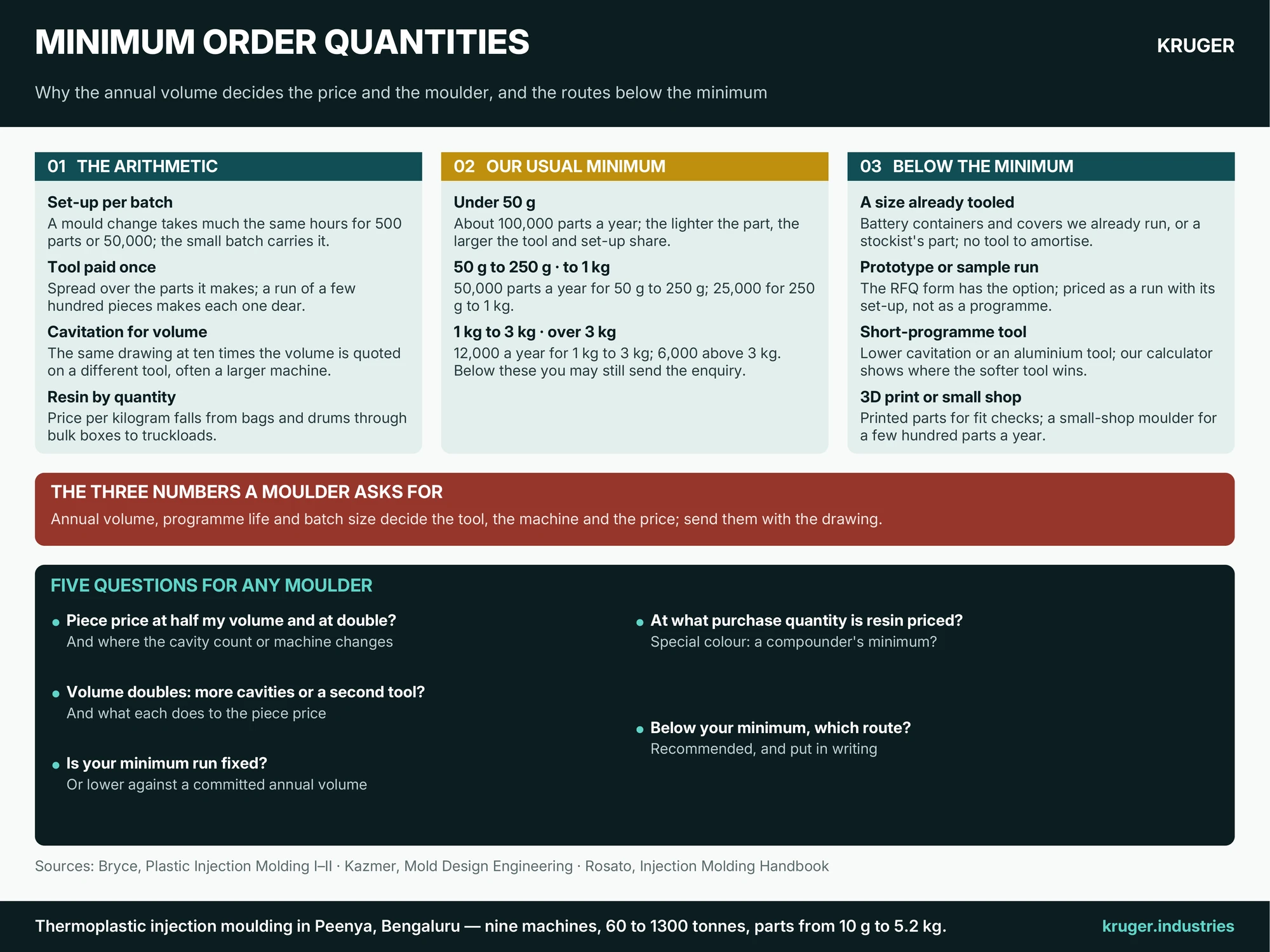
The three numbers a moulder asks for
Annual volume, programme life and batch size. Kazmer’s production-data worksheet shows why: lifetime and total quantity steer the mould material and its treatment, while the monthly minimum and maximum, with the cycle time, help fix the number of cavities and of moulds. Batch size sets how often the set-up is paid. Our quotation names the machine and puts the minimum run beside the set-up time and the set-up charge.
Our published minimum, by part weight
Our RFQ page publishes our usual minimum by part weight, each figure approximate; the numbers below are exactly as printed there.
- Under 50 g: about 100,000 parts a year.
- 50 g to 250 g: 50,000 parts a year.
- 250 g to 1 kg: 25,000 parts a year.
- 1 kg to 3 kg: 12,000 parts a year.
- Above 3 kg: 6,000 parts a year.
The RFQ page adds: “Below that you may still send your enquiry, but we may not be able to quote: the mould cost does not spread over enough parts to give you a sensible price.” The ladder falls because a heavier part carries more resin and machine time, so tool and set-up are a smaller share of its price.
Below the minimum: five routes
- A size already tooled. A battery container or cover we already run, or a stockist’s standard part: the sample comes off the existing mould and there is no tool to amortise.
- A prototype or sample run. The RFQ form has a “Prototype or samples only” option; it is priced as a run, with its set-up, not as a programme.
- A lower-cavitation or aluminium tool for a short programme. Bryce’s product-design volume notes that some programmes start on a cheaper single-cavity tool and add cavitation in the peak years, and that prototype tooling can run the first year if designed for it. The aluminium versus steel calculator shows where the softer tool wins; the tooling guide carries our ownership terms.
- 3D-printed parts for fit checks. Our reply can include one before steel is cut; it proves geometry, not the moulded material.
- A small-shop moulder. For a few hundred parts a year the honest answer is a shop with small machines and quick changeovers. Our machines run from 60 to 1300 tonnes around programmes; we will say so when the fit is wrong, and our spare capacity page describes a programme on open hours.
Five questions for any moulder
- What is my piece price at half my annual volume and at double, and at which volume does your cavity count or machine change?
- If my volume doubles in year three, do I add cavities or buy a second tool, and what does each do to the piece price?
- Is your minimum run fixed, or does it fall if I commit the annual volume in a schedule agreement?
- At what purchase quantity is resin priced, and does a special colour carry a compounder’s minimum?
- Below your minimum, which route do you recommend, in writing?
Send the drawing with the annual volume, programme life and batch size. The reply covers machine fit and material and, where we can quote, states the piece price with its assumptions written down and the cavitation and machine named; below our minimum, the routes above are the honest answer.
Sources quoted: D. M. Bryce, Plastic Injection Molding, Vol. I: Manufacturing Process Fundamentals (Society of Manufacturing Engineers, 1996); D. M. Bryce, Plastic Injection Molding, Vol. II: Material Selection and Product Design Fundamentals (Society of Manufacturing Engineers, 1997); D. O. Kazmer, Injection Mold Design Engineering (Hanser, 2007); D. V. Rosato, D. V. Rosato and M. G. Rosato (eds), Injection Molding Handbook, 3rd edition (Kluwer Academic Publishers, 2000).