
/ KNOWLEDGE · ECONOMICS
What does an injection moulded part cost? How a piece price is built — and how to check one
A piece price is not a number a moulder chooses; it is a number a moulder assembles. Kazmer’s text on mould design engineering reduces it to three drivers — “the cost of the mold and its maintenance, the materials cost, and the processing cost” — added together and divided by yield, the fraction of parts that come out acceptable. Every one of those terms can be rebuilt from your own drawing and a handful of questions, which means every quote you receive can be checked. This guide shows how each term is built and what to ask when a quote does not survive the arithmetic. Our part-cost calculator runs the sums; this page explains them.
Material: weight times price — times waste
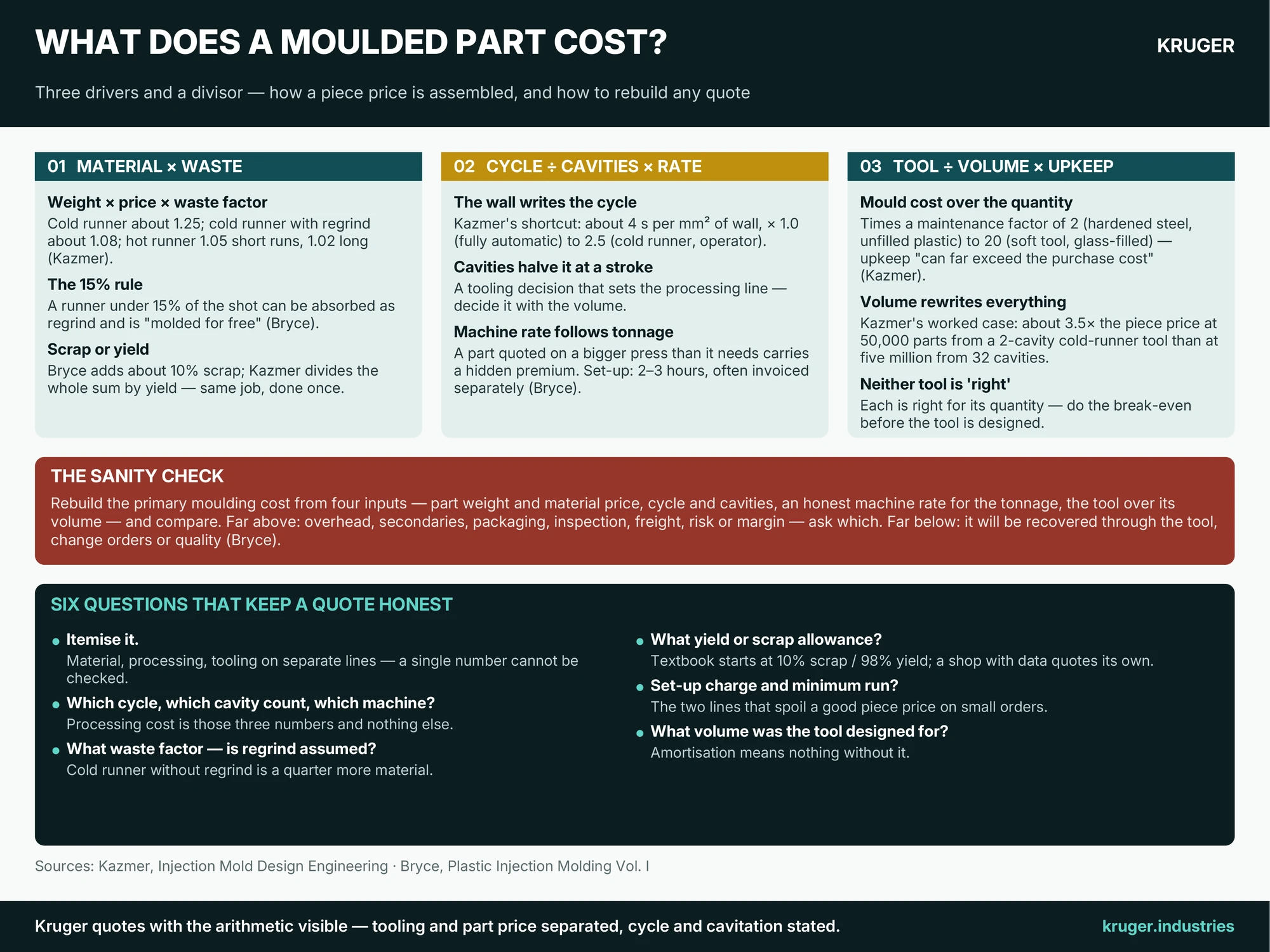
The obvious term is the least obvious in practice. Material cost per part is the part’s volume times the material’s density times its price per kilogram — and then times a waste factor for everything the shot contains that is not the part. Kazmer tabulates that factor by feed system: a cold runner consumes about 25% more material than the parts alone; a cold runner whose runners are ground and fed back as regrind, about 8% more; a hot runner about 5% more on short runs and 2% on long ones. Bryce gives the shop-floor version of the same idea: if the runner system is “less than 15 percent of the total shot size” it can be absorbed as regrind and the runner is “molded for free”; the “typical average is approximately 15-percent regrind mixed with 85-percent virgin”. So a fat cold runner on a small part is not a tooling detail — it is a material surcharge on every shot, and whether regrind is permitted is a contract term, not an assumption (the regrind guide gives the clauses). Bryce also adds a scrap allowance to the moulding cost, “usually 10 percent”, for start-up shots, purging and rejects — Kazmer’s yield divisor does the same job at the end of the sum.
Processing: cycle, divided by cavities, times the machine rate
Processing cost per part is the cycle time divided by the number of cavities, multiplied by the hourly rate of the machine and its labour. Two of those three numbers are set before the moulder is chosen. Cycle is written by the part’s wall — Kazmer’s shortcut is about 4 seconds per square millimetre of wall thickness, multiplied by an efficiency factor that runs from 1.0 for a fully automatic cell to 2.5 for a cold-runner mould with an operator pulling parts; the cooling-time guide explains why the wall is squared, and the cycle-time calculator puts a number on your part. Cavities are a tooling decision that halves or doubles this term at a stroke (see how many cavities?). The machine rate is the moulder’s number: Kazmer models it as a function of clamp tonnage and machine capability, which is why a part quoted on a bigger press than it needs carries a hidden premium — the clamping-force calculator tells you the tonnage the part actually needs. Then there are the numbers that arrive separately: Bryce puts an average set-up at “2 to 3 hours” of machine time, and says a set-up charge “is usually levied” where moulds change often — “usually invoiced separately”, or amortised over a small run. Whether an operator’s wages sit inside the machine rate or beside it is a moulder’s policy decision; ask which, so two quotes compare like for like.
Tooling: the mould, spread over the parts — with its maintenance
If the tool is amortised into the piece price, the term is the mould cost divided by the total quantity — multiplied, in Kazmer’s method, by a maintenance factor, because “the maintenance costs can far exceed the purchase cost across the operational lifetime of the mold”. His table runs from a factor of 2 for a hardened tool running an unfilled, easy-flowing plastic to 20 for a soft aluminium or mild-steel tool running a viscous, glass-filled one: the same mould price can mean very different money per part depending on what you push through it. This is also where volume rewrites everything. In Kazmer’s worked comparison, one part made from a two-cavity cold-runner tool at 50,000 pieces costs roughly three and a half times as much per piece as the same part from a 32-cavity hot-runner tool at five million — the tool costs far more, the cycle per part collapses, and the material waste shrinks. Neither tool is “right”; each is right for its quantity, which is why he insists on a break-even analysis before the tool is designed, and why what a mould costs and the aluminium-versus-steel calculator belong in the same conversation as the piece price. A buyer who holds the tooling and the part price on separate lines — and knows the volume both were built for — can see when a moulder is recovering one through the other.
Reading a quote against the arithmetic
Bryce’s advice is that the primary moulding cost, once you have rebuilt it, “can also be used as a ‘sanity check’ to determine whether a vendor is charging a reasonable price”. Rebuild it from four inputs — part weight and material price, cycle and cavities, an honest machine rate for the tonnage, and the tool cost over the volume — then compare. A quote far above the arithmetic is overhead, secondary operations, risk or margin; ask which, because Bryce is explicit that packaging, inspection and freight “may have to be added” and secondary operations are costed the same way as moulding. A quote far below it deserves more suspicion, not less: the difference will be recovered somewhere — through the tool, through change orders, or through quality. The questions that keep a quote honest:
- Itemise it. Material, processing and tooling on separate lines — Kazmer’s three drivers. A single number cannot be checked.
- Which cycle, which cavity count, which machine? Processing cost is those three numbers and nothing else. If any is missing, the price was guessed.
- What waste factor, and is regrind assumed? Cold runner without regrind is a quarter more material; say in writing whether regrind is allowed at all.
- What yield or scrap allowance? Bryce’s 10% and Kazmer’s 98% are textbook starting points; a moulder with process data will quote his own.
- Set-up charge and minimum run? The two lines that turn a good piece price into a poor invoice on small orders.
- What volume was the tool designed for? Amortisation is meaningless without it — and a tool built for a million parts is the wrong tool for fifty thousand.
Kruger quotes with the arithmetic visible: tooling and part price separated, cycle and cavitation stated, the assumed volume written down. Run your own part through the part-cost calculator first, send the drawing with the volumes and the material using the RFQ checklist, and an engineer replies within 48 hours on working days with the piece price built the way this page describes — so you can check it.
Sources quoted: D. M. Bryce, Plastic Injection Molding, Vol. I (Society of Manufacturing Engineers, 1996); D. M. Bryce, Plastic Injection Molding, Vol. II (Society of Manufacturing Engineers, 1997); D. O. Kazmer, Injection Mold Design Engineering (Hanser, 2007).