
/ KNOWLEDGE · CAVITY ARITHMETIC
How many cavities? The volume arithmetic
Cavity count is the one tooling decision that is almost pure arithmetic — and it is still usually made by habit. Every added cavity multiplies the tool invoice and divides the moulding share of piece price; the exchange rate between those two is your annual volume and your programme life. This page gives you the reasoning, and the calculators give you your own numbers.
The two curves that cross
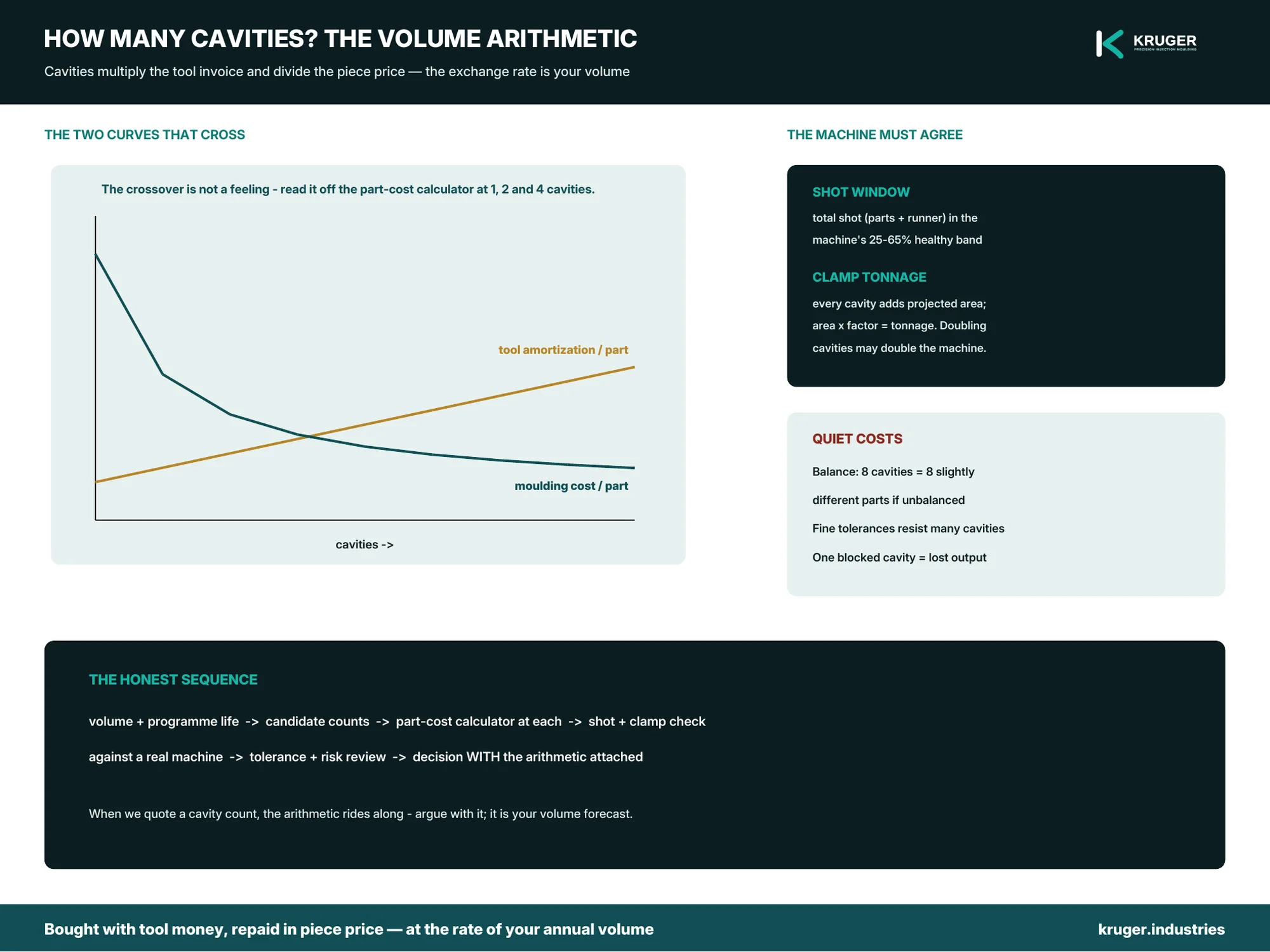
Curve one: tooling amortization. The tool’s cost divided by the parts it will make in its life — more cavities push this per-part figure UP, because the tool cost rises. Curve two: moulding cost per part. Machine-hour rate × cycle time ÷ parts per cycle — more cavities push this DOWN, because each cycle yields more parts. Low volumes never repay curve one’s premium; high volumes are punished every single cycle for not having paid it. The crossover is not a feeling — put your part into the part-cost calculator at one, two and four cavities and read it off.
The machine must agree
Cavity count is also a machine-fit question, twice over. Shot: total shot weight (parts × cavities + runner) should sit in the machine’s healthy window — our shot-size calculator works to a 25–65% band of rated capacity, the conservative synthesis of the handbook windows. Clamp: every cavity adds projected area, and projected area × material factor sets the tonnage — the clamping-force calculator does this in seconds. Double the cavities and you may have doubled the machine; a 4-cavity tool that forces you from a 250T machine onto a 650T machine carries that machine’s hour rate on every part. The arithmetic must include the machine it lands on — ours runs 60 to 1300 tonnes, which is why the recommendation comes with the machine named.
What multiplying cavities quietly costs
- Balance — all cavities must fill together; an unbalanced tool makes eight slightly different parts per cycle.
- Tolerance — Rosato is blunt: fine tolerances usually cannot be held across many cavities. Precision features and high cavitation pull in opposite directions (see the tolerance guide).
- Risk concentration — one damaged cavity in a two-cavity tool halves output; blocking it in an eight-cavity tool costs an eighth. Spares philosophy belongs in the decision.
- Runner discipline — more cavities mean more runner; at some count the hot-runner conversation begins (the crossover logic is in the tooling guide).
The honest sequence
Annual volume and programme life → candidate cavity counts → part-cost calculator at each count → shot and clamp check against a real machine at each count → tolerance and risk review → decision, with the arithmetic attached. That attachment is the point: when we quote a cavity count, the arithmetic rides along, and you are welcome to argue with it — it is your volume forecast, after all.
Bring the volume, leave with the count
Part drawing + annual volume + how many years the programme runs. The reply names the cavity count, the machine, and the arithmetic that chose both. Request a quote.