
/ KNOWLEDGE · REGRIND POLICY
Regrind in injection moulding — settle it in writing, not in good faith
Regrind is neither free material nor automatic contamination — it is a variable, and unmanaged variables are where field failures come from. Every thermoplastic moulding shop generates it, most reuse it, and very few purchase orders say a word about it. This guide explains what regrind actually is, why it is not virgin material, the handling rules that make it safe, and the clauses a buyer should put in writing before the first lot ships.
What regrind is
Cold-runner moulding produces sprues and runners with every shot, plus the occasional reject part. Granulated into particles a few millimetres across, this material — regrind — can be fed back into the process blended with virgin granules, and doing so minimises scrap disposal (BASF). So far, so sensible: a moulder who never reuses clean runner material is throwing away polymer you paid for. The questions that matter are what fraction, of what quality, in which parts.
Why regrind is not virgin
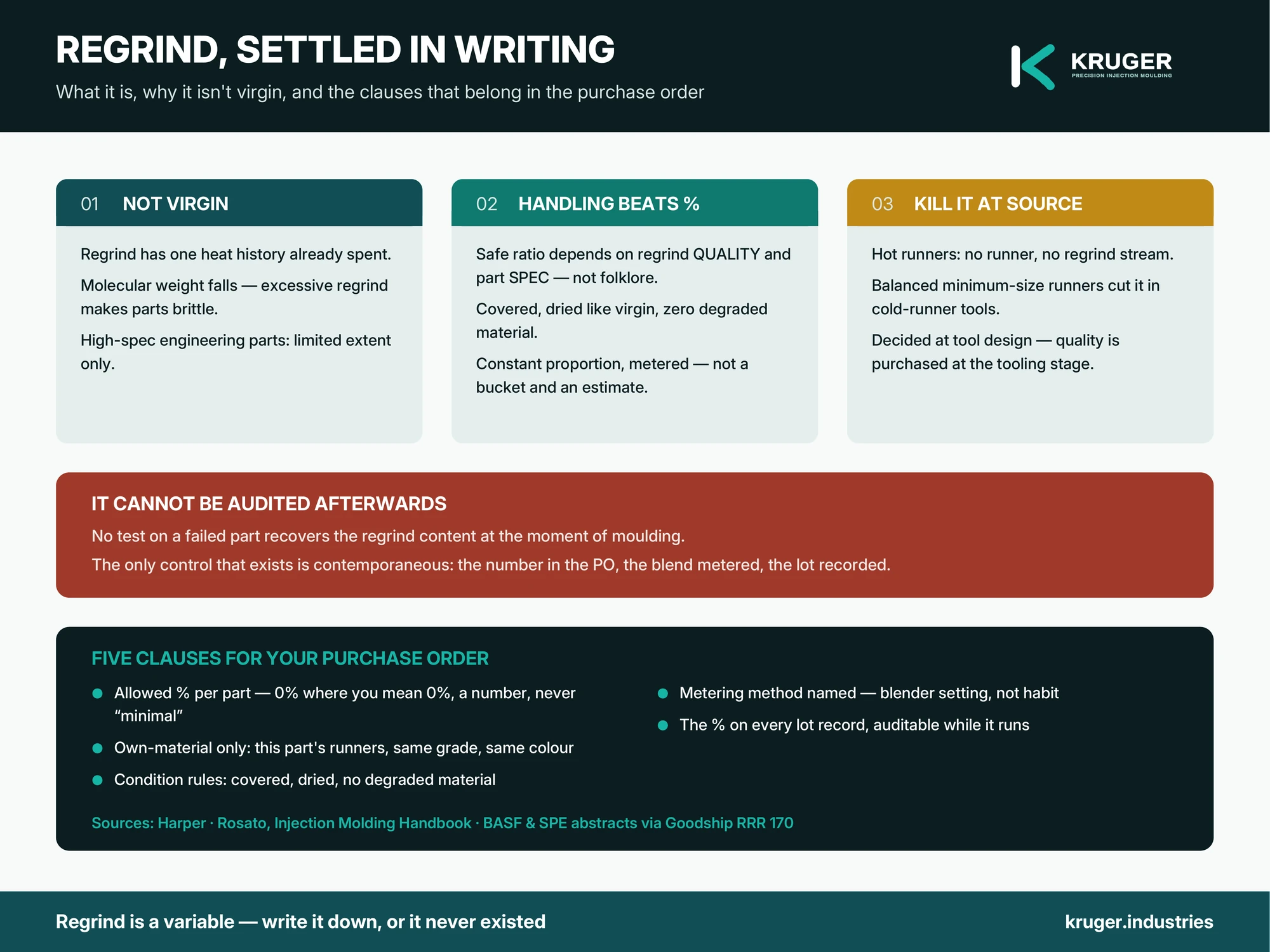
Regrind has been through the barrel once already. That heat history costs molecular weight, and excessive regrind makes parts brittle — the handbook’s advice is to keep regrind at lower levels precisely to avoid molecular-weight loss accumulating in the blend (Harper). For mouldings made to high specifications from engineering thermoplastics, the trade literature is blunter still: regrind use is possible only to a limited extent, because the material degrades both during moulding and during granulation itself (BASF, from trials on PBT and PA6). The degradation is real, cumulative, and invisible on the surface of the part.
Handling quality beats percentage
The most useful thing the literature says about regrind is that the safe percentage is not a constant — it depends on the quality of the regrind and the specification of the part, and with careful handling, meaningful percentages can run without difficulty (Rosato, on nylon 66). What “careful handling” means is spelled out: keep regrind covered and protected from moisture — ground material re-wets faster than granules; keep burned or degraded material out of the stream entirely; don’t let regrind accumulate in open containers — eliminate intermediate storage where possible; and blend a constant proportion with virgin before moulding, not a proportion that drifts shot to shot (Rosato). One more subtlety: regrind’s different bulk density changes how the screw feeds, so an unsteady blend means an unsteady melt (Rosato). A moulder who can describe their regrind handling in this vocabulary has a system. One who says “we put the runners back in” has a habit.
Why it cannot be audited afterwards
The same failure-analysis warning that applies to moisture applies here: when a part fails, reconstructing the regrind content of the raw material at the time of moulding is not possible. No test on the failed part recovers the number. Which means the only regrind control that exists is the contemporaneous one: the percentage written down, the blend metered, the lot recorded. If it isn’t in the paper trail while the parts run, it never existed.
Killing regrind at the source
The cleanest regrind policy is less regrind to police. Hot runner systems eliminate the runner — and with it the regrind stream — along with reducing the tonnage the shot needs (SPE mouldmaking literature), at the price of added process variables and higher-skilled setup. Even in cold-runner tools, computer-aided filling analysis lets the toolmaker design minimum-size runners that reduce regrind at the source (Harper). Runner strategy is decided when the tool is designed, which is one more reason the tooling conversation is where quality is actually purchased.
The clauses that belong in your purchase order
- Allowed percentage, per part — including 0% where you mean 0%, stated as a number, not “minimal”.
- Own-material only — regrind from this part’s own runners and rejects, same grade, same colour; never a mixed house stream.
- Condition rules — covered storage, dried like virgin (hygroscopic regrind re-wets faster), no degraded or contaminated material.
- Metering method — how the constant proportion is actually achieved: blender setting, not a bucket and an estimate.
- Records per lot — the percentage on the lot record, auditable while it runs, because it cannot be audited after.
Ask us the same question
State your regrind position in the RFQ — a percentage, or zero. Our quote replies with ours, in writing, part by part. Request a quote; an engineer replies within 48 hours on working days.