
/ KNOWLEDGE · MATERIALS
The basics of polymers, for people who buy parts
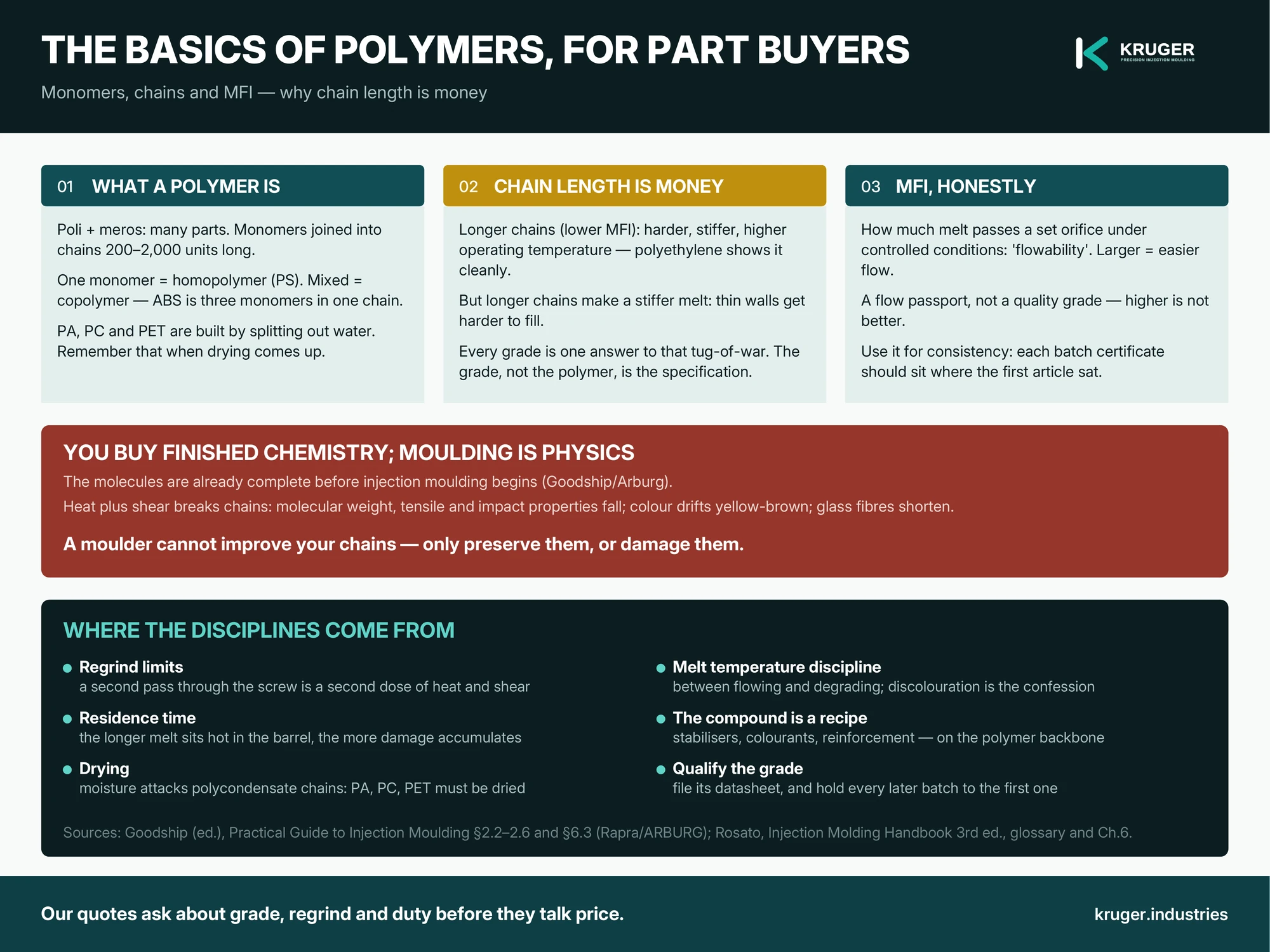
A polymer is a very long molecule built from many small repeated units called monomers — the word itself is Greek, poli (many) and meros (parts) — and a useful polymer chain may consist of 200 to 2,000 monomers joined end to end (Goodship/Arburg). Every property you pay for in a moulded part — stiffness, toughness, temperature resistance, chemical resistance — lives in those chains: how long they are, how they are built, and how carefully they are treated on the way to becoming your part. That is the entire subject, and it is worth twenty minutes of any buyer’s time, because chain length is money.
From gas to granule: how chains are built
The simplest and most common monomer is ethylene — two carbon atoms, four hydrogen atoms, and a double bond whose opening lets monomers link into the chain we call polyethylene. The number of monomers in a finished macromolecule is the degree of polymerisation: the chemist’s phrase for chain length (Goodship/Arburg §2.2–2.3). Three reaction routes build the chains, and the names on your drawings fall neatly out of them:
- Polymerisation joins identical or different monomers with no by-product. One monomer type gives a homopolymer (standard polystyrene); mixed monomers give a copolymer — ABS is three monomers in one chain: acrylonitrile, butadiene and styrene. That is why “ABS” behaves like a committee: each monomer contributes a property (Goodship/Arburg §2.3).
- Polycondensation builds chains “under the splitting action of another substance, usually water” — this is how PA 6, PA 66, polycarbonate and PET are made (Goodship/Arburg §2.3). Remember which families are on this list: it returns two sections down, attached to an invoice.
- Polyaddition builds chains from two monomer types with no cleavage product — polyurethanes and epoxies (Goodship/Arburg §2.3), families that mostly live on the thermoset side of the fence, covered in our thermosets guide.
Now the sentence that makes this page commercial rather than academic. For thermoplastics, the handbook is explicit: the type of formation reaction “plays no part in the subsequent injection moulding… The molecules are already complete before injection moulding begins. They are merely melted, and then solidify in the mould to form the component” (Goodship/Arburg §2.3). You buy finished chemistry; moulding is physics. No moulder can improve the chains a compounder delivered — we can only preserve them or damage them. Everything else on this page, and half the discipline on our shop floor, follows from that sentence.
Chain length is money
Chain length is molecular weight, and “the length of the chain is related to the molecular weight, the molecular weight to the properties” (Goodship/Arburg §2.6.3). Polyethylene shows the trade cleanly: as density and degree of polymerisation increase — and melt flow index falls — hardness, rigidity and upper operating temperature all rise, while brittle temperature and the tendency to stress-crack formation fall (Goodship/Arburg §6.3.2). Longer chains, better part. The catch is the other direction: longer chains also mean a stiffer melt that is harder to push into a thin-walled tool. Every grade on the market is somebody’s answer to that tug-of-war — which is why one polymer name covers dozens of grades, and why the grade, not the polymer, is the specification. What the supplier promises for a given grade, and what those promises are worth, is the subject of how to read a plastics datasheet.
MFI: the one number everyone quotes and few define
The melt index “indicates how much material can be pushed through a set orifice with other conditions controlled. It expresses the ‘flowability’ of a material. Larger values indicate easier flow” (Rosato, who notes the quantity is used mainly for polyethylene, though the trade quotes it far more widely). Treat MFI as a flow passport, not a quality grade: it tells you, in one number, whether this batch flows like the batch you qualified. It does not tell you toughness, and a higher number is not a better material — for polyethylene it generally signals shorter chains, which is the trade described above. The buyer’s use for it is consistency: the MFI on each batch’s certificate should sit where it sat when you approved the first article. A drifting MFI is a drifting material.
How chains die — and where your disciplines come from
Heat and shear, combined, break chains. The handbook’s list of consequences is short and expensive: chain breakage changes molecular weight and viscosity, degrades tensile and impact properties, shows itself as yellow or brown discolouration, and — in glass-filled materials — shortens the fibres that were bought for stiffness (Goodship/Arburg §2.6.3). Overheat any polymer far enough and it degrades outright (Goodship/Arburg §2.6.2). Every processing discipline a good moulder holds is chain preservation wearing work clothes:
- Regrind limits. A second pass through the screw is a second dose of heat and shear — shorter chains, and shorter glass fibres, than virgin. That is the entire scientific case for settling regrind percentage and handling in writing.
- Residence time. The longer the melt sits hot in the barrel, the more chain damage accumulates. Our residence-time estimator makes the exposure visible before the machine is chosen.
- Drying. Recall which families are built by polycondensation — the reaction that splits out water. Those same families must be dried before moulding, because moisture in a hot barrel attacks the chains chemically: damage you cannot see in the granule and cannot undo in the part. The schedules, and what wet granules cost, are in drying plastics before moulding, with per-material values on the temperature and drying chart.
- Melt temperature discipline. Each polymer has a window between flowing and degrading; holding it is the moulder’s job, and discolouration is the confession that somebody did not. The defects guide shows what escaped chains look like in daylight.
From polymer to compound — why your granule is a recipe
One more step stands between the reactor and your part: almost nothing is moulded as bare polymer. The granule you buy is a compound — base polymer plus a recipe of additives: stabilisers against heat and light, lubricants for flow, colourants, flame retardants where specified, and often reinforcement. A 30 per cent glass-filled nylon 66 is a different engineering material from the nylon 66 it started as — that difference is priced out in polymer composites and filled plastics — and colour alone is a specification decision with its own guide, colour in injection moulding. The practical consequence repeats the theme of this whole page: two suppliers’ “PP” are two different recipes on the same backbone. Qualify the grade, file its datasheet, and hold every later batch to the first one.
What this buys you at the moulding shop
Kruger moulds thermoplastics on nine machines from 60 to 1300 tonnes, under ISO 9001:2015, from 10 g to 5.2 kg — the working palette is on the materials guide. None of the chemistry above is exotic to us; it is simply why our quotes ask about grade, regrind position, and duty before they talk price. Send the drawing with the grade you have in mind — or the duty, if the grade is still open — and an engineer replies within 48 hours on working days, including the honest sentence when the grade and the part disagree.
Sources quoted: V. Goodship (ed.), Practical Guide to Injection Moulding (Arburg / Rapra Technology, 2004); D. V. Rosato, D. V. Rosato and M. G. Rosato, Injection Molding Handbook, 3rd ed. (Kluwer Academic, 2000).