
/ KNOWLEDGE · DEFECTS, DECODED
Moulding defects — and what they say about your moulder
Every defect is a message from the process, written in plastic. The troubleshooting literature — Goodship’s dedicated volume runs to seventeen distinct defect classes with cause-and-fix flowcharts — reads like a diagnostic manual because that is what it is. A buyer doesn’t need to memorise it; a buyer needs to know the families, the one famous myth, and the question that reveals whether a supplier troubleshoots systematically or by folklore.
The surface family — what the eye catches
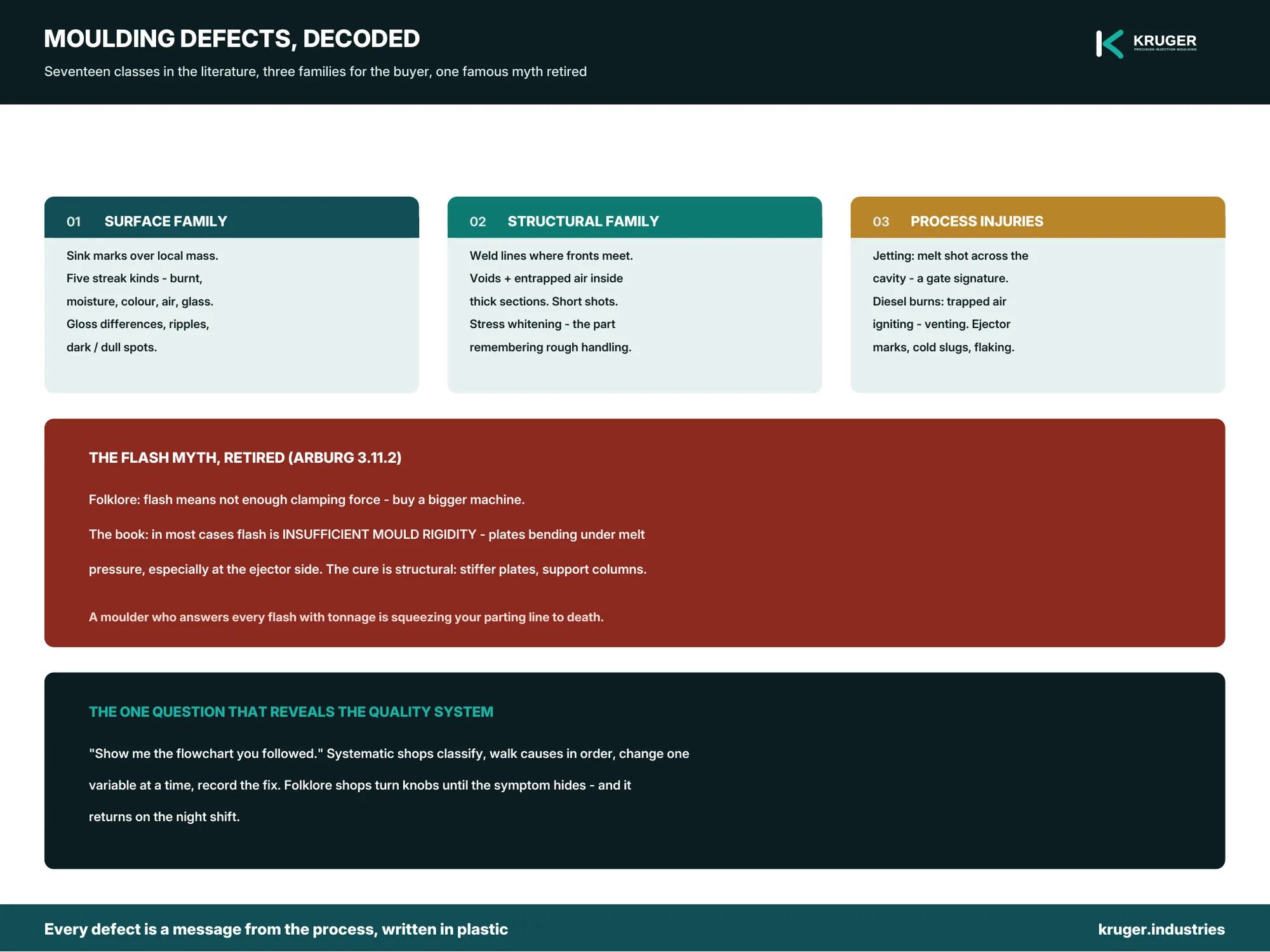
Sink marks — depressions over local mass (thick ribs, bosses); usually a design conversation as much as a process one — the ball test predicts them before the tool exists. Streaks — Goodship distinguishes five kinds by cause: burnt (overheated material), moisture (wet granules — drying discipline), colour (masterbatch mixing), air, and glass-fibre streaks (fibres showing at the surface). The kind names the cure, which is why “polish it out” is never a root-cause answer. Gloss differences, record-groove ripples, dull or dark spots — finer surface signatures of temperature, flow and contamination, each with its own flowchart.
The structural family — what the part hides
Weld lines — where two flow fronts meet; visible at best, weak at worst, and moveable by gating decisions made at the tool-design stage. Voids and entrapped air — hollows inside thick sections (the wall guide again) or trapped gas that never escaped — venting and racetracking territory. Short shots — incompletely filled parts: flow length beyond the wall’s ability to carry it. Stress whitening and cracks — the part remembering how hard it was packed or ejected. These are the family that reaches the field if lot inspection is weak — which is why they anchor the paper-trail guide.
The process-injury family — what handling did
Flash (the famous one — next section). Jetting — a worm-like squiggle where melt shot across the cavity instead of filling smoothly: a gate-design signature. Diesel-effect burns — compressed trapped air igniting at the end of fill: venting. Ejector marks, demoulding deformation — the part leaving the tool harder than it should: draft, polish, ejection design (the DFM rules earn their keep here). Cold slugs, flaking, blisters — nozzle and temperature discipline.
The flash myth, retired
The folklore says flash means not enough clamping force — buy a bigger machine. The ARBURG guide says otherwise, in as many words: in most cases flash is caused not by inadequate clamping force but by insufficient rigidity of the mould — the plates bending under internal melt pressure, especially around the ejector system, letting melt escape at the parting line. The prescribed cure is structural, not muscular: stiffer plates and additional support columns (set a few hundredths of a millimetre proud of the outer supports) so the plate cannot bow. Why a buyer should care: a moulder who answers every flash with more tonnage is squeezing your tool’s parting line to death; a moulder who talks about plate support has read the book.
The one question that reveals the quality system
When a defect appears, ask your moulder: show me the flowchart you followed. Systematic shops troubleshoot the way the literature does — classify the defect, walk the causes in order, change one variable at a time, record what fixed it. Folklore shops turn knobs until the symptom hides, and the defect returns on the night shift. The existence of a written, followed method is the whole difference — and it is visible in the answer to one question.
A defect on your current parts?
Send photographs and the story — material, machine, when it started. Diagnosis is free, systematic, and occasionally the beginning of a better supplier relationship. Request a quote.