
/ KNOWLEDGE · PROCESS
The advantages and disadvantages of injection moulding — with the prices left in
Injection moulding is the most economical way ever devised to make large numbers of identical plastic parts — and an expensive way to make small numbers of them. The handbook states the advantage plainly: it is “a very economical method of mass production”, in which “ready parts with tight tolerances can be produced in one step, often completely automatically”, and “in general after-processing is not necessary” (Goodship/Arburg). Every disadvantage of the process is the price of that sentence. This guide sets out both halves honestly, with the real costs attached, so you can decide whether your part belongs in a mould at all.
The advantages — and the condition attached to each
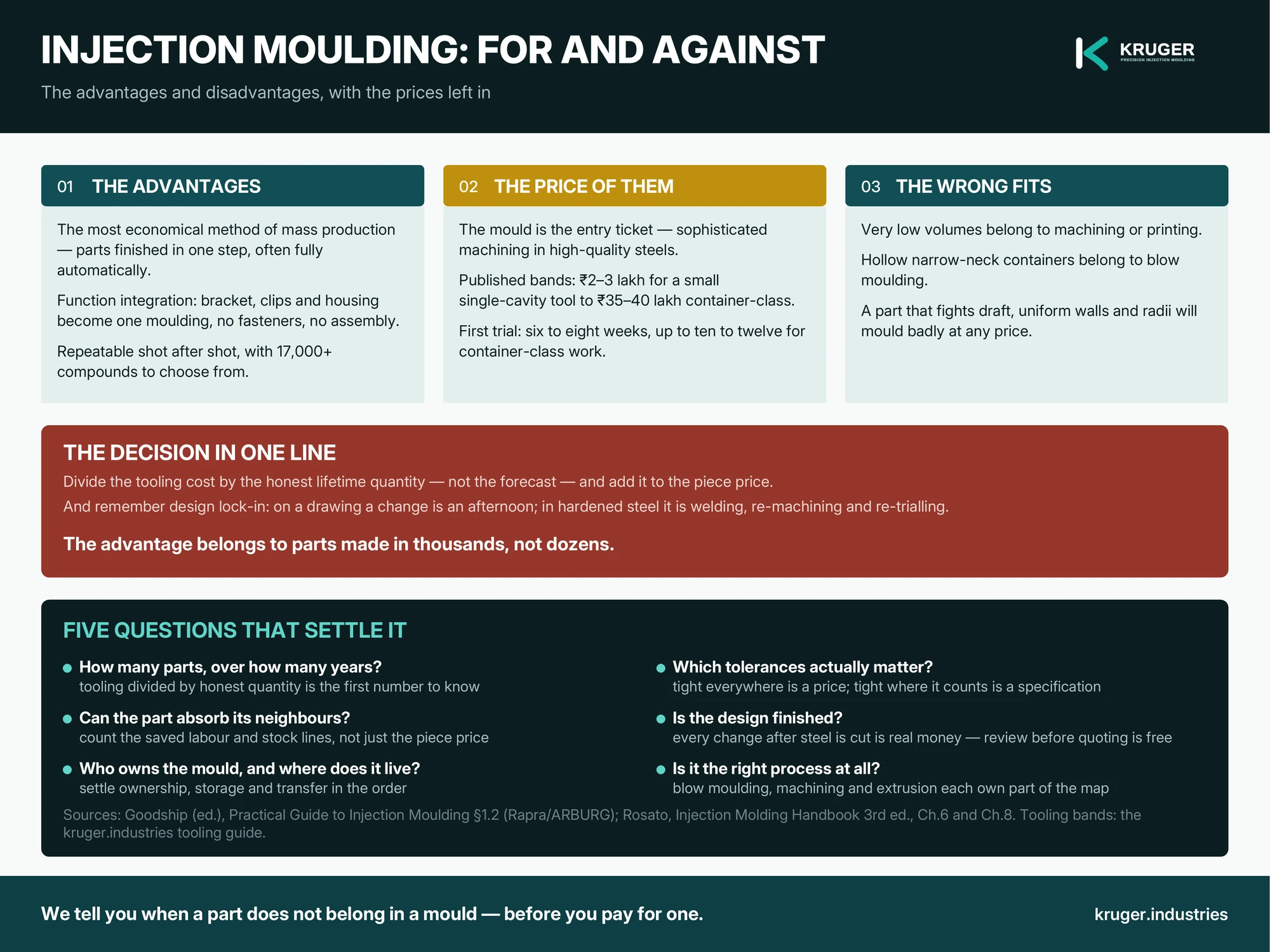
Piece price at volume. Once the mould exists, the machine turns out parts in a cycle measured in seconds, and material plus a share of machine time is most of what each part costs. Our part-cost calculator shows the arithmetic openly. The condition: the piece price is low because the mould absorbed the cost up front. The advantage belongs to parts made in thousands, not dozens.
Finished parts in one step. Parts come off the machine done — colour in the material, texture in the steel, holes, threads, clips and hinges formed in the shot. Rosato puts it as “the ability to produce finished, multifunctional, or complex molded parts accurately and repeatedly in a single, highly automated operation”. The condition: everything you want “for free” in the moulding must be designed into the tool before it is cut, which is what our design-for-mouldability guide is for.
Function integration. The same handbook sentence hides the biggest commercial win: multifunctional. A bracket, a snap feature, a cable clip and a housing can become one moulding with no fasteners and no assembly labour. Done well, this pays for tooling faster than any piece-price saving. The condition: consolidation concentrates risk in one tool — a design change now touches everything.
Repeatability. A stable process repeats to tight limits shot after shot, which is why demanding industries qualify moulded parts by the million. The condition: “tight” has grades, and tolerance costs money — our tolerances guide explains the three honest bands and where tightness actually earns its keep.
Material breadth. Rosato counts more than 17,000 compounds commercially available worldwide, and 85 to 90 per cent of everything injection moulded is thermoplastic — a family that melts, shapes and re-melts, which is what makes runner regrind and recycling possible at all. Our materials guide covers the working palette, and our regrind guide covers how to keep the re-melt honest. The condition: breadth is a trap without discipline — specify the grade, not the polymer.
The disadvantages — priced, not whispered
The mould is the entry ticket. Rosato is blunt about what a mould is: “a highly sophisticated piece of machining” comprising many parts requiring high-quality steels, running “at high temperature and very high pressure, in a reciprocating machine that may well cycle several times a minute or even more, over long production runs”. That is why it costs what it costs. Our published indicative bands run from ₹2–3 lakh for a small single-cavity tool to ₹35–40 lakh for a container-class tool — the full table, and the six drivers behind it, are on the mould-cost guide and the tooling guide.
The wait before the first part. Steel takes time to cut: our published first-trial windows run from six to eight weeks for simple tools up to ten to twelve weeks for container-class work. If your deadline is next month and your tool does not exist, injection moulding cannot help you this time — and a moulder who says otherwise is telling you something about their honesty, not their speed.
Volume dependence. Divide the tooling cost by the number of parts you will genuinely make — not the number in the optimistic forecast — and add it to the piece price. At some quantity that sum crosses what machining or printing charges per part; below it, moulding is the wrong answer. We publish an aluminium-versus-steel break-even calculator precisely because the answer moves with the tool you choose, and the cavities guide shows how cavitation shifts the same trade at higher volumes.
Design lock-in. On a drawing, a change is an afternoon. In hardened steel, a change is a welding, re-machining and re-trialling exercise — and some changes mean a new tool. This is the strongest argument for spending unhurried engineering time before steel: a design-for-moulding review costs days and saves lakhs. It is also why we review drawings before quoting rather than after.
The process has geometry rules. Mouldings want uniform walls, draft on vertical faces, radii in corners and ribs sized to the wall — the square law of cooling and the physics of ejection are not negotiable, only accommodated. Our wall-thickness guide covers the one rule that writes your piece price. A part that fights these rules will mould badly at any price.
Sometimes it is simply the wrong process. A hollow container with a narrow neck belongs to blow moulding — our ISBM guide explains the boundary and says openly which of the two processes we run. Very low volumes belong to machining or printing. Large flat sheets belong to extrusion. The process guide explains what the machine is actually good at, and thermosetting materials are a different conversation again — covered honestly in our thermosets guide.
Five questions that settle it
- How many parts, over how many years? Tooling divided by honest lifetime quantity is the first number to know. If it embarrasses the piece price, stop here.
- Can the part absorb its neighbours? If the moulding can replace an assembly of three parts and their fasteners, count the saved labour and stock lines, not just the piece price.
- Who owns the mould, and where does it live? Settle ownership, storage and transferability in the order — our position is published on the tooling guide.
- Which tolerances actually matter? Tight everywhere is a price, tight where it counts is a specification.
- Is the design finished? Not “drawn” — finished. Every change after steel is cut is real money; a design review before quoting is free.
Where we stand, honestly
Kruger runs thermoplastic injection moulding on nine machines from 60 to 1300 tonnes, under ISO 9001:2015, moulding parts from 10 g to 5.2 kg. We do not run blow moulding, and we say so on the page that explains it. If your part suits the process, send the drawing and the honest quantity — an engineer replies with design-for-moulding feedback within 48 hours on working days. And if your part does not suit the process, we will tell you that too, with the reasoning attached — it costs us a quote and saves you a mould.
Sources quoted: V. Goodship (ed.), Practical Guide to Injection Moulding (Arburg / Rapra Technology, 2004); D. V. Rosato, D. V. Rosato and M. G. Rosato, Injection Molding Handbook, 3rd ed. (Kluwer Academic, 2000).