
/ KNOWLEDGE · SOURCING
How to identify an injection moulding partner offshore — the commercial mechanics that decide it
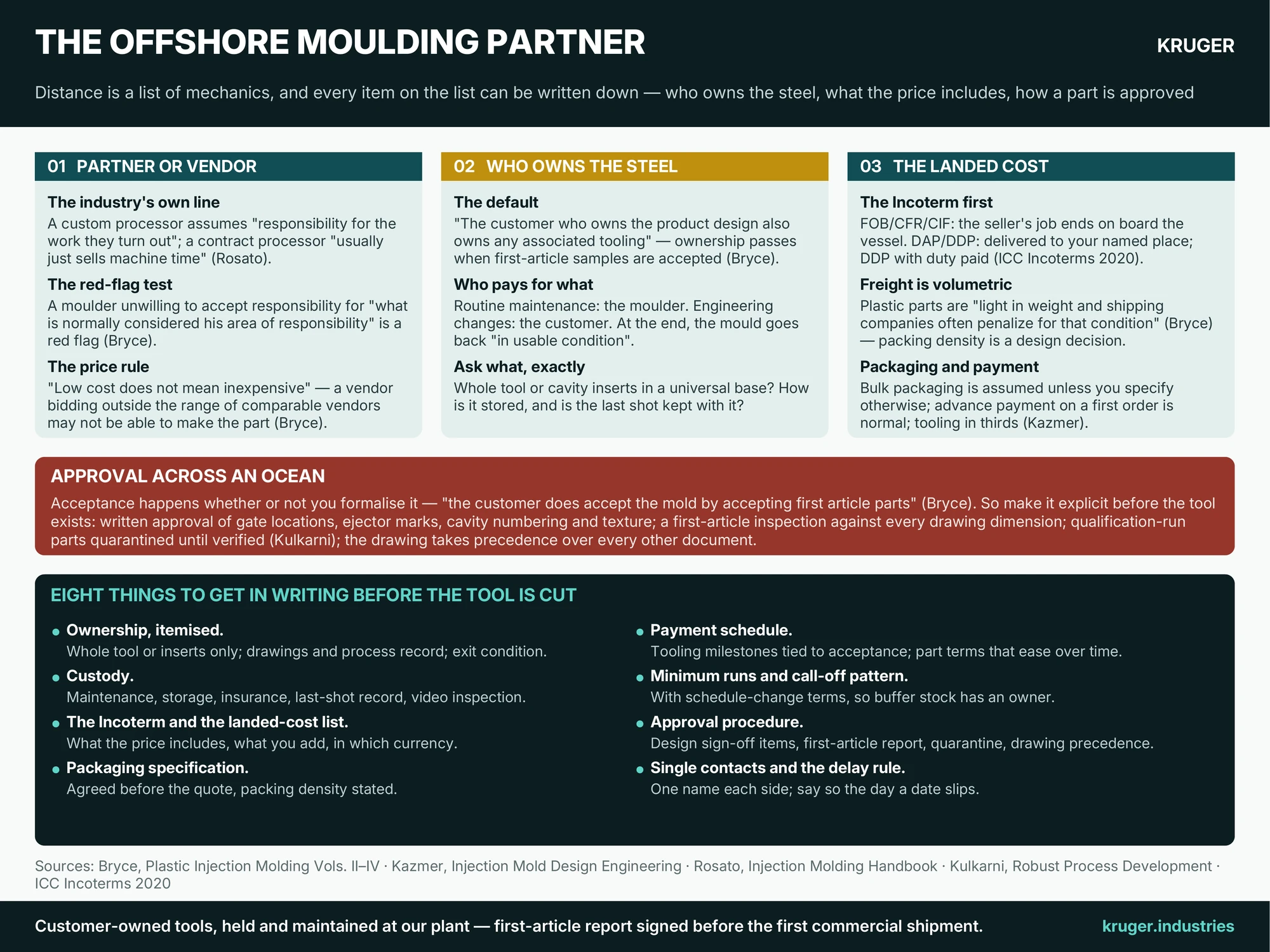
An injection moulding partner offshore is identified less by the factory tour than by five things that get written down: who owns the steel, what the price includes, how a part is approved across an ocean, how time is managed, and what happens at the end. Our guide to qualifying a moulding supplier in India covers the audit; this page starts where it ends, with the honest objection. Bryce’s management text warns that “as the distance between vendor and OEM increases, the effectiveness of the partnership dwindles.” He is right wherever proximity papers over vagueness; the answer is mechanics that survive distance.
Partner or vendor — decide which you are buying
Rosato’s handbook separates the custom processor, who helps design product and mould and stands behind what it ships, from the contract processor, who in Rosato’s words “usually just sells machine time.” Offshore that is the whole game: machine time is easy to buy anywhere, responsibility is not. Bryce’s test: a moulder who farms out a secondary operation stays answerable for the finished part, and one who will not own what is plainly his job, Bryce says, “should be viewed as a red flag.” His price rule travels too: “Low cost does not mean inexpensive”.
Who owns the steel — and where it lives
Everything else can be renegotiated; the mould cannot be un-cut. Bryce sets out the industry default: whoever owns the product design owns its tooling; ownership passes when first-article samples are accepted; routine upkeep is the moulder’s cost while the tool is in its shop; engineering changes are billed to the customer; and at the end the moulder must return the mould in working condition. He also names the trap of owning only inserts in the moulder’s base: ask exactly what you will own. Ask how the tool is kept — a real question in a monsoon climate — and copy Bryce’s habit of storing each run’s last shot with the mould. Our terms are public in the tooling guide: you pay for the mould, you own the mould; it is held and maintained at our plant, carries your identity, is cut by specialist toolmakers under our management, can be inspected on a video call whenever you ask, and if you ever move it, it moves documented and crated with its history.
The price is a landed cost, not a piece price
A quote is only comparable once you know where the seller’s responsibility stops. The International Chamber of Commerce’s Incoterms 2020 rules fix that point: under FOB, CFR and CIF the seller’s job ends with the goods on board the vessel; under DAP and DDP the seller delivers to your named place, DDP including import clearance and duty. Add what the term leaves out: freight, insurance, duty, port charges, haulage, currency. Two of Bryce’s warnings bite harder at sea: carriers charge for the space light parts fill, so packing density is a design decision, and a moulder quotes on bulk packaging unless asked otherwise, so settle packaging before quoting. Kazmer’s advice is to fix minimum quantities and schedule-change charges in the contract before the tool is cut. Bryce notes that a moulder may want full payment up front from a new customer, since no moulder can afford to carry a customer’s debt; Kazmer’s norm is tooling paid in thirds, the last on acceptance of parts. Our quotes state the Incoterm, the tooling and part prices on separate lines, and the payment schedule; the RFQ guide lists what to send, and what a mould costs explains the tooling line.
Approval across an ocean
Proximity meant standing at the press for T1; offshore, the trial has to be a document. Bryce’s warning is that acceptance happens whether or not you formalise it: accept first-article parts and you have accepted the tool, payments due, even with no written procedure. So write it down before the tool exists: sign-off of Bryce’s mould-design checklist items — gate positions, ejector-pin marks, cavity numbering and texture — a first-article inspection against every drawing dimension, and Kulkarni’s practice of quarantining qualification-run parts until every record is checked. One paper rule, Bryce’s, prevents most transoceanic arguments: “the drawing takes precedence over any other documents” — with revision control. Our published promise is the first-article report signed by both sides before the first commercial shipment, with golden samples retained; the quality paper trail lists the documents, and the transfer playbook shows the same sequence for a tool you already own.
Time, distance and the single contact
Bryce’s schedule rule matters more abroad: a schedule must allow for tool delivery and transport, not just press time, in his view. Build the sea leg and a buffer stock into the plan from day one. Then insist on information. Bryce puts an “ethical (if not legal) obligation” on the moulder to say the moment a delivery is known to be late, and what is being done, and asks both sides for one named contact for every communication. Then test the reply: send a drawing with the volumes, the material and the packaging you expect. An engineer here answers within 48 hours on working days, with questions about draft, walls and gating.
Eight things to get in writing before the tool is cut
- Ownership, itemised. Whole tool or inserts only; who holds the drawings and process record; the condition in which the tool leaves.
- Custody. Maintenance, storage protection, insurance, the last-shot record, video inspection on request.
- The Incoterm and the landed-cost list. What the price includes, what you add, in which currency.
- Packaging specification. Agreed before the quote, packing density stated.
- Payment schedule. Tooling milestones tied to acceptance; part terms that ease as the relationship proves itself.
- Minimum runs and call-off pattern. With schedule-change terms, so buffer stock has an owner.
- Approval procedure. Mould-design sign-off items, first-article report, quarantine until release, drawing precedence.
- Single contacts and the delay rule. One name each side, and the duty to say so the day a date slips.
Kruger has shipped moulded parts to the Middle East and the United States, and recent export work leaves as finished, printed, assembled and individually packed units. Every mould in the plant belongs to the customer who paid for it, and the first-article report is signed before the first commercial shipment; the spare-capacity guide tells you how to check how loaded we are before you commit. Send the drawing and the volumes; the reply covers the eight items above for your part, in writing, within 48 hours on working days.
Sources quoted: D. V. Rosato, D. V. Rosato and M. G. Rosato, Injection Molding Handbook, 3rd ed. (Kluwer Academic, 2000); D. M. Bryce, Plastic Injection Molding, Vol. II (Society of Manufacturing Engineers, 1997); D. M. Bryce, Plastic Injection Molding, Vol. IV (Society of Manufacturing Engineers, 1999).