
/ KNOWLEDGE · MACHINES
What is an injection moulding machine — and will your part fit one?
An injection moulding machine is two machines working to one controller: an injection unit that melts, meters and injects the plastic, and a clamping unit that holds the mould shut against the pressure of that melt. Everything a moulder decides about your part — which machine it runs on, what the cycle costs, whether it flashes — comes out of four checks against those two units. A buyer who can run the same four checks can read a quotation properly, and can tell the difference between a moulder who allocated a machine and one who guessed.
Two units, one controller
The vocabulary is worth having, because it appears on every machine data sheet. The injection unit feeds, melts and injects the material; its reciprocating screw both plasticises and injects. The clamping unit is where the mould is mounted, and it provides both force and movement. The fixed platen does not move during closing and carries the mould-mounting holes; the moving platen carries the moving mould half and the ejection mechanism; tie bars link and align the two platens; and daylight is the maximum distance between them (Arburg, machinery glossary). The mould itself is the subject of our guide to mould construction.
Check one — the clamp, and why toggle versus hydraulic matters to you
Clamping units are rated and described separately from the injection unit. There are three main ways the force is developed — hydraulic, toggle and hydromechanical — with electric and combined electric-hydraulic drives alongside them (Rosato, Arburg).
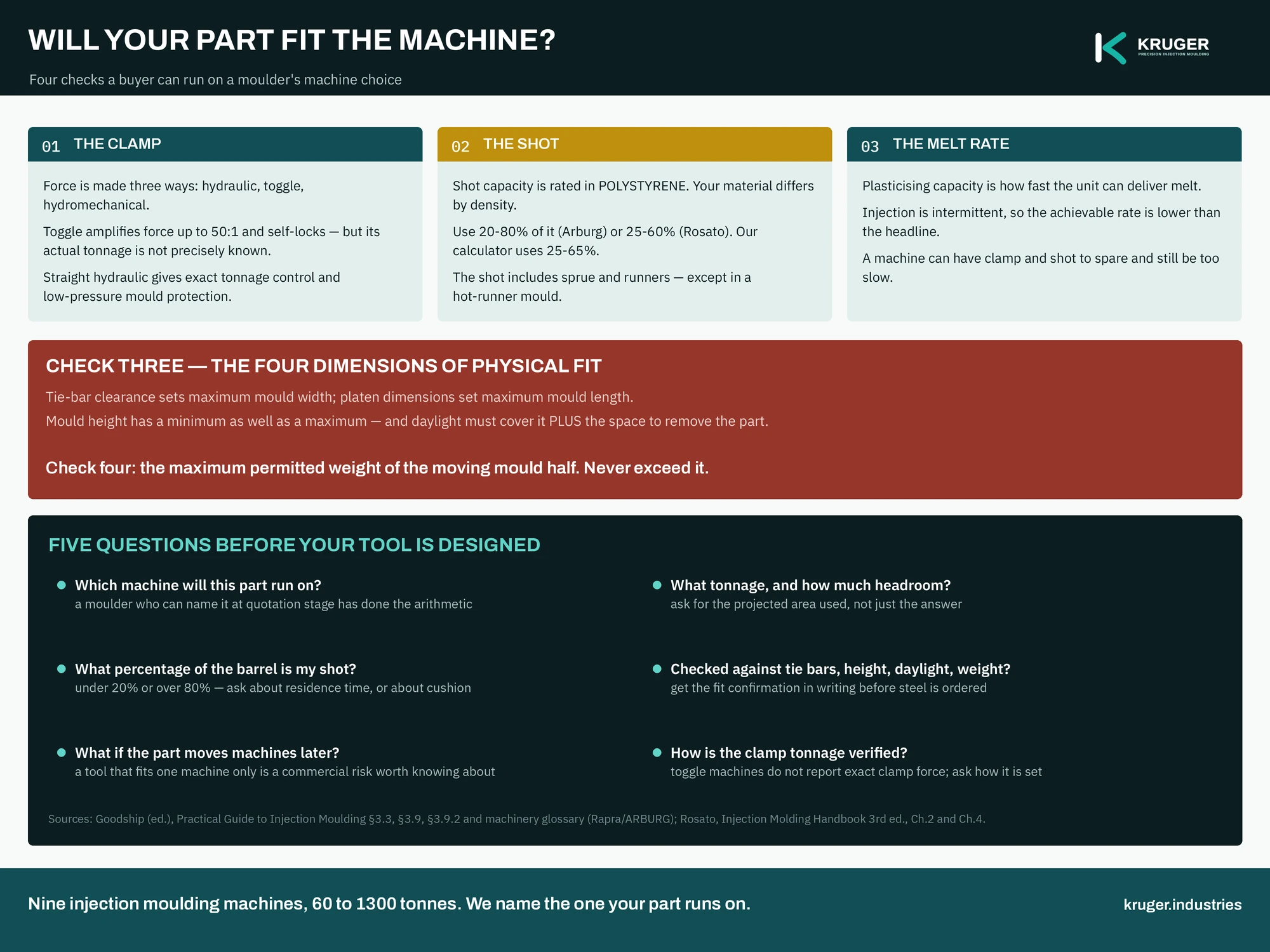
A toggle clamp uses the mechanical advantage of a linkage: two bars on a pivot that form a V when open and a straight line when closed. Because the linkage amplifies force, a much smaller hydraulic cylinder is needed — Arburg puts the advantage as high as 50:1 — and once extended the toggle is self-locking, where a direct hydraulic clamp needs constant line pressure. The costs are equally specific: it is more difficult to control the speed and force of a toggle mechanism, and the linkage must be adjusted for different mould depths so that the toggle fully extends (Arburg). Rosato adds the sentence a buyer should remember: with a toggle clamp, “the actual clamp tonnage is not precisely known” — and the design “will also develop higher than lockup tonnage if the clamp is overpowered by the injection end, or there is temperature buildup in the mold”.
A straight hydraulic clamp trades speed for control. Rosato’s summary is that it has proved over the years to give long-term reliability, excellent low-pressure mould protection and exact control of tonnage, and that it will not allow the clamp to be overstressed by high injection forces. Neither type is better in the abstract; what matters is that they fail differently. If your tool is delicate, or your part is prone to flash, ask which clamp type it will run on and how the tonnage is set and verified — and note that our defects guide retires the common assumption that flash is always a tonnage problem.
The number itself comes from projected area and material, and our clamping-force calculator works it out with typical tonnage factors and about ten per cent headroom. Reinforced grades push it up — that is one of the three costs set out in polymer composites and filled plastics.
Check two — shot capacity, and why the number on the data sheet is not your number
Shot capacity is the full amount, by weight or volume, that the screw injects in one moulding stroke — and here is the catch that catches everyone. It “is usually given as a shot capacity for polystyrene, and will vary with material” (Arburg). Rosato says the same twice over: capacities are commonly rated in ounces of polystyrene injected by one full stroke, and because plastics have different densities, a better way to express shot size is as a volume. So a machine advertised at 500 g is 500 g of general-purpose polystyrene. Your nylon, your polycarbonate and your glass-filled polypropylene all give a different figure, and the conversion is a density calculation, not an opinion.
Second catch: you should never use all of it. The literature agrees on a working window without agreeing on its edges — Arburg advises a dosage volume of around 20 to 80 per cent of total shot capacity; Rosato gives “generally 25 to 60 per cent of a four-diameter full stroke on a 20:1 L/D screw”, and elsewhere puts the requirement at about 50 per cent of machine shot capacity, at most 60 to 70 per cent, to ensure proper plasticising action. Our shot-size calculator uses 25–65 per cent — a deliberately conservative synthesis of those windows: its floor matches the books’ cautious end, and its ceiling stays well inside Arburg’s range while running slightly past Rosato’s observed 60.
Both edges of the window are real failures. Run a small shot in a big barrel and the material sits too long at melt temperature and degrades — the reason our residence-time estimator exists. Run a shot near the top of the barrel and there is no cushion left to pack with, so weights and dimensions wander shot to shot. And remember what the shot must include: the sprue and runners as well as the parts, except in a hot-runner mould (Rosato).
One more rating is quietly decisive. Plasticising capacity is the maximum rate at which the injection unit can deliver melt; because injection is intermittent rather than continuous, the achievable rate is lower than the headline, and it depends on shot size, cylinder capacity, screw design, screw speed and heater-band power (Arburg). A machine can have enough clamp and enough shot and still be unable to melt fast enough for a short cycle time.
Check three — will the mould physically fit?
The first question on Rosato’s mould-design checklist is not about plastic at all. It asks whether the mould will fit the intended machine — not only between the tie bars, but between the minimum and maximum mould height. Four dimensions decide it, and all four appear on the machine’s data sheet:
- Tie-bar clearance — determines the maximum permissible mould width.
- Platen dimensions — determine the maximum permissible mould length.
- Minimum and maximum mould height — the thicknesses of mould admitted between the platens. A mould can be too thin as well as too thick.
- Daylight opening — the clearance between the platens, which must cover the mould height plus the space needed after the mould opens to get the part out (Rosato).
Add the ejector pattern and stroke, and that is the whole physical-fit question. It is asked once, at design stage, and it costs a phone call. Asked after the steel is cut, it costs a tool.
Check four — mould weight, the one nobody puts on the drawing
Every machine has a maximum permitted weight for the movable mould half, and Arburg is blunt about it: these values should not be exceeded for any reason, because production problems and premature wear are the result. Heavier tools may be allowed if the machine has vertical support, horizontal support or support of the tie bars — which is a machine specification, not a hope. If your tool is a large multi-cavity or container-class mould, the weight of the moving half belongs in the specification alongside its dimensions.
Five questions to ask before your tool is designed
- Which machine will this part run on? A moulder who can name it at quotation stage has done the arithmetic. One who cannot, has not.
- What clamp tonnage does it need, and how much headroom is left? Ask for the projected area used in the calculation, not just the answer.
- What percentage of the barrel will my shot use? If the answer is under 20 or over 80 per cent, ask what happens to residence time or to the cushion.
- Has the tool been checked against that machine’s tie bars, mould height, daylight and maximum mould weight? Get it in writing before steel is ordered.
- What happens if the part moves to a different machine later? A tool designed to fit one machine only is a commercial risk you should know you are taking.
What we run — and what “spare capacity” honestly means
Kruger runs nine injection moulding machines in Bengaluru — eight horizontal from 60 to 1300 tonnes and one vertical machine for insert moulding — all retrofitted with servo drives and digital SCADA controllers, under ISO 9001:2015, moulding parts from 10 g to 5.2 kg. The full list with tonnages is on our capabilities page; the checks and records that keep those machines honest are in the quality paper trail.
If you arrived here hunting for spare moulding capacity, the honest answer is that it changes month to month — so ask rather than assume. Send the part weight, the material, the projected area or the drawing, and the annual volume. An engineer replies within 48 hours on working days naming the machine we would allocate, the tonnage the part needs and the shot percentage it would use — all of which you can check yourself first with the engineering calculators.
Sources quoted: V. Goodship (ed.), Practical Guide to Injection Moulding (Arburg / Rapra Technology, 2004); D. V. Rosato, D. V. Rosato and M. G. Rosato, Injection Molding Handbook, 3rd ed. (Kluwer Academic, 2000); V. Goodship, Troubleshooting Injection Moulding, Rapra Review Report (Rapra Technology); H. Rees, Understanding Injection Mold Design (Hanser, 2001).