
/ KNOWLEDGE · OVERMOULDING & INSERT MOULDING
Overmoulding and insert moulding — a buyer’s guide
Overmoulding is how one part does two jobs: a rigid body with a sealing face, a copper conductor with a moulded strain relief, a housing with a soft grip. One material is moulded over another — plastic over plastic, or plastic over metal — and done well, the joint outlives the product. This guide explains the process routes, what actually makes two materials hold together, and the questions that separate a moulder who understands overmoulding from one who merely owns the tooling.
The three routes, in plain language
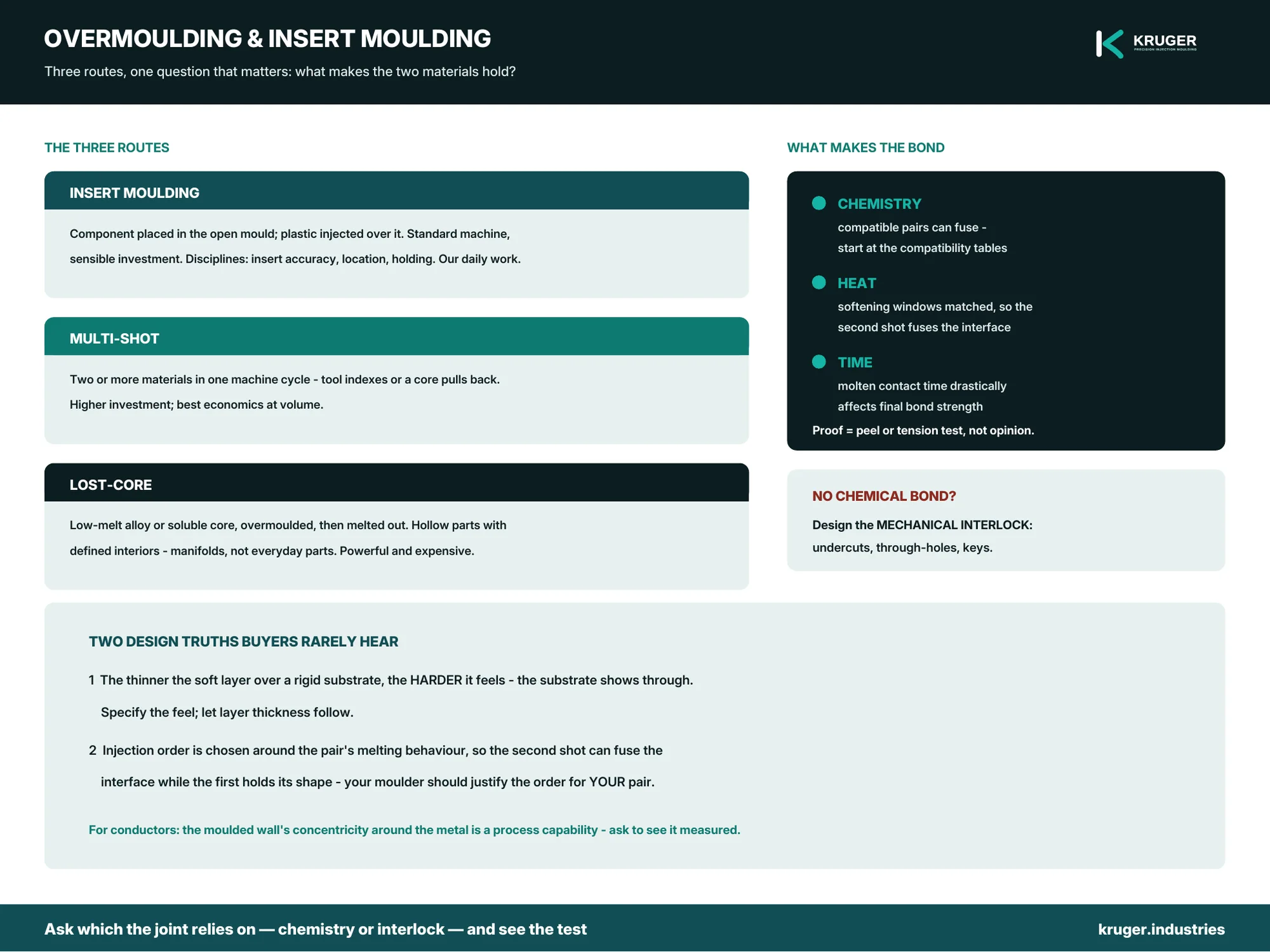
Insert moulding — a finished component (a metal lug, a threaded bush, a first-shot plastic part) is placed into the open mould, and molten plastic is injected over it. It runs on a standard machine, which keeps investment sensible; its disciplines are placement accuracy and holding the insert still — an insert that is out of position or loose does not just make a bad part, it can damage the tool. Multi-shot moulding — two (or more) materials are injected in one machine cycle, the tool indexing or a core pulling back between shots; higher investment, best economics at volume. Lost-core moulding — for hollow parts with a defined internal surface: a low-melting-alloy or soluble core is overmoulded, then melted or dissolved out. Powerful and expensive — the route of air-intake manifolds, not of everyday parts. Most industrial requirements, including cable and connector assemblies, are served by the first route.
What actually makes two materials stick
Three things, and a moulder should be able to talk about all of them. Chemistry: compatible material pairs can fuse at the interface; the handbooks publish compatibility tables of which elastomers bond to which substrates, and the choice starts there. Heat: the bond forms where the second shot’s heat softens the surface of the first — softening and melting ranges of the pair must be matched so the interface fuses without the first shot losing its shape. Time: the molten contact time drastically affects final bond strength — which is why the injection sequence and technique are engineering decisions, not habits. And where the chemistry refuses — many pairs simply do not bond — the design answer is the mechanical interlock: undercuts, through-holes and keys that lock the second material in place with no adhesion at all. Ask your moulder which of the two the joint relies on; the answer should be immediate, and it should be testable — bond strength is verified by peel or tension testing, not by opinion.
Two design truths buyers rarely hear
First: with a soft-touch layer, thickness is the feel. The thinner the elastomer layer over a rigid substrate, the harder it feels under the finger — the substrate shows through. Specify the feel you want and let the layer thickness follow. Second: the injection order is chosen around the pair’s melting behaviour, so that the second shot can fuse the interface while the first holds its geometry — it is a decision your moulder should be able to justify for your specific pair, not a default.
Overmolding metal: cables, connectors, inserts
Plastic-over-metal is the oldest overmoulding there is, and it is our daily work: cable assemblies where the moulded body provides insulation and strain relief over a welded copper joint, brass inserts captured in housings, terminals overmoulded for creepage and protection. The disciplines are the insert-moulding ones — dimensional accuracy of the insert, clean location in the tool, and a moulded section designed to the same wall rules as any other part (our design-for-mouldability guide applies inside an overmould too). For conductors there is one more: the metal must be held so the melt cannot displace it — concentricity of the moulded wall around a conductor is a process capability, and you may ask to see it measured.
The questions to put to any overmoulding supplier
- Does this pair bond chemically, or is the joint a mechanical interlock — and what test evidence exists either way?
- What is the injection sequence for this pair, and why?
- How are inserts located and held, and what happens to a mislocated insert before it reaches the tool?
- For soft-touch: what layer thickness delivers the specified feel?
- For conductors: how is wall concentricity measured and recorded?
Bring us the pair
Substrate, overmould, insert, duty — send the combination and the drawing. We mould over metal and plastic every working day, and the reply comes from an engineer who can answer every question on the list above. Request a quote.