
/ KNOWLEDGE · MACHINES
Toggle clamps and clamping force — how a machine actually holds a mould shut
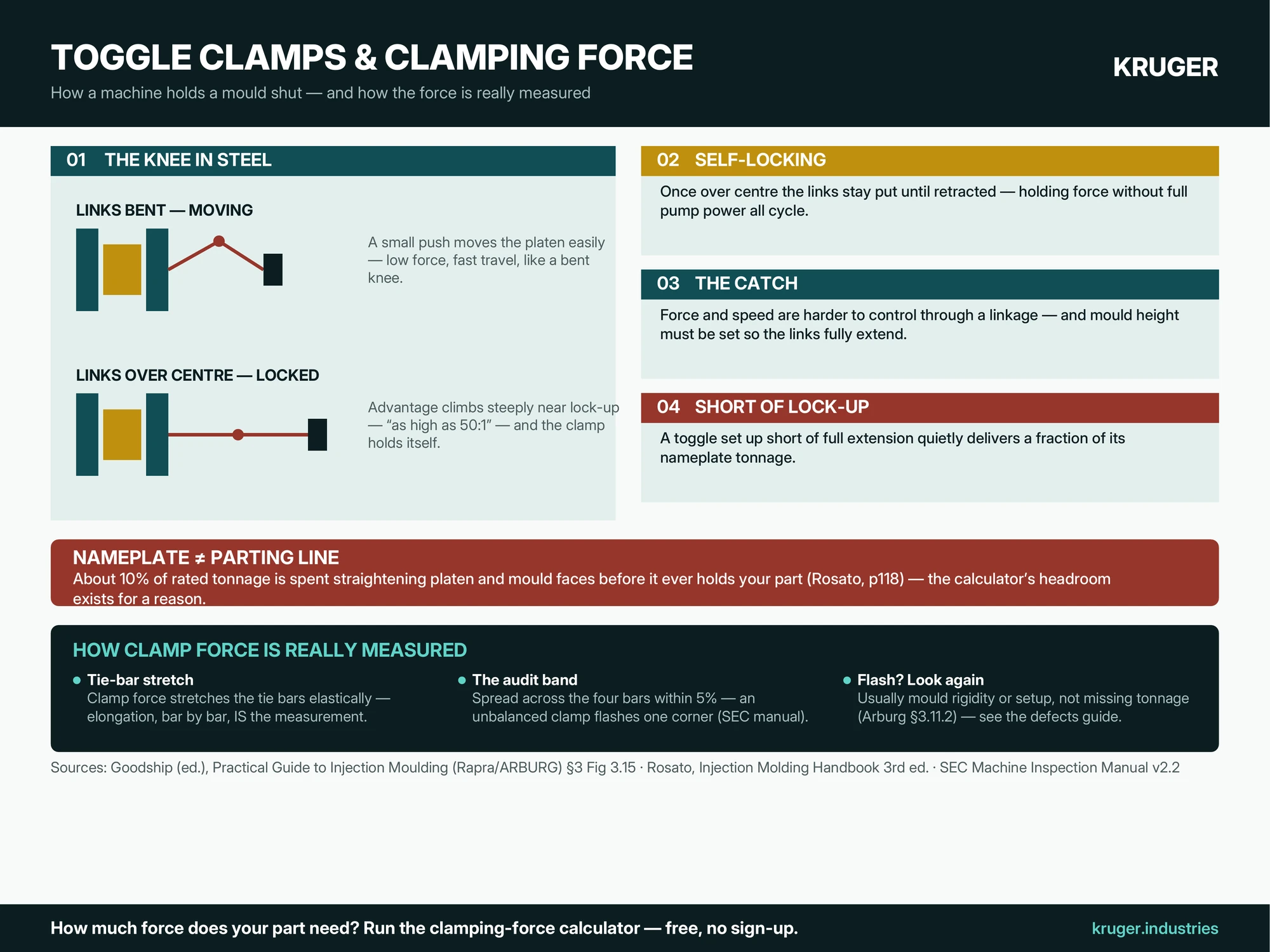
A toggle clamp is a linkage that multiplies force: a modest hydraulic or electric push on the crosshead becomes a very large force at the platen — an advantage that “can be as high as 50:1” — and once the links go over centre the clamp is self-locking (Goodship/Arburg, Fig 3.15). That is how a machine holds a mould shut against melt being injected at enormous pressure, without running a giant cylinder at full pressure all cycle. If you searched for hand-operated toggle clamps for workholding and jigs, that is a different device with the same name and geometry — this page is about injection moulding machines. How much force your part needs is the other half of the question, and it has its own tool: the clamping-force calculator.
Why the clamp exists at all
During injection, melt pressure acts on the whole projected area of your part and its runners, trying to push the mould halves apart. The clamp’s job is to lose that argument by nothing — hold the parting line shut so tightly that molten plastic cannot escape into it. Undersized or poorly maintained clamping shows up as flash; oversized clamping wastes energy and can crush vents. The machine’s clamp rating — the headline “tonnage” in every machine list, including ours — exists for this one job.
Three ways machines generate it
Machine builders solve the problem three ways: direct hydraulic clamps, where a large cylinder pushes the platen and holds it under pressure; toggle clamps, where a linkage amplifies a smaller actuator; and hydromechanical designs that combine the two (Rosato Ch.2 lists exactly these three force types). Fully electric machines typically drive a toggle with a servo motor and ballscrew instead of a cylinder — the linkage logic is the same. None of the three is “best”; they trade force control against speed, energy and cost.
How the toggle does its trick — and what it costs
Picture your own knee. Bent, a small force moves it easily; as it straightens toward lock, the same push produces enormous holding force. A toggle clamping unit is that knee in steel: as the links approach full extension the mechanical advantage climbs steeply, and “once extended the toggles remain there until retracted, making them self-locking” — the machine is not spending full hydraulic power to hold the mould shut, which is why toggle machines dominate the mid-size market and why energy-conscious builders like them (Goodship/Arburg §3, Fig 3.15).
The costs of the trick are equally mechanical. Force and speed are “more difficult to control” through a linkage than in a direct hydraulic cylinder. And because the force peaks only at full extension, a toggle machine “must be adjusted for different depths of mould tool to ensure that the toggle is fully extended” — the mould-height adjustment that moves the whole clamp assembly (Goodship/Arburg; Rosato Ch.2). A toggle machine set up with the links short of lock-up is quietly delivering a fraction of its nameplate tonnage. When your moulder’s setup sheet records mould-height setting per tool, this is what that line is for.
How clamping force is actually measured
Here is the part most pages skip: you cannot read true clamping force off a dial. The honest measurement is indirect — clamp force stretches the tie bars elastically, so measuring tie-bar elongation under lock, bar by bar, gives both the force and its balance across the four corners. The OEM machine-audit standard we follow in our own quality documentation checks exactly this: the spread of tie-bar elongation across bars must stay within 5 per cent, because an unbalanced clamp flashes one corner while starving another (Samsung SEC machine-inspection manual; the full set of checks is in our quality paper-trail guide). Rosato adds the standing correction: roughly 10 per cent of nameplate tonnage is consumed just straightening mould faces and platen non-parallelism — which is why our calculator carries a 10 per cent headroom and why “300 tonnes” on the nameplate is not 300 tonnes on your parting line (Rosato p118).
What this means for your part
Two buyer-grade conclusions. First: if your parts flash, do not accept “the machine is too small” as the reflex diagnosis — in the standard troubleshooting literature flash is more often a mould-rigidity or setup problem than a tonnage problem, a myth we retire properly in the defects guide. Second: machine fit is a real sourcing question. A part that needs 70 tonnes belongs on a 90-tonne machine, not a 500-tonne one — cavity count, projected area and clamp factor decide it, and the calculator puts numbers on it in a minute.
Four questions worth asking any moulder
- What clamp tonnage will my part run at, and on which machine? The answer should reference projected area and material, not just habit.
- How is mould height set and recorded for my tool? On a toggle machine this is the difference between nameplate force and actual force.
- When were the machine’s tie bars last checked for balanced elongation? A moulder with a machine-health routine will have a date and numbers.
- If flash appears, what gets checked first? The good answer starts with the mould and the setup, not with buying tonnage.
The rest of the machine — screw, shot capacity, the four dimensions that decide whether your mould fits — is in the injection moulding machine guide, and every tool on the site is on the engineering tools page. If you would rather just send the drawing and the duty, do that — an engineer replies with the machine fit worked out, within 48 hours on working days.
Sources quoted: V. Goodship (ed.), Practical Guide to Injection Moulding (Arburg / Rapra Technology, 2004); D. V. Rosato, D. V. Rosato and M. G. Rosato, Injection Molding Handbook, 3rd ed. (Kluwer Academic, 2000); V. Goodship, Troubleshooting Injection Moulding, Rapra Review Report (Rapra Technology).