
/ KNOWLEDGE · MATERIAL DRYING
Drying plastics before moulding — the invisible discipline behind part strength
A part moulded from wet granules can look perfect and still be brittle. That one fact makes material drying a buyer’s subject, not just a moulder’s chore. Drying is cheap, unglamorous and completely invisible in the finished part — which is exactly why it separates disciplined moulding shops from lucky ones. This guide explains what moisture actually does to a polymer, which materials are at risk, what the drying numbers look like, and the questions that reveal whether a supplier’s drying is a system or a habit.
Moisture attacks twice — and only one attack is visible
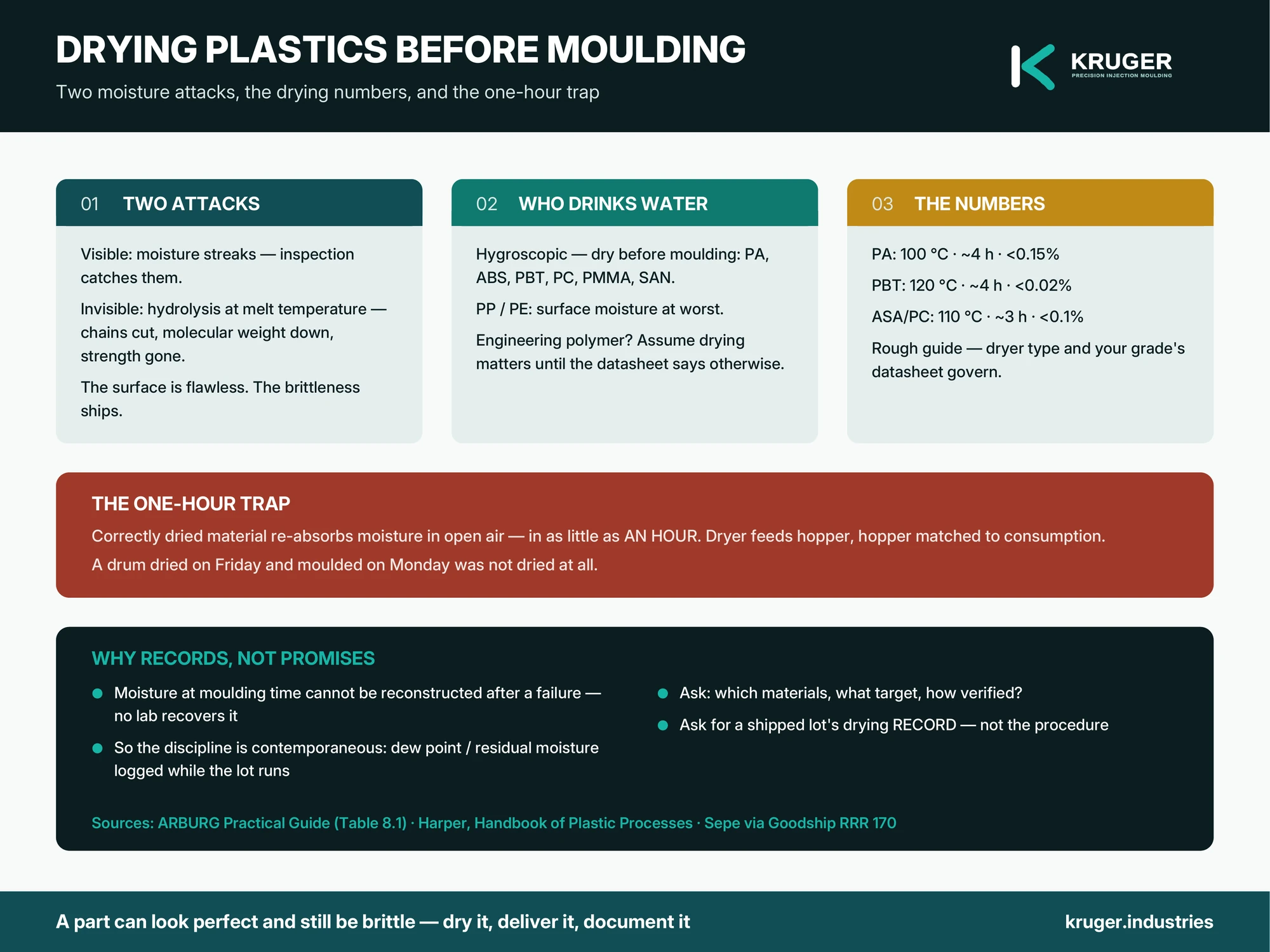
The visible attack is cosmetic: water turning to steam in the melt drags silvery moisture streaks across the surface — one of the five streak kinds the troubleshooting literature classifies, and the easy one, because inspection catches it. The invisible attack is chemical. Melt a hygroscopic polymer with moisture still inside it and hydrolysis takes place at melt temperature: the reaction cuts the polymer chains, molecular weight falls, and the part’s physical properties fall with it (Harper). The surface can be flawless. The brittleness ships. A moulder who treats drying as a cosmetic fix — “dry it if it streaks” — has solved the attack you can see and left the one you can’t.
Which materials drink water
The hygroscopic list covers most of technical moulding: nylons (PA), ABS, PBT, PC, PMMA, SAN and cellulosics all absorb water into the granule itself and must be dried before moulding (Arburg). The polyolefins — PP and PE — carry surface moisture at worst, which is why commodity moulders can be casual about dryers and technical moulders cannot. If your part is in an engineering polymer — and on this site’s materials guide most of them are — assume drying matters until the datasheet says otherwise.
The numbers — and where the full table lives
The machine-maker guidance is specific. Nylon dries at about 100 °C for around 4 hours, to below 0.15% residual moisture. PBT is the cautionary tale: 120 °C, around 4 hours, to below 0.02% — one-fiftieth of one per cent, because PBT hydrolyses aggressively. ASA/PC blends: about 110 °C for 3 hours, to below 0.1% (Arburg, Table 8.1). Two honest caveats come with the numbers, straight from the same source: the table is a rough guide, because drying time depends on the dryer type — and your specific grade’s datasheet always governs. The full working table, with melt and mould temperatures alongside, lives on our temperature chart.
The one-hour trap
Drying is not a state, it is a countdown. Correctly dried material left exposed to the atmosphere begins to re-absorb water — even when left for just an hour, depending on conditions and material (Arburg). That single sentence explains two fixtures of a disciplined shop: dryers that deliver material straight to the machine hopper, and hoppers that are never overloaded with hygroscopic material, so granules are consumed before they can re-wet. A drum of nylon dried on Friday and moulded on Monday was not dried at all.
Why you cannot audit it afterwards
Here is the uncomfortable part for a buyer. When a moulded part fails in service, the failure analysis literature is blunt: reconstructing the moisture content of the raw material at the time the part was moulded is not possible — no laboratory can recover that number after the event (Sepe). Drying is therefore a contemporaneous-records discipline: dew-point or residual-moisture checks logged while the lot runs, or nothing. That is why drying records belong in the same conversation as the quality paper trail — and why “we dry everything, don’t worry” is an answer that should worry you.
Five questions that reveal a drying culture
- Which of my materials do you dry, at what temperature and time, and to what residual moisture target?
- What kind of dryers, and how is dryness actually verified — dew point, moisture analyser, or assumption?
- How is hopper loading matched to consumption, so dried granules don’t sit re-wetting in open air?
- What happens to dried material during a machine stoppage — back to the dryer, or into the next shot?
- Show me drying records for a lot you shipped last month. Not a procedure — a record.
Moulded dry, on record
Kruger Industries moulds dried, documented engineering polymers — the same discipline this guide teaches you to demand of any moulder, ours included. Ask us these five questions with your RFQ. Request a quote; an engineer replies within 48 hours on working days.