
/ KNOWLEDGE · SOURCING
Battery containers by injection moulding — what the application demands
A battery container spends its whole service life holding lead plates and dilute sulphuric acid, through charge-cycle heat, handling shocks and stacking loads — and it must come out of the mould flat enough for a lid to be heat-sealed onto it. For a commodity-looking box, it is one of the hardest-working mouldings in industry. It is also home ground for us: we mould containers and lids for our own group’s battery factories — the most demanding kind of customer, because they own the warranty on everything that goes inside. The commercial capability lives on our battery containers page; this page is about what the application actually demands, from anyone who moulds it.
Why the trade moulds them in polypropylene
The material answer is so settled that the reference books use it as their default example: Rosato’s mould-engineering chapter illustrates side-core action with a schematic captioned simply “battery case molded of PP”, and the Arburg/Goodship guide’s table of common thermoplastics lists “battery casings” among polypropylene’s applications. The reasons are the polymer class itself. PP is semi-crystalline — the class the handbook characterises by good chemical resistance, bought at the price of higher shrinkage (Rosato) — and it shows “no tendency to stress crack formation” (Goodship/Arburg §6.3.3), which matters in a part that lives under load in a chemical environment. Our thermoplastics guide explains what semi-crystalline means for your drawing.
Straight homopolymer PP has a catch: its impact resistance “falls off sharply” toward cold (Goodship/Arburg). A battery container’s design case is a drop or a knock in an unheated warehouse in January. That is why “there are also copolymers with ethylene, to increase impact resistance below 0 °C” (Goodship/Arburg §6.3.3) — and why Harper’s applications history names polypropylene copolymer, specifically, for batteries. So the buyer’s first specification question is not “PP?” but “which PP” — homopolymer or ethylene copolymer, which grade, whose datasheet. How to read that datasheet is its own guide.
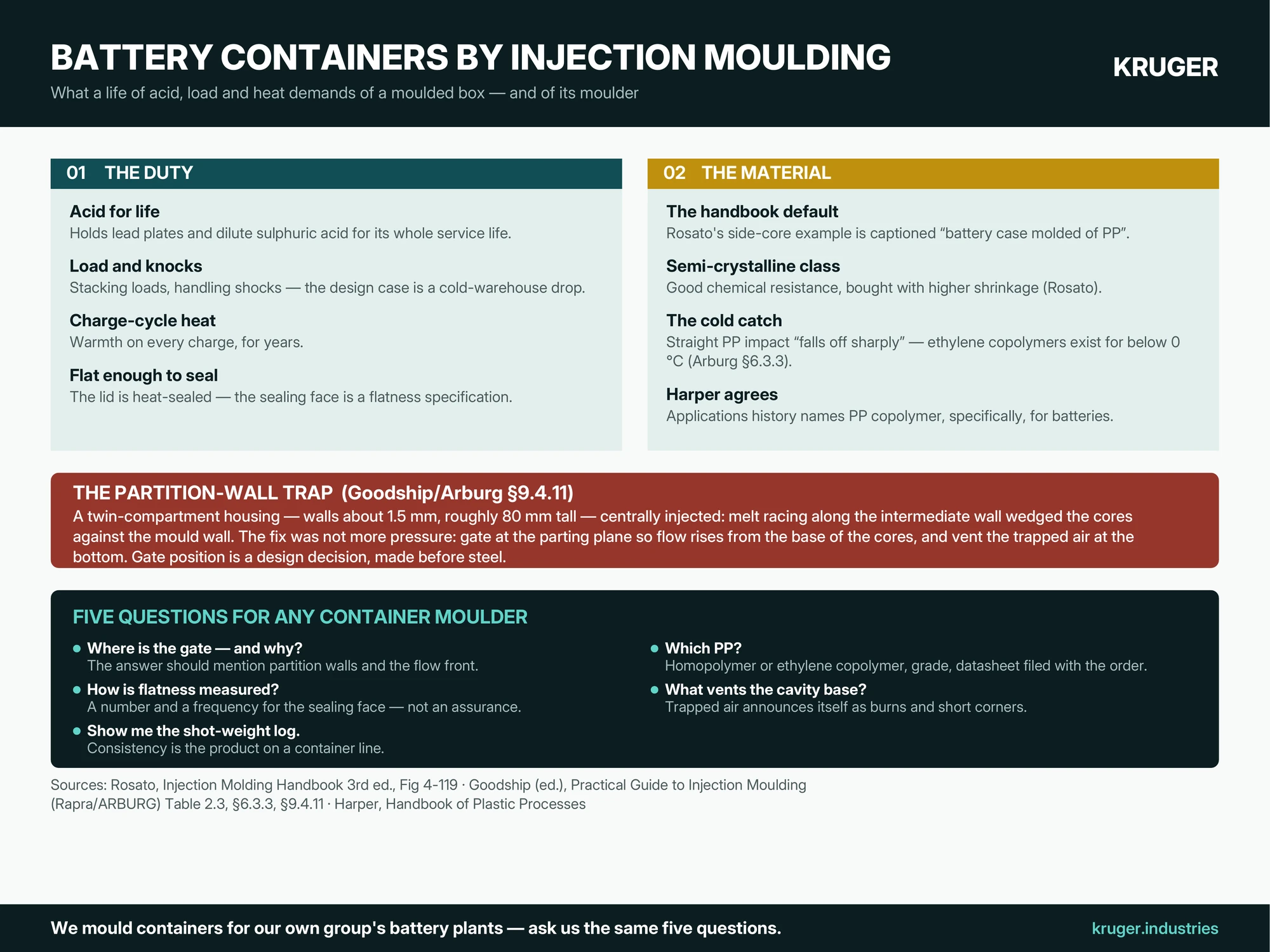
The partition-wall trap — a case study from the literature
A battery container is not one box; it is several cells sharing thin internal walls, formed by tall cores standing in the mould. The Arburg/Goodship guide devotes a worked case study (§9.4.11) to exactly this part: a twin-compartment battery housing with walls and intermediate wall of about 1.5 mm, roughly 80 mm tall, centrally injected through a rod runner. During injection, melt racing along the intermediate wall produced “a strong wedge effect” that pressed the cores hard against the external mould wall — cores machined from a single unit, still displaced by the flow. The cure was not more pressure. It was moving the injection point to the parting plane, so the compound arrived at the base of the cores and rose as a uniform flow front that no longer pushed them anywhere — plus air-venting plungers at the housing base to release the trapped air.
That is the single most useful thing a buyer can know about this part family: in a multi-cell box, gate position is a design decision, made before steel is cut — not a toolmaker’s afterthought. It belongs in the same conversation as walls, ribs and draft — the design-for-mouldability rules — and it is one of the things a mould’s construction either provides for or forever lacks. Starved corners, burn marks at the base and displaced walls are all written up in the defects guide; in this part family they are usually gate-and-venting stories, not machine stories.
Flat enough to seal
The lid is heat-sealed to the container, so the sealing face is a flatness specification, not a suggestion. Everything semi-crystalline shrinkage can do — more shrinkage than amorphous materials, more in the flow direction, sensitive to cooling — it will try to do across a deep box with internal walls. The countermeasures are unglamorous and decisive: uniform wall policy, cooling the tool evenly, and cutting the cavity to the grade’s real shrinkage — the shrinkage calculator shows the arithmetic, and the tolerances guide says what flatness a moulding can honestly hold. A container moulder should be able to tell you how the sealing face is measured, and how often.
The numbers a box this size demands
A container’s projected area — box plus partitions — sets the clamp it needs; run yours through the clamping-force calculator and you will know which of a moulder’s machines the job honestly fits. And because containers run in long series for years, consistency outranks brilliance: the machine-audit standard we publish in our quality paper-trail guide checks the spread of shot weights across consecutive shots for exactly this reason. A container line lives or dies by repeatability — ask to see the weight log, not the best sample.
Five questions for any container moulder
- Where is the gate, and why there? The answer should mention the partition walls and the flow front — the §9.4.11 lesson, whether or not they know the book.
- Which polypropylene — homopolymer or ethylene copolymer — and what is the cold-impact story? Grade and datasheet, filed with the order.
- How is the sealing face’s flatness measured, and how often? A number and a frequency, not an assurance.
- What is the venting design at the base of the cavities? Trapped air at the bottom of deep cells announces itself as burns and short corners.
- Can I see a shot-weight log from a production shift? Consistency is the product.
We answer those five questions every week for the battery factories inside our own group — which is the best apprenticeship a container moulder can serve. If you are specifying containers, lids, vent plugs or handles, send the drawing — an engineer replies within 48 hours on working days. And if you want the checklist for judging any moulder, not just us, it is the supplier-qualification guide.