
/ KNOWLEDGE · SOURCING
Second-sourcing a moulded part: duplicate tool, tool transfer or capacity share?
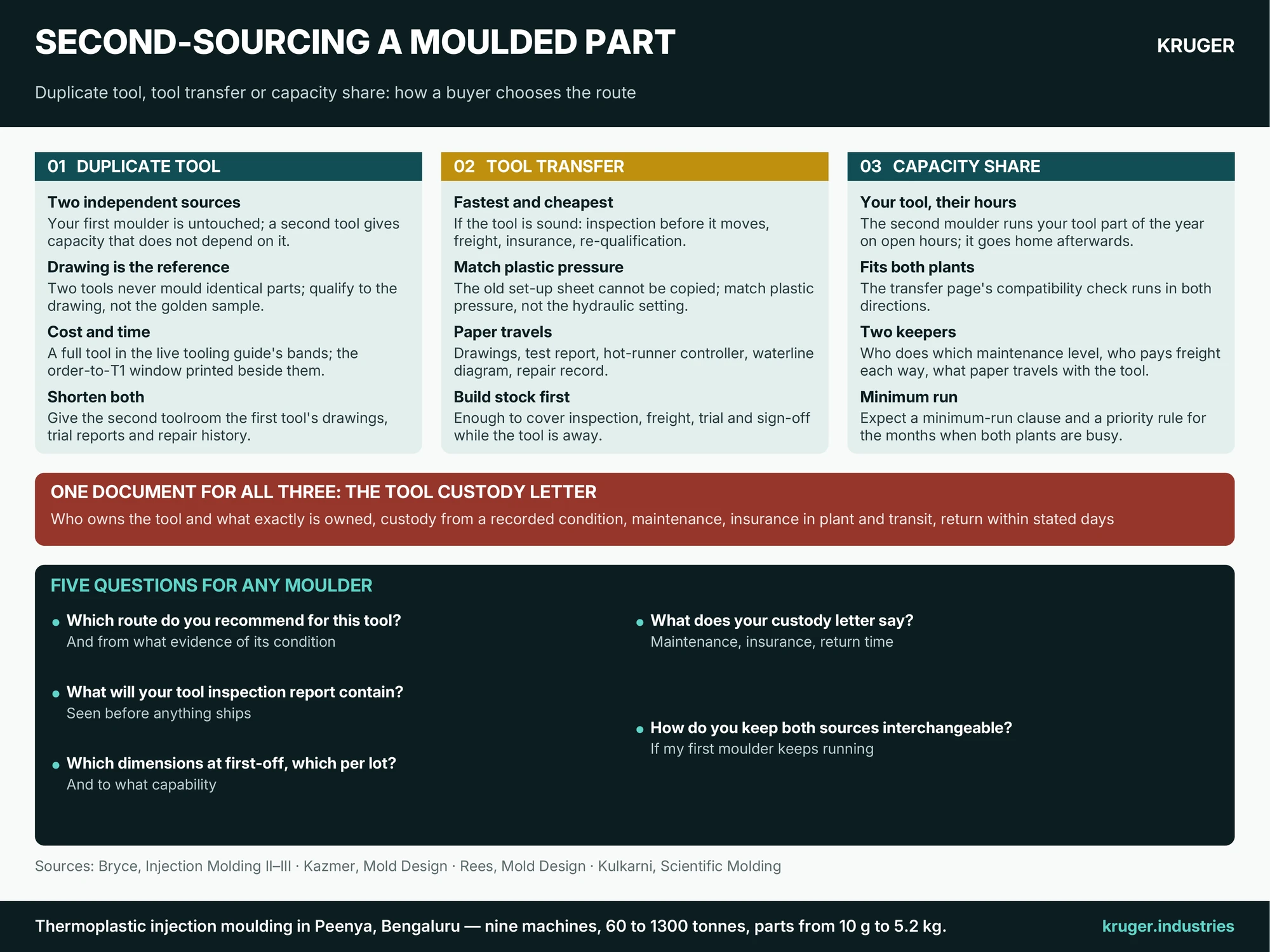
A second source for a moulded part is bought in one of three ways: a duplicate tool built at a second moulder, the existing tool moved to one, or the existing tool run part of the year on another moulder’s open machine hours. The reason is usually plain: single-source risk, a supplier in trouble, a drifted price, a plant move or a customer audit that demands dual sourcing. The move itself is on our mould transfer page and our machine hours on the spare capacity page; this page is the decision between the routes.
Route 1: a duplicate tool at the second moulder
Your first moulder is untouched; you gain two independent sources. The weakness: two tools never mould identical parts. Kulkarni’s text on scientific moulding notes that even two cavities in one mould can differ through a steel-cutting error or an oversized gate; two tools from two toolrooms, run on two presses, differ more. So the reference for the second source must be the drawing and its tolerances, not the golden sample from tool one. The cost is a full tool, in the indicative bands by tool class that our live tooling guide publishes; the time is the order-to-T1 window printed beside them. Both shrink if the second toolroom receives the first tool’s drawings, trial reports and repair history: a toolroom prices the unknowns.
Route 2: transfer the existing tool
Fastest and cheapest, if the tool is sound. The costs are a tool inspection before it moves, freight and insurance, and re-qualification on the new press: a T1 trial, a dimensional report against the drawing and a capability study on the critical dimensions. The risks are a tool in poor condition, missing paperwork and downtime while it travels. On paperwork Rees is blunt: “drawings are part of the job and must be shipped to the customer together with the mold”, with a report of the test machine, settings and resin. Kulkarni explains why the old set-up sheet cannot be copied: when a mould moves to another machine the plastic pressure, not the hydraulic setting, must be matched, or the parts flash or come out dimensionally different. A missing hot-runner controller, waterline diagram or repair record adds delay. Build stock before the tool leaves, enough to cover inspection, freight, trial and sign-off.
Route 3: capacity sharing
Here the second moulder runs your tool for part of the year on open machine hours, and the tool goes home afterwards. The hours usually exist: Bryce’s product-design volume observes that custom moulders seldom let one mould hold a press beyond about three to four months in a year. The tool must fit both plants; the transfer page’s compatibility check runs in both directions. Custody and maintenance go in writing, because the tool now has two keepers: who performs which of the maintenance levels Kazmer lists, from preventive care after every run to rebuilding, who pays the freight each way, and what paper travels with the tool. Expect a minimum-run clause and a priority rule for the busy months.
The one document all three need
A tool custody letter, however the tool is sourced. It states who owns what, the whole tool or just the inserts that run in someone else’s base; who holds it, and from what recorded condition on arrival; the holder’s maintenance duties and who approves a repair; insurance in the plant and in transit; and return, with drawings and records, within a stated number of days. Settle the first moulder’s account before the tool moves. Our ownership terms are published on the tooling guide and the written custody terms come with every offer; our maintenance and storage guide describes the care the holder owes.
The qualification plan to demand
Whichever route, the second source is qualified by four things: a first-article inspection to the drawing, signed by both sides; capability on the two or three critical dimensions, from a statistically adequate sample; a material certificate for the exact grade, not an equivalent; and an agreed cosmetic standard with reference parts, settled before the dimensions are signed off, since a part can be in tolerance and still fail on appearance. Our quality paper trail lists the records that should then travel with every lot.
When none of the three is the better buy
Sometimes the honest answer is to stay single-sourced and fix the relationship. A second source means two maintenance files, two qualification files and two prices; for a tool that runs a few weeks a year that overhead can exceed the risk it insures, and a drifted price is often better met by asking for the cost breakdown. And sometimes the tool is too worn to transfer. Bryce’s view is that a mould can in theory last forever, but that keeping an old one going can cost more than building new; rust in a cavity may need welding and refinishing. Kazmer adds that the harder a resin is on the steel it runs in, the faster the mould wears, so an old tool in glass-filled nylon deserves a harder look than one in polypropylene. A transfer of such a tool is a duplicate tool in disguise, and should be priced as one.
Five questions for any second-source moulder
- Which of the three routes do you recommend for this tool, and from what evidence of its condition?
- What will your incoming tool inspection report contain, and will I see it before anything ships?
- Which dimensions will you measure at first-off and which per lot, and to what capability?
- What does your custody letter say about maintenance, insurance and the return time?
- If my first moulder keeps running, how do you keep the two sources’ parts interchangeable?
Tell us which route you are weighing. Send the drawing, the annual volume, the tool’s age, its cavitation and photographs, and we will give you a written view and a quotation for the route that fits.
Sources quoted: D. M. Bryce, Plastic Injection Molding, Vol. II: Material Selection and Product Design Fundamentals (Society of Manufacturing Engineers, 1997); D. M. Bryce, Plastic Injection Molding, Vol. III: Mold Design and Construction Fundamentals (Society of Manufacturing Engineers, 1998); D. O. Kazmer, Injection Mold Design Engineering (Hanser, 2007); H. Rees, Understanding Injection Mold Design (Hanser, 2001); S. Kulkarni, Robust Process Development and Scientific Molding, 2nd ed. (Hanser, 2017).