
/ KNOWLEDGE · QUALITY
Cp and Cpk in injection moulding — how to read a moulder’s capability claim
A tolerance on the drawing is a request; a capability index is evidence that a process can meet it. Buyers increasingly write a Cpk figure into the order, and moulders increasingly quote one back. The number is only as useful as the details behind it: what was measured, how many parts, and which floor the contract names. This page explains Cp and Cpk in plain terms, why the same figure can be earned two ways, and five questions that make a capability claim worth trusting. It pairs with our tolerances guide, which says what a moulded part can be asked to hold; this page is about checking that a moulder holds it.
Two numbers, two questions
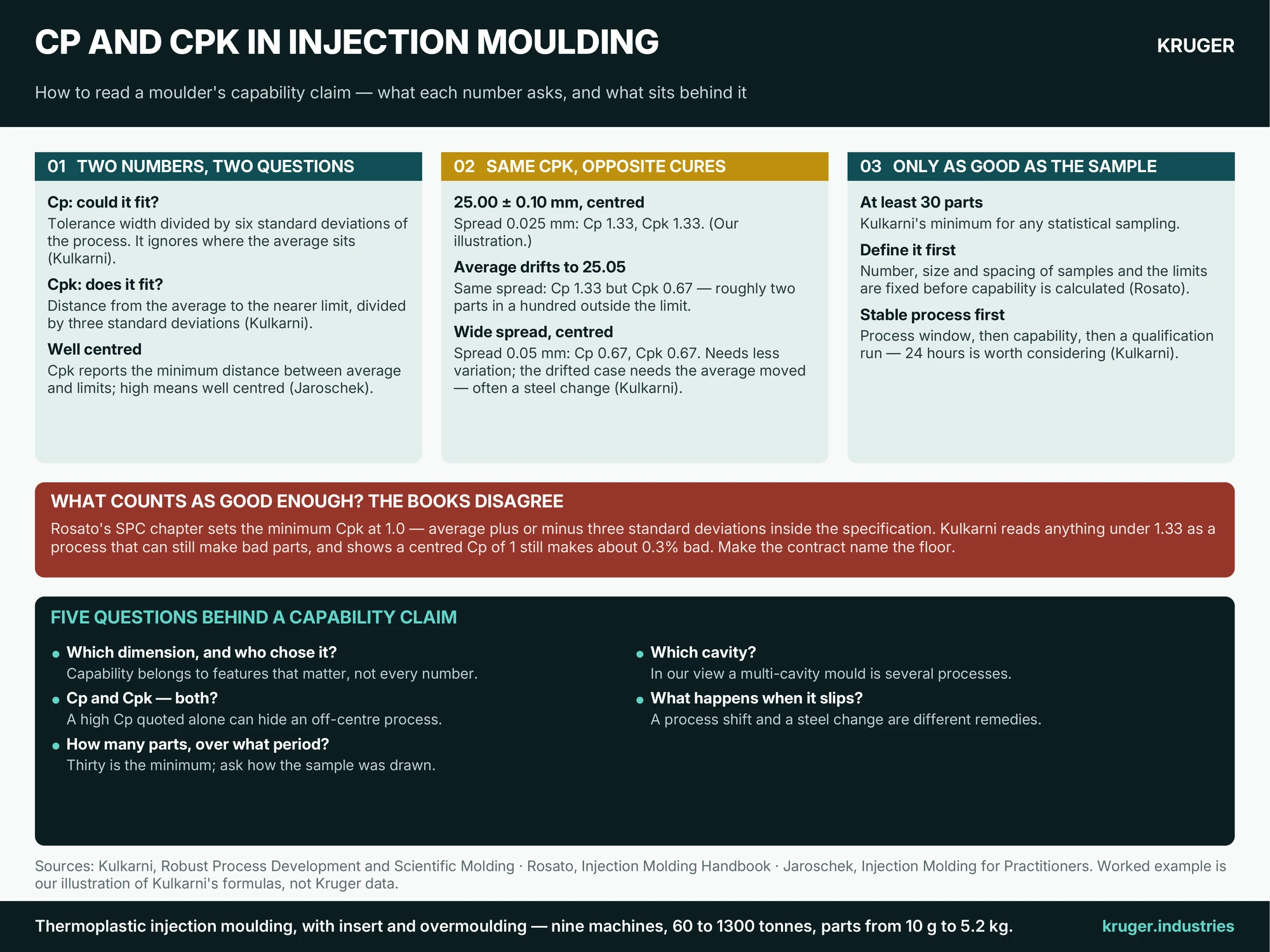
Kulkarni defines the capability index, Cp, as the width of the tolerance band divided by six standard deviations of the process — the spread that contains practically every part. Cp ignores where the average sits. Cpk, which he calls process capability, takes the distance from the average to the nearer limit and divides it by three standard deviations. Cp asks whether the process could fit the window; Cpk asks whether it does, where it currently runs. Jaroschek frames Cpk the same way: it reports the minimum distance between the average and the limits, so a high value marks a well-centred process.
| Process (feature 25.00 ± 0.10 mm) | Average | Cp | Cpk |
|---|---|---|---|
| Centred, spread σ = 0.025 mm | 25.00 | 1.33 | 1.33 |
| Drifted, spread σ = 0.025 mm | 25.05 | 1.33 | 0.67 |
| Centred, wide spread σ = 0.05 mm | 25.00 | 0.67 | 0.67 |
Rows two and three share a Cpk and need opposite cures. For a high Cp with a low Cpk, Kulkarni advises leaving a robust process alone and moving the average — in moulding, often a steel change in the cavity. A wide spread, by contrast, needs the variation itself reduced.
What counts as good enough
Kulkarni shows that a centred process with a Cp of exactly 1 still makes about 0.3 per cent bad parts, and reads a Cpk below 1.33 as a process that can still make unacceptable parts where it currently runs. Rosato’s chapter on statistical process control sets the minimum at a Cpk of 1.0 — the average plus or minus three standard deviations inside the specification. Two respected books, two floors. “Capable” therefore means whatever number the contract names, so write it down, and for a feature that matters, ask for the higher one.
A capability figure is only as good as its sample
Kulkarni gives 30 parts as the minimum acceptable sample for any statistical sampling. Rosato requires the number, size and spacing of the samples, and the specification limits, to be fixed before a capability figure is calculated; his worked example draws its samples from 300 shots. Capability also assumes a stable process. Kulkarni’s order is process window first, then capability, then a qualification run — 24 hours is what he suggests considering for a mould that will run most of the year — with the parts quarantined until the data has been checked. Once production runs, Kulkarni’s statistical process control keeps Cpk in view for the critical dimensions and tracks machine outputs such as cushion, fill time and cycle time against control limits, which flag a drift early, while the parts are still good and nobody has yet scrapped or shipped a bad one.
Five questions behind a capability claim
- Which dimension, and who chose it? Capability belongs to a feature that matters, not to every number on the drawing.
- Cp and Cpk — both, or one? A high Cp quoted alone can hide an off-centre process.
- How many parts, over what period? Thirty is Kulkarni’s minimum; ask how the sample was drawn.
- Which cavity? In our view a multi-cavity mould is several processes, so ask for the figure cavity by cavity.
- What happens when it slips? A process shift and a steel change are different remedies; the answer shows whether the moulder knows which one it faces.
Our quality paper trail guide lists the records that should travel with a lot, and the guide to how many cavities explains why a precision feature can push towards fewer of them. The RFQ guide shows where the capability requirement belongs in the enquiry. Send the drawing, mark the two or three features that matter, and ask us these five questions.