
/ KNOWLEDGE · SOURCING
How to compare injection moulding quotations line by line: a buyer’s guide
Two quotations for the same moulded part rarely line up, and the lowest piece price is rarely the cheapest buy. Before you compare anything, put every quotation on one basis. Kazmer’s mould-design text describes the moment: one drawing goes to several suppliers, the mould prices come back several-fold apart, and the right response is to ask what sits behind each number, because the dearer mould may buy better materials and workmanship, a faster cycle and a longer life. Rosato’s handbook explains part of the spread: many estimators skip scrap, colourant and set-up time and add a fudge factor, so an incomplete quotation can look cheap. This page does not rebuild the arithmetic; our guide to what a moulded part costs does that, and the part-cost calculator runs it.
The material line
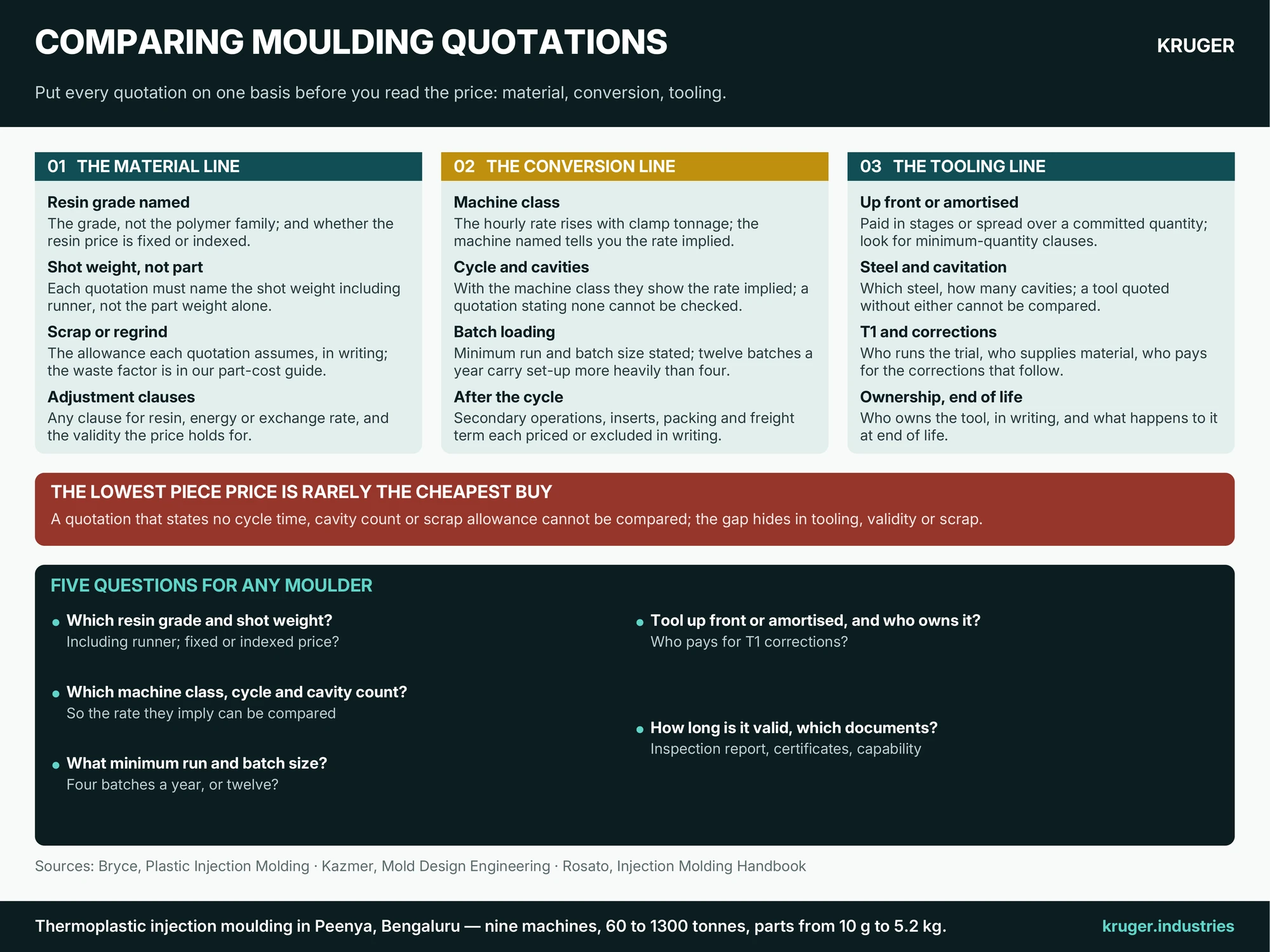
Make each quotation name the resin grade, not the polymer family; the shot weight including runner, not the part weight alone; the scrap or regrind allowance; and whether the resin price is fixed or indexed. The waste factor and the regrind clauses are in our part-cost guide; for comparison you need the scrap or regrind allowance each quotation assumes, in writing.
The conversion line
Conversion is the machine’s share, and the hourly rate rises with clamp tonnage. A quotation that states machine class, cycle time and cavity count has told you the rate it implies; one that states none of them cannot be checked. Then the loading: the minimum run and batch size, since twelve batches a year carry set-up more heavily than four. After the cycle come secondary operations, inserts, packing and the freight term, each priced or excluded in writing, packing method included.
The tooling line
This is where a low piece price most often hides its recovery, so read it hardest. Is the tool paid up front, in stages or amortised, and over what committed quantity? Who owns it, in writing? Which steel, and how many cavities? Kazmer’s mould-cost chapter adds two things: repeated cavity sets get cheaper, about 15 per cent per doubling up to sixteen, so four cavities should not cost four times one; and a vertically integrated supplier that takes a development fee up front and then a per-part fee protects itself with minimum quantities and schedule-change fees. Who runs the T1 trial, who supplies trial material, who pays for the corrections that nearly always follow? The SPI Moldmakers Division quotation guide in Rosato’s handbook settles these fields (cavity count against drawing revision, steel hardened or pre-hardened, clamp tonnage, who designs, tries out and supplies trial material), holds for thirty days and is tied to the drawing submitted. Ask what happens to the tool at end of life. Our tooling guide and mould-cost page carry the published bands and what a tooling quotation should itemise; how many cavities covers the volume arithmetic.
Validity, terms and the documents included
A quotation is an offer with a life. Note its validity, its payment terms, including when the tool is paid for, and any adjustment clause for resin, energy or exchange rate. Then the documents: does the price include a first-article inspection report, material certificates per lot, a certificate of conformance, capability data on the dimensions that matter? The quotation that includes the paper is pricing work the silent one has left for later. Our quality paper trail guide lists what to specify.
Red flags
- Bryce’s product-design volume treats a supplier that habitually bids well outside the range of comparable moulders, high or low, as one that may have misread the job or be unable to estimate it, and separates a non-binding budgetary figure from a formal quotation; know which you hold.
- Validity too short to finish the comparison, or a resin price indexed with no stated base. The number you compare is not the number you will pay.
- No drawing revision or freight term named. Prices built on different drawings or delivery points do not compare.
- A tool quoted without steel grade or cavitation. You cannot compare it, or know what you would own.
When the higher quotation is the cheaper buy
Illustrative, with no currency: quotation A is a tenth below quotation B, states no cycle or cavity count and no scrap allowance, quotes “steel” without a grade and holds for two weeks. B names a four-cavity pre-hardened tool with its cycle time, carries a scrap allowance, includes a first-article report and lot certificates, and holds for ninety days. Run B’s cycle and cavities with A’s price through the calculator: the hourly rate A implies shows where the gap hides. The reverse also holds: for a short programme at modest volume, a softer, cheaper tool with a shorter life can be the right buy, and we will say so.
Five questions for any moulder
- Which resin grade and shot weight, runner included, and is the resin price fixed or indexed?
- Which machine class, cycle and cavity count, so the rate they imply can be compared?
- What minimum run and batch size, and how does the price move between four batches a year and twelve?
- Is the tool paid up front or amortised, who owns it, and who pays for T1 corrections?
- How long is the quotation valid, and which documents travel with the parts?
Send us the drawing, the annual volume and the quotation you already hold, and we will quote with the arithmetic visible: tooling and part price separated, cycle and cavitation stated, the assumed volume written down (tooling built by partner toolrooms under our design authority and proved on our machines), with validity, terms and the documents included. Our RFQ guide lists what to attach.
Sources quoted: D. M. Bryce, Plastic Injection Molding, Vol. I: Manufacturing Process Fundamentals (Society of Manufacturing Engineers, 1996); D. M. Bryce, Plastic Injection Molding, Vol. II: Material Selection and Product Design Fundamentals (Society of Manufacturing Engineers, 1997); D. O. Kazmer, Injection Mold Design Engineering (Hanser, 2007); D. V. Rosato, D. V. Rosato and M. G. Rosato (eds), Injection Molding Handbook, 3rd edition (Kluwer Academic Publishers, 2000).