
/ KNOWLEDGE · PROCESS
Plastic moulding processes compared — which one your part actually needs
Plastic moulding processes are chosen by the part’s shape first and its volume second — and injection moulding, for all its reach, is the right answer to only some of them. Rosato’s handbook lists what drives the choice: the material, the properties the part needs, process cost, speed and quantity. Goodship’s Arburg guide adds a caveat: “For some components, there may be more than one suitable process route.” Kruger runs thermoplastic injection moulding, including insert and overmoulding, and none of the others here — we say so where it matters.
The shape decides first
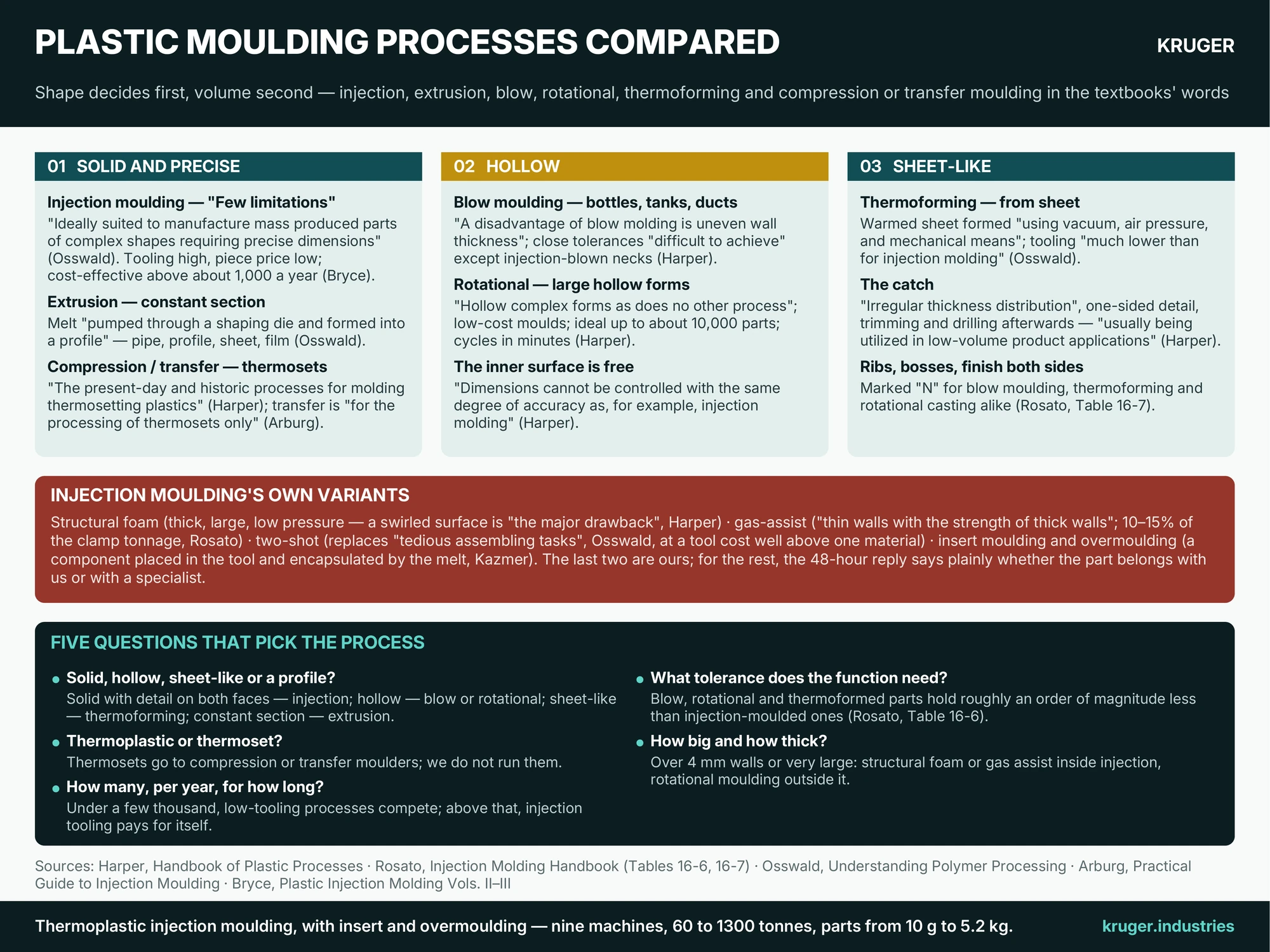
Rosato’s process-selection table sorts every method by the shape it can produce: injection moulding with hardly any restriction on form; blow and rotational moulding for hollow parts; extrusion for a cross-section that never changes; thermoforming and compression moulding for parts formed in one plane. His companion table says what is ruled out: blow moulding, thermoforming and rotational casting cannot form ribs or bosses, or finish both faces well. Rosato on short runs: “For small quantities, competing processes include thermoforming, compression molding, rotational molding, casting, and stampable reinforced plastics”; for long runs the field narrows to injection moulding, extrusion feeding thermoforming, and blow moulding. Bryce’s rule of thumb: injection moulding is “cost-effective when the required annual quantities are more than 1,000 units”.
Process by process, in the books’ words
Injection moulding. Osswald calls it “ideally suited to manufacture mass produced parts of complex shapes requiring precise dimensions”. Harper’s rule of thumb keeps walls under about 4 mm, sending thicker sections to the variants below; the process guide walks the cycle. Extrusion. Osswald describes it as pumping polymer melt through a die into a continuous profile — sheet, film, tube or any other section; its sheet feeds thermoforming. Blow moulding. Harper’s handbook treats blow moulding as the route to hollow thermoplastic objects — bottles, tanks, ducts — with two built-in limits: uneven walls, and tolerances hard to hold except on injection-blow-moulded bottle threads. Rotational moulding. Harper says it “lends itself to hollow complex forms as does no other process”, and suits runs up to roughly 10,000 parts because moulds and machines are simple and cheap. The price is precision and time: Harper names tolerance control, surface finish and stiffness as its usual difficulties, since the inner surface forms freely, and cycles run to minutes. Thermoforming. Osswald describes it as heating a sheet and drawing it into a cavity or over a tool by vacuum, air pressure or mechanical force, with tooling far cheaper than an injection mould. Osswald’s catch is uneven thickness across the part; add one-sided detail and trimming afterwards, and Harper finds it mostly used at low volume, asking outright: “But are you in the right process?” Compression and transfer moulding. Harper’s handbook presents these as the thermoset processes, historic and current — phenolics, melamines, epoxies, SMC. Transfer, Harper explains, holds tighter tolerances because the mould is clamped shut, metal to metal, before the material flows in; Goodship’s Arburg guide reserves it for thermosets. A thermoset part belongs here, not with us — see the thermoplastic-vs-thermoset guide.
| Process | Makes | Shape rule (Rosato) | Tooling and volume (per the books) | Tolerance, ± (Rosato Table 16-6) | Kruger runs it? |
|---|---|---|---|---|---|
| Injection moulding | Solid precision parts, features both faces | Almost any shape | Tooling high, piece price low; over ~1,000/yr | 0.001 in. | Yes — thermoplastics |
| Extrusion | Pipe, profile, sheet, film | Uniform cross-section only | Die tooling; continuous lengths | 0.005 in. | No |
| Blow moulding | Bottles, tanks, ducts | Hollow forms | Uneven walls; injection blow for precise necks | 0.01 in. | No |
| Rotational moulding | Large hollow forms, tanks | Hollow forms | Low-cost tooling; up to ~10,000 parts; long cycles | 0.01 in. | No |
| Thermoforming | Trays, liners, enclosures from sheet | Formed in one plane | Least expensive tooling; low volume; trimming after | 0.01 in. | No |
| Compression / transfer | Thermoset parts, SMC panels | Formed in one plane / simple shapes | Thermosets; transfer closer tolerances than compression | 0.001 in. | No — thermoplastics only |
Injection moulding’s own variants
Structural foam adds a blowing agent to mould thick, large parts at low pressure in cheaper tooling, at the cost of a swirled surface that Harper singles out as its main drawback. Gas-assisted moulding cores out thick sections with nitrogen, giving, in Harper’s account, thin-walled parts as strong as thick ones. Two-shot or multi-component moulding injects two materials in sequence; Osswald sees its purpose as doing away with assembly, at a tool cost well above a single-material mould. Insert moulding and overmoulding place a component in the tool and mould around it; Kazmer defines it as a separate component set inside the mould and then encapsulated, wholly or in part, by the injected plastic — see the overmoulding guide. These two are ours: a vertical machine runs insert-moulded connectors and similar overmoulded parts every working day. For the rest, the 48-hour reply says plainly whether the part belongs with us or a specialist.
Five questions that pick the process
- Is the part solid, hollow, sheet-like or a profile? Solid with detail on both faces → injection; hollow → blow or rotational; sheet-like → thermoforming; constant section → extrusion.
- Thermoplastic or thermoset? Thermosets go to compression or transfer moulders; we do not run them.
- How many, per year, for how long? Under a few thousand, low-tooling processes compete; above that, injection tooling pays for itself — the advantages guide prices the crossover.
- What tolerance does the function need? In Rosato’s table, blow, rotational and thermoformed parts hold roughly an order of magnitude less than injection-moulded ones.
- How big and how thick? Over 4 mm walls or very large: structural foam or gas assist within injection, or rotational moulding outside it — our large-part guide and wall-thickness guide put numbers on both.
If the answers point to a solid thermoplastic part with features on both faces, made in thousands or millions, it is an injection-moulded part — and nine machines from 60 to 1300 tonnes, for parts from 10 g to 5.2 kg, are the window we can offer it (see the machine guide). If they point elsewhere, we will tell you where. Send the drawing; an engineer replies within 48 hours on working days, starting with which process the part needs.
Sources quoted: V. Goodship (ed.), Practical Guide to Injection Moulding (Arburg / Rapra Technology, 2004); C. A. Harper (ed.), Handbook of Plastic Processes (Wiley, 2006); D. V. Rosato, D. V. Rosato and M. G. Rosato, Injection Molding Handbook, 3rd ed. (Kluwer Academic, 2000); D. M. Bryce, Plastic Injection Molding, Vol. III (Society of Manufacturing Engineers, 1998); T. A. Osswald, Understanding Polymer Processing, 2nd ed. (Hanser, 2017).