
/ KNOWLEDGE · TOOLING
Mould design review — what to check on the drawing before steel is cut
A mould is cheapest to change while it is still a drawing. Once the steel is cut, the same change costs machining, a new insert or a weld repair, and Bryce notes that welding can shorten a mould’s life because of the stresses it leaves behind. The design review is therefore the buyer’s best moment of influence in a tooling project, yet many buyers either skip it or sign without knowing what to look for. This page shows where the review sits in the schedule, what a non-specialist can verify on a mould drawing, and five questions to put to any toolmaker or moulder. It sits beside our tooling guide, which explains what a mould is and who owns what, and the guide to mould types.
Where the review sits
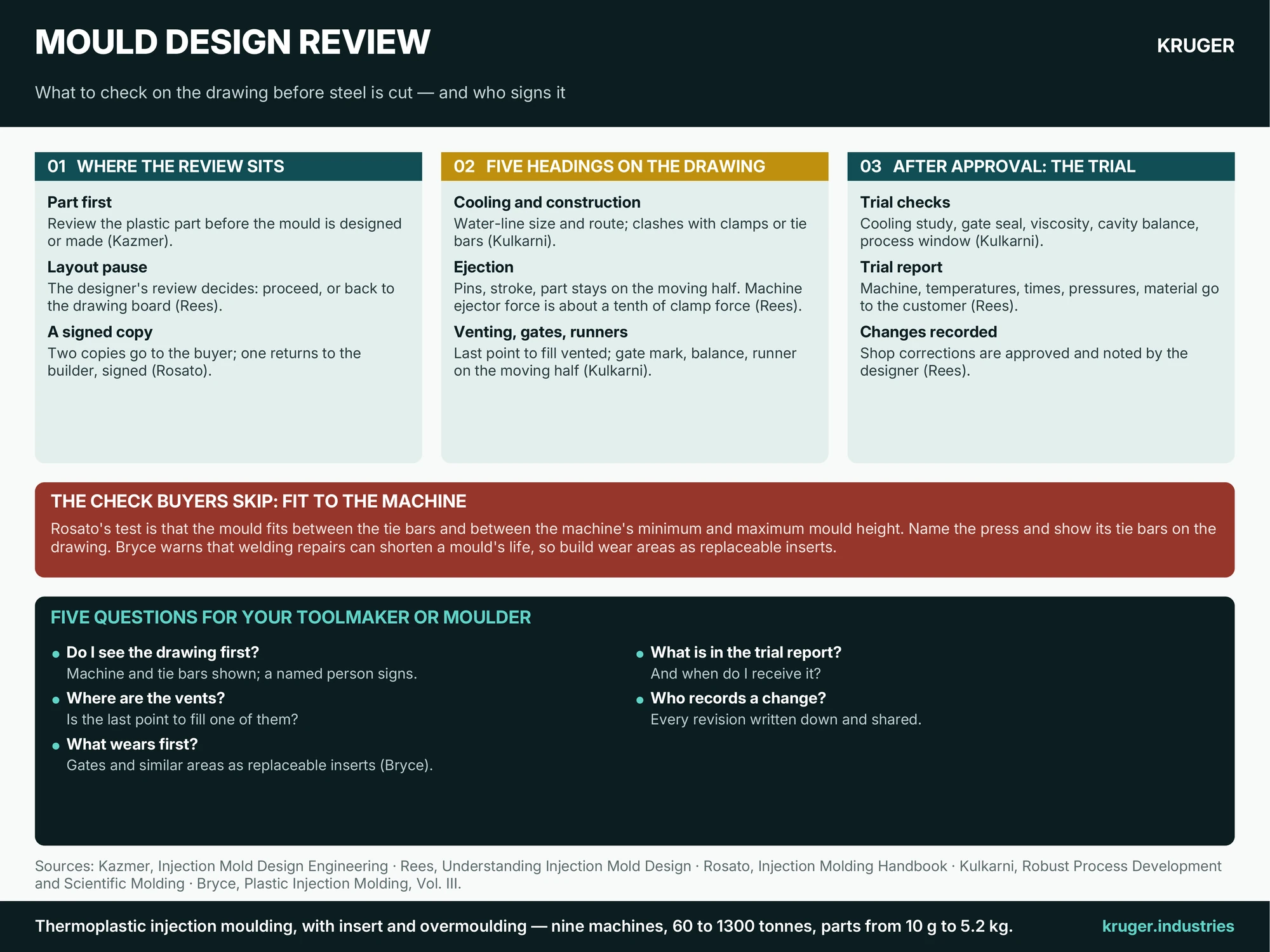
Kazmer puts a review of the plastic part first: it should happen before the mould is designed or made, because the part’s geometry decides much of what the mould must do. The mould layout follows. Rees, who writes for mould designers, treats the finished layout as a deliberate pause for a design review and says its outcome decides whether to proceed or go back to the drawing board; new ideas, he adds, often come out of the meeting and can give a better mould at a lower cost. Rosato describes the formal end of the process: once the design is complete, two copies go to the mould buyer, one for the buyer’s file and one returned to the builder with an approval signature. That signature is the gate. Ask to receive the drawing in time to read it, and ask who signs.
What you can verify without being a toolmaker
Kulkarni’s mould design review appendix groups its questions under five headings: cooling, construction, ejection, venting, and gates and runners. They give a buyer a map of the drawing.
- Fit to the machine. The press the mould is meant for should be named, with its tie bars shown. Rosato’s test is that the mould fits between the tie bars and also between the machine’s minimum and maximum mould height. Our guide to the injection moulding machine covers the platen arithmetic.
- Ejection. Look for enough pins of adequate size, enough ejector stroke to clear the part, and a layout that keeps the part on the moving half as the mould opens (Rosato, Kulkarni). Rees notes that a machine’s ejector force is usually about a tenth of its clamp force, which suits most moulds but not all; deep or tight parts may need extra ejection built into the tool.
- Cooling. Ask where the water lines run, how large they are, and whether they clash with clamps or tie bars (Kulkarni).
- Venting. Kulkarni asks whether the last point to fill is vented, and whether corners, ribs, bosses, deep pockets and runners are too. The cost of getting it wrong shows up later: Bryce explains that blocked vents force higher injection pressure, which can flash the mould and damage it.
- Gates and runners. Check the gate size, where the gate mark will fall on the part, whether the runner is balanced and whether it stays on the moving half (Kulkarni, Rosato). Our guides to gate design and the sprue, runner and gate explain the choices.
The trial is the second checkpoint
A drawing cannot show how a mould behaves. Kulkarni’s mould qualification checklist asks whether a cooling study, a gate seal test, a viscosity test, a cavity balance check and a process window study have been done, alongside cycle time, venting and water flow. Rees adds a duty of record: any correction made in the shop should be approved and noted by the designer, so that a repeat order does not repeat the mistake, and a complete trial report — test machine, temperatures, times, pressures and material — should travel to the customer with the mould. If you own the mould, that report is part of what you own.
Five questions for your toolmaker or moulder
- Do I see the drawing before steel is cut? With the intended machine and tie bars shown, and a named person signing.
- Where are the vents? Is the last point to fill one of them?
- Which areas will wear first? Bryce advises that, for high volumes, vulnerable areas such as gates be built as replaceable inserts, which costs more at the build and less over the mould’s life.
- What will the trial report contain, and when do I receive it?
- Who records a change? If the review alters the drawing, the revision should be written down and shared.
Our mould cost guide covers the money side of these choices. Send the part drawing and we will go through these questions with you before any tooling decision is made.