
/ KNOWLEDGE · DESIGN
Specifying glass-filled nylon fan blades, housings and HVAC parts for a quotation
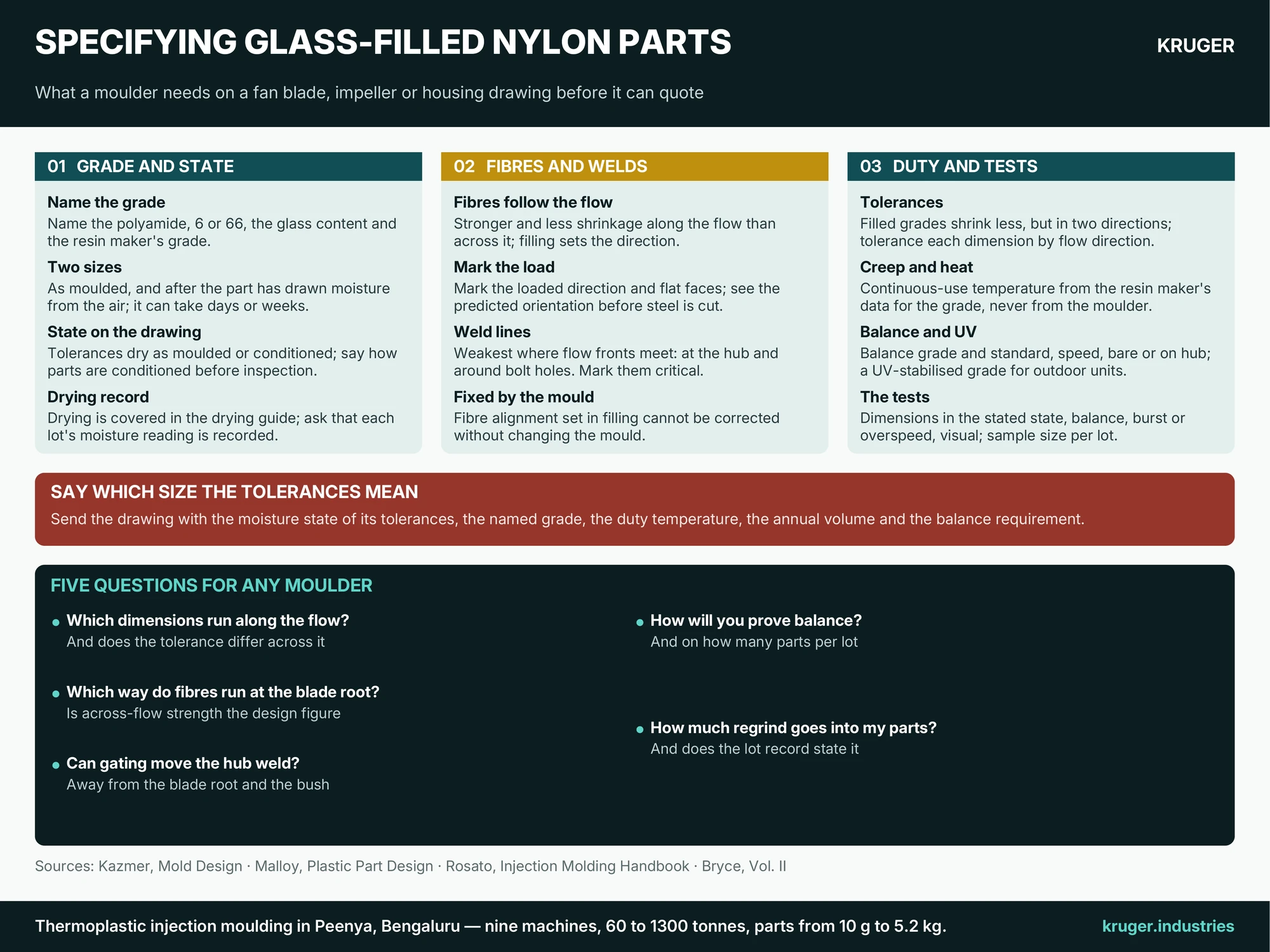
A glass-filled nylon part has two sizes: the one it leaves the mould with, and the one it settles to after drawing moisture from the air. A drawing that does not say which size its tolerances mean cannot be quoted, merely guessed at. Here is what a moulder needs to quote a blade, impeller, housing or bracket in it. Our HVAC and refrigeration page lists what we mould for the sector; our nylon guide covers the material.
Grade and moisture state
Name the polyamide, 6 or 66, the glass content and the resin maker’s grade. Rosato’s handbook sizes a nylon 66 cavity backwards from the part’s dimensions in service, at its duty temperature and humidity, because the part grows after moulding. Malloy’s part-design text notes that standard shrinkage data are taken after two days’ conditioning at set temperature and humidity, and that a dried nylon part swells for days or weeks before it reaches equilibrium. So the drawing must name the state its tolerances hold in, dry as moulded or conditioned, and the conditioning routine parts go through before anyone measures them. Drying before moulding is in our drying guide; ask that each lot’s moisture reading is recorded.
Fibres, gate and flatness
Glass fibres line up with the flow (our composites guide explains why a filled part is stronger and shrinks less along the flow than across it); Kazmer’s mould-design text adds that filling analysis can steer the flow direction on glass-filled grades, and with it orientation, strength and shrinkage. On a blade root under cyclic load, the across-flow figure matters. Jaroschek’s practitioner text warns that the fibre alignment the injection process sets cannot be corrected without changing the mould. So mark the loaded direction and the flat faces, and see the predicted orientation before steel is cut. Osswald’s processing text names gate number and position as the warpage levers once the resin is fixed (our warpage guide).
Weld lines at hub and holes
Where flow fronts meet, at the hub of a multi-gated blade or around every bolt hole, the part is weakest. Malloy’s weld-strength table has unreinforced nylon 66 keeping most of its tensile strength across a weld and the 30 per cent reinforced grade little more than half, on a double-gated test bar and varying by grade; his rule: put welds where neither looks nor loads are critical. Jaroschek adds that a weld is weakest at the surface and may open into a notch after demoulding. Mark the hub and fastener holes as critical and ask where the welds fall; our weld-line guide covers remedies and cost.
Tolerances, creep and temperature
Filled grades shrink less, so they hold a tighter band, but in two directions: tolerance each critical dimension by its direction to the flow; the bands are in our tolerances guide. Bryce’s materials volume records that glass reinforcement generally improves creep resistance; Fried’s polymer text notes that thermoplastic matrices creep more than thermosets under sustained load. A part stiff on the bench can creep and warp at its duty temperature, in sunlight included: take the continuous-use temperature from the resin maker’s data for the named grade, never from the moulder, and put duty temperature and load on the drawing.
Balance, inserts, colour and UV
A fan or impeller passes on the buyer’s balance test. State the grade and the standard, ISO 21940-11, which replaced ISO 1940-1 (check the edition), the speed, and whether the blade is balanced bare or on its hub. We publish no balance data; put the limit on the drawing. Draw any metal hub or bush fully, with material, knurl and position tolerance; brass-bush pump impellers are quoted here for insert moulding on the vertical machine. Supply a colour master sample; for outdoor units specify a UV-stabilised grade, since Bryce states that sunlight eventually degrades virtually every plastic, black being the most effective absorber and additive absorbers depleting with age.
The tests, and on how many
List them: a dimensional report in the stated moisture state after conditioning; balance to the named grade; burst or overspeed at duty temperature if specified; visual against a signed sample, weld lines included; a material certificate for the grade; and the sample size per lot for each. A moulder who sees the tests before quoting prices the measurement rather than the argument.
When glass-filled nylon is the wrong answer
A guard or grille that must flex or snap over a shaft wants unfilled nylon or polypropylene. A flat housing whose flatness matters more than stiffness may do better in a hybrid glass-and-mineral grade, which shrinks more evenly. Where chemical resistance and cost lead, 20 per cent glass-filled polypropylene is the grade one air-filter-housing programme has run in here since 2010 for a global filtration OEM. Where the duty temperature exceeds the resin maker’s continuous-use data, or tip speed and life demand creep resistance the plastic cannot give, a die-cast aluminium blade is the better buy, and we say so.
Five questions for any moulder
- Which of my critical dimensions run along the flow, and does your tolerance differ for those across it?
- Which way will the fibres run at the blade root, and is across-flow strength your design figure?
- Can gating move the hub weld away from the blade root and the bush?
- How will you prove balance, and on how many parts per lot?
- How much regrind goes into my parts, and does the lot record state it?
Send the drawing with the moisture state of its tolerances, the named grade, the duty temperature, the annual volume and the balance requirement; we quote the tool and the piece, or say which grade or metal the part should stay in.
Sources quoted: D. V. Rosato, D. V. Rosato and M. G. Rosato, Injection Molding Handbook, 3rd ed. (Kluwer Academic, 2000); R. A. Malloy, Plastic Part Design for Injection Molding (Hanser, 1994); D. O. Kazmer, Injection Mold Design Engineering (Hanser, 2007); C. Jaroschek, Injection Molding for Practitioners (Hanser, 2024); T. A. Osswald, Understanding Polymer Processing, 2nd ed. (Hanser, 2017); D. M. Bryce, Plastic Injection Molding, Vol. II: Material Selection and Product Design Fundamentals (Society of Manufacturing Engineers, 1997); J. R. Fried, Polymer Science and Technology (Prentice Hall PTR, 1995).