
/ KNOWLEDGE · MATERIALS
Nylon (polyamide) injection moulding — a buyer’s guide
Nylon is strong, tough and hard-wearing, and it is the one common moulding material whose size and properties go on changing after the part has left the mould, because it absorbs water. Bryce counts more than a hundred types and combinations of polyamide, known for toughness, abrasion resistance, low friction and heat resistance, and names the major drawback in the same paragraph: nylons take up moisture from the air and so have poor dimensional stability. This page covers which nylon, what water does before and after moulding, how the material behaves in the machine, and five questions for any moulder. It follows our materials guide.
Which nylon?
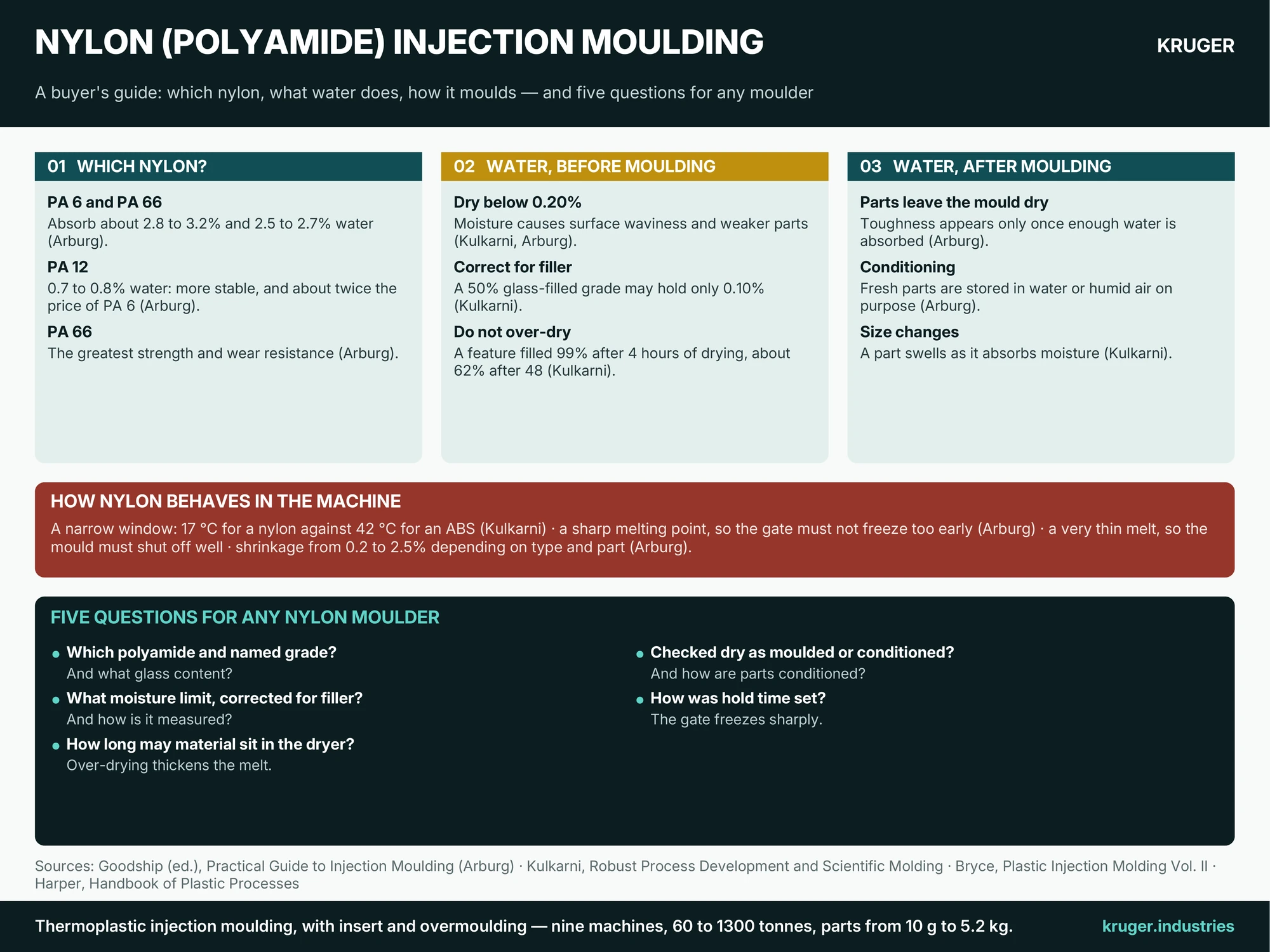
The numbers in a nylon’s name count the carbon atoms in its building blocks, and the Arburg guide shows why they matter to a buyer. PA 6 absorbs about 2.8 to 3.2% water and PA 66 about 2.5 to 2.7%, against 0.7 to 0.8% for PA 12. As the numbers rise, water uptake falls and dimensional stability improves, strength and rigidity fall slightly, and the price rises; Arburg puts PA 12 at twice the price of PA 6. PA 66 has the greatest strength and wear resistance. Arburg also states that PA 6 and PA 66 are not suited to precision components, because of their water absorption.
Water, before moulding
Arburg calls pre-drying absolutely necessary: moisture causes surface waviness and weaker parts. Kulkarni gives the working figure, that nylons typically need to be below 0.20% moisture before processing, and then two refinements that most people miss.
- Correct for the filler. Glass does not absorb water. In a 50% glass-filled grade only half the weight is nylon, so the allowable moisture is half as well, 0.10%. Kulkarni notes that datasheets often overlook this.
- Do not over-dry. Moisture also thins the melt, so there is a minimum as well as a maximum. In a study Kulkarni reports, a 15% glass-filled nylon 66 was dried for 4 hours and for 48 hours. A feature that filled 99% with the 4-hour resin filled only about 62% with the over-dried resin.
So ask for the moisture reading, not just the drying time. Our guide to drying plastics covers the equipment.
Water, after moulding
A nylon part leaves the mould dry, and dry nylon is stiffer and less tough than it will be in service. Arburg explains that typical properties such as toughness only appear once the part has absorbed enough water, so fresh parts are deliberately conditioned, by storage in water or a humid atmosphere, and adds that this matters for checking operating dimensions too. As water content rises, rigidity falls and toughness rises. Kulkarni notes the size change: a part swells as it absorbs moisture and can move outside its specification.
The practical point is that a nylon drawing needs one line most drawings lack: whether dimensions and properties apply dry as moulded or conditioned, and how parts are to be conditioned before inspection. Datasheets usually give both sets of values; our guide to reading a datasheet and the tolerances guide show where this bites.
How nylon behaves in the machine
- A narrow window. Kulkarni’s example gives a nylon a melt processing window of 17 °C, against 42 °C for an ABS. Working ranges are in our temperature chart.
- A sharp melting point. Arburg warns that the gate must not freeze too early, or holding pressure cannot do its work.
- A very thin melt. Arburg describes the flow as very good, and published vent depths for nylon are among the shallowest (Kulkarni), so the mould must shut off well.
- Shrinkage that varies widely. Arburg gives 0.2 to 2.5% depending on type and part; Harper lists 0.7 to 1.5% for nylon 6 and 1.0 to 2.5% for nylon 66. A hotter mould raises crystallinity and reduces shrinkage after moulding (Arburg).
- Short residence. Arburg asks for the shortest possible dwell time in the cylinder, because the melt oxidises and yellows if air gets in.
Glass-filled grades and other properties
Arburg notes that nylon housings, fan wheels and similar parts are usually glass-fibre reinforced, and Bryce that glass is commonly added to raise the material’s properties. Reinforcement brings its own rules, covered in our guides to polymer composites and weld lines; Harper adds that filled nylons should not be stripped over undercuts. On chemicals, Bryce reports resistance to common organic solvents except phenol and formic acid, with strong mineral acids and oxidising agents attacking slowly, and Arburg lists resistance to petrol and oil. Both books call nylon self-extinguishing, at least in part. That is a description, not a rating; see our guide to UL 94.
Five questions for any nylon moulder
- Which polyamide, which named grade, and what glass content?
- What moisture limit do you dry to, corrected for filler, and how is it measured?
- What is the longest the material may sit in the dryer?
- Are dimensions and properties checked dry as moulded or conditioned, and how are parts conditioned?
- How was hold time set, given a gate that freezes sharply?
Send the part drawing and the duty it must survive, and we will go through these questions with you.