
/ KNOWLEDGE · DESIGN
Specifying a moulded connector housing: what to put on the drawing before a moulder can quote
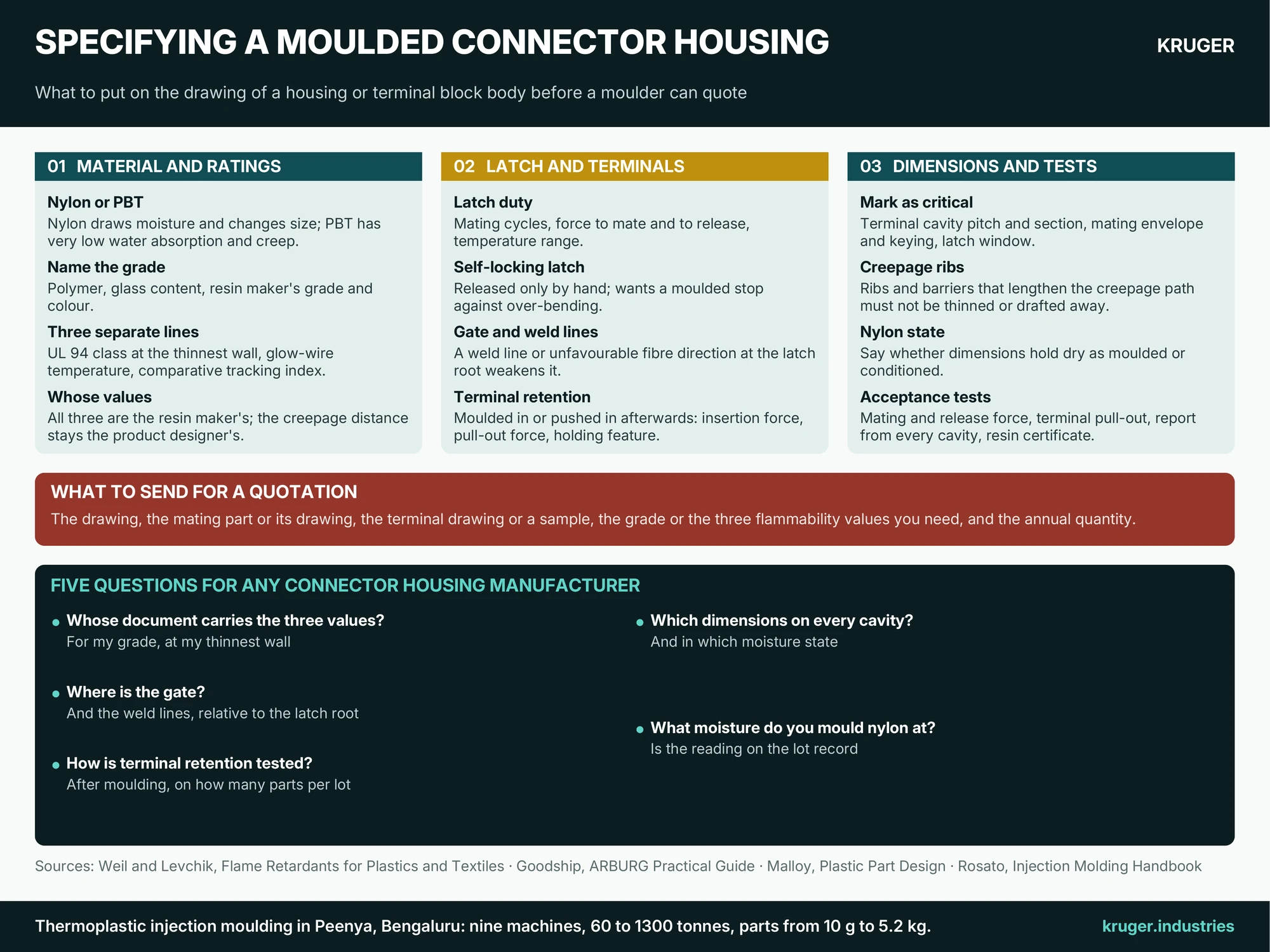
A connector housing weighs a few grams and does four jobs: it insulates, it holds the terminals, it latches to its mate, and it must not burn or track when something goes wrong. A drawing that says “nylon, V-0” covers half of one of them. Here is what to put in front of any connector housing manufacturer for a housing, a terminal block body or another small insulating part. Our electrical connectors page shows what we mould for the sector; the enclosure guide covers boxes, lids and insert-moulded caps.
Nylon or PBT, by named grade
Weil and Levchik’s flame-retardant handbook counts electrical parts, connectors among them, as probably the largest use of flame-retarded polyamides, and connectors as the largest flame-retardant use of PBT. Nylon draws moisture and changes size and toughness, as our nylon guide explains; Goodship’s Arburg guide lists PBT with very low water absorption and very low creep. A housing that must hold its terminal spacing argues for PBT; a latch that must flex without cracking argues for nylon. Name the polymer, glass content, resin maker’s grade and colour. Our connector work to date is in nylon, unfilled and glass-filled. If your housing needs PBT, say so in the enquiry and we will tell you plainly whether we can trial your grade.
Flame class, glow-wire and tracking: three separate lines
The UL 94 class is earned by standard specimens at a stated thickness, so ask for it at the housing’s thinnest wall. For glow-wire, Weil and Levchik describe a heated wire pressed against the specimen for thirty seconds, and the ignition temperature it gives is a material value under IEC 60695-2-13:2021. Tracking is leakage across a contaminated surface, measured as the comparative tracking index under IEC 60112:2025. Check which edition your product standard cites.
The three do not move together. The same handbook reports glass-filled PBT at about 300 V of tracking index with one flame-retardant system and at 500 to 600 V with another. “FR grade” on a drawing settles nothing: write the class and thickness, the glow-wire temperature and the tracking index you need. All three are the resin maker’s values, and the creepage distance stays the product designer’s decision. No V-0 glass-filled nylon grade has run here yet, so we quote one with a trial.
The latch: say how often it is opened
A latch is a snap joint: it bends as the halves meet, then springs back. Malloy’s part-design text gives three cautions that belong on the drawing. A self-locking latch with a square return face can be released only by hand, and wants a moulded stop against over-bending. The strain a beam may take depends on the material at its service temperature and humidity, and falls when many deflections are expected. A weld line or unfavourable fibre direction at the root weakens it, so the gate position is part of the latch specification. State the mating cycles, the force to mate and to release, and the temperature range.
A nylon latch can also be moulded too dry. Rosato’s handbook reports a producer of nylon connectors who cut brittle failures in flexing fingers by 70 per cent by moulding nylon 66 at 0.15 to 0.3 per cent moisture and no drier.
Terminal retention: moulded in, or pushed in afterwards
Terminals are placed in the open tool and moulded over, which our insert moulding guide covers and which runs on our vertical machine; or they are pushed into a moulded cavity afterwards and held by a shoulder or a moulded finger. Rosato says moulded-in inserts usually cost more in the long run, and lists fitting the metal after moulding among the alternatives. Send the terminal drawing or a sample and state the insertion force, the pull-out force and the feature that does the holding. Mark the terminal cavities free of flash: a film of it stops a terminal seating.
Critical dimensions, and the mating part
A housing is judged by whether it mates. Mark as critical only what decides that: the pitch between terminal cavities, the cavity section, the mating envelope and its keying, the latch window, and any rib or barrier that lengthens the creepage path, which must not be thinned or drafted away. For nylon, say whether those dimensions hold dry as moulded or conditioned; our tolerances guide gives the bands. Send the mating part, or its drawing: first samples are checked against it.
Tests, and what a moulder cannot certify
Write the acceptance tests and the sample size: mating and release force against the mating part, terminal pull-out, a dimensional report on the critical features from every cavity, and the resin maker’s certificate for the lot. The connector’s electrical rating and any listing belong to the product owner. We supply the moulded housing with its records and do not certify a connector. Complete battery cable connector assemblies have their own page.
When we are the wrong moulder
Parts under 50 g sit on the top rung of our published minimum, about 100,000 parts a year; below that, a catalogue housing is the sensible buy. A miniature fine-pitch housing in a many-cavity tool belongs with a connector-moulding specialist; our machines start at 60 tonnes.
Five questions for any connector housing manufacturer
- Whose document carries the flame class, glow-wire and tracking values for my grade at my thinnest wall?
- Where is the gate, and where do the weld lines fall relative to the latch root?
- How is terminal retention tested after moulding, and on how many parts per lot?
- Which dimensions are measured on every cavity, and in which moisture state?
- What moisture do you mould nylon at, and is the reading on the lot record?
Send the drawing with the mating part or its drawing, the terminal drawing or a sample, the grade or the three flammability values you need, and the annual quantity. The reply names the machine and the material route and quotes the tool and the piece price, or says plainly that another supplier suits the part better.
Sources quoted: E. D. Weil and S. V. Levchik, Flame Retardants for Plastics and Textiles: Practical Applications, 2nd ed. (Hanser, 2016); V. Goodship (ed.), ARBURG Practical Guide to Injection Moulding (Rapra Technology, 2004); R. A. Malloy, Plastic Part Design for Injection Molding (Hanser, 1994); D. V. Rosato, D. V. Rosato and M. G. Rosato (eds), Injection Molding Handbook, 3rd ed. (Kluwer Academic, 2000). Standards named: IEC 60112:2025, Method for the determination of the proof and the comparative tracking indices of solid insulating materials; IEC 60695-2-13:2021, Glow-wire ignition temperature (GWIT) test method for materials; UL 94, Tests for Flammability of Plastic Materials for Parts in Devices and Appliances. Check the current edition of each before relying on it.