
/ KNOWLEDGE · SOURCING
Moulded Plastic Parts for Defence: Approving a Supplier
Plastic moulded parts for defence are approved twice: first the supplier, then the part. If you are a purchase or design engineer at a defence public-sector unit or a licensed private firm, the moulder has to reach your approved vendor list before a housing, enclosure or cover can be ordered. This page sets out what registration asks for, how the trial order and inspection run, and where an ISO 9001 moulder such as Kruger stops. The factory audit is in our supplier qualification guide.
Plastic moulded parts for defence: the registration pack
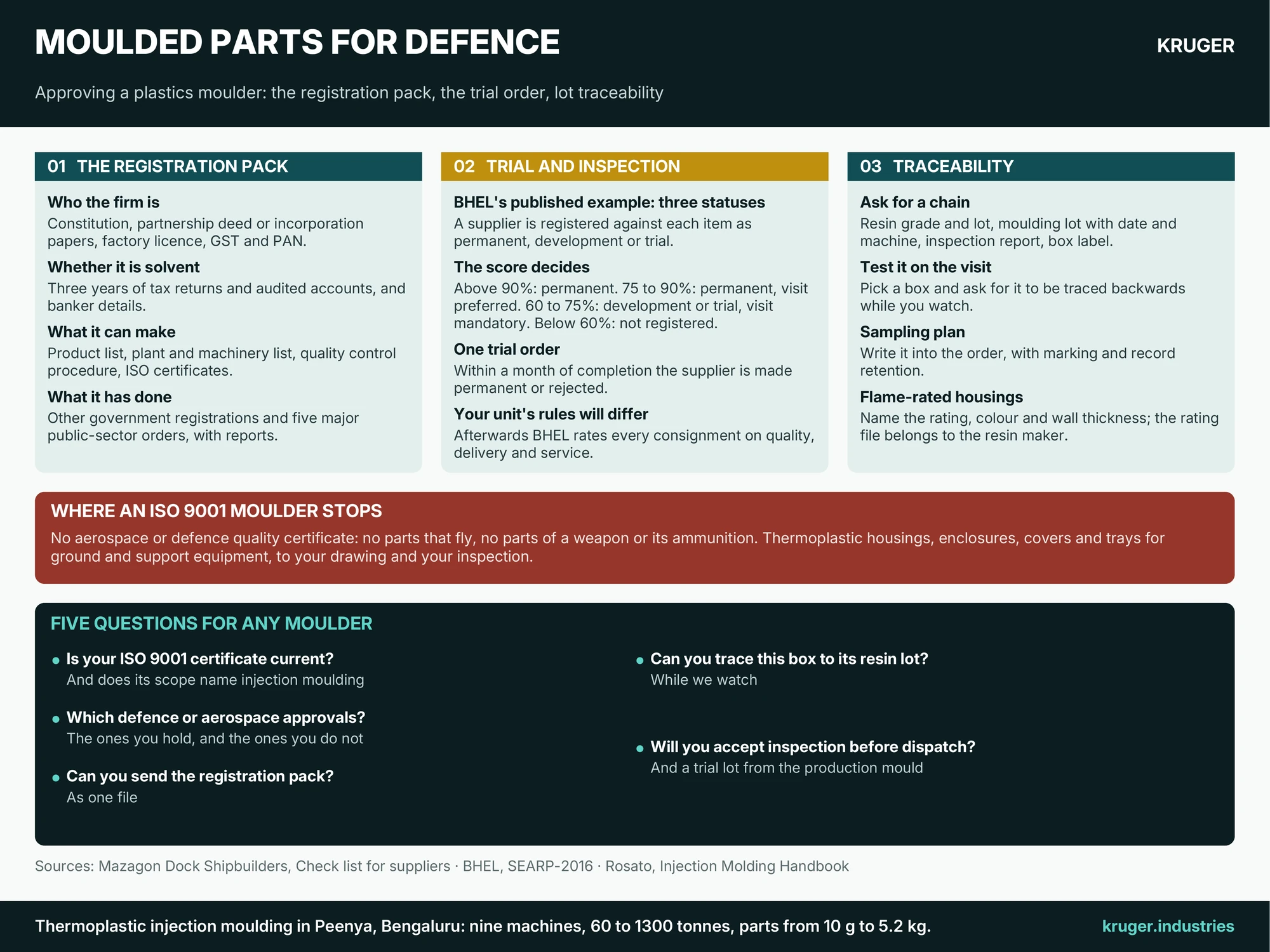
Forms differ by unit, but the published ones ask for much the same paper. Mazagon Dock Shipbuilders prints a 49-line checklist for suppliers, which sorts into four groups. Who the firm is: its constitution, partnership deed or incorporation papers, factory licence, GST and PAN. Whether it is solvent: three years of tax returns and audited accounts, and banker details. What it can make: the product list, the plant and machinery list, the quality control procedure and any ISO 9000 or 14000 certificate. What it has done: registration with other government undertakings or with DGQA, and five major orders executed for government or public-sector buyers, with performance reports.
Ask the moulder for this pack as one file before you raise the vendor request. Our supplier onboarding page lists the documents we send. If the part is on an indigenisation list, the Ministry of Defence’s SRIJAN portal is where units display such items and Indian firms register interest. It is non-transactional; orders still run through your tender route or the Government e Marketplace.
Trial order, works visit and inspection before dispatch
The clearest public account we have read is the supplier evaluation procedure BHEL published in 2016; your unit’s rules will differ. A supplier is registered against each item as permanent, development or trial, and the application is scored. Above 90 per cent the supplier is registered as permanent, normally without a visit. Above 75 and up to 90 it is also permanent, with a visit preferred. From 60 to 75 per cent it gets development or trial status and a works visit is mandatory. Below 60 per cent it is not registered. A trial supplier receives one order for the item. On its completion, which may be defined as inspection clearance before dispatch, it is made permanent or rejected. A complete application is to be decided within three months, and afterwards every consignment is rated on quality, delivery and service.
Allow a quarter for registration alone. In BHEL’s procedure the trial order may follow up to 90 days later, and the decision comes a month after it is completed, so start the paperwork well before you need the part. Choose a trial part that represents the real work. On the visit, look past the certificates to the machines. One OEM audit manual for moulding subcontractors grades seven items of machine performance, and our machine health page sets out five checks with pass bands. The records that should travel with each lot are listed in the quality paper trail.
Traceability of material and lots
Rosato’s handbook treats the plastic itself as usually the hardest variable in moulding to control. So a defence drawing should ask for a chain, not a single certificate: the resin grade and lot on the maker’s certificate, the moulding lot with its date and machine, the inspection report for that lot, and a box label that carries the lot number. On your visit, pick a box and ask for it to be traced backwards while you watch. Write the sampling plan into the order too; Rosato traces such plans to a United States military standard, MIL-STD 105.
For housings near live circuits, name the flame rating, colour and wall thickness. The rating file for a grade belongs to the resin maker; the moulder’s task is to prove which lot went into your parts. See our pages on flame-retardant ratings and specifying an electrical enclosure.
Where an ISO 9001 moulder stops
Kruger holds ISO 9001:2015, certificate NVT 147210, and its scope names plastic injection moulded components. Test any such certificate: read the scope line, then confirm the certificate number and its dates with the body that issued it, and ask which accreditation body stands behind that issuer. The certificate covers the management system, not any part.
We hold no aerospace or defence quality certificate such as AS9100, and we are not registered with DGQA, the Ministry of Defence’s quality assurance directorate for stores supplied to the armed forces. So we do not quote parts that fly, parts of a weapon or its ammunition, or any part whose drawing requires the moulder to hold such an approval. If yours does, a moulder that holds it is the right buy. What suits a general-industry moulder is thermoplastic housings, enclosures, covers and trays for ground and support equipment, made to your drawing and released on your inspection. Qualification testing of the equipment stays with you.
Five questions for any moulder
- Is your ISO 9001 certificate current, and does its scope name injection moulding?
- Which defence or aerospace approvals do you hold, and which not?
- Can you send the registration pack as one file?
- Can you trace this box back to its resin lot while we watch?
- Will you accept inspection before dispatch, and a trial lot from the production mould?
What to send for a first quotation
Send the drawing or STEP file with its revision, the material specification with flame rating and colour, and the annual quantity and lot size: defence lots are often small, so check our floor on the minimum order page. Include the inspection clause: sampling plan, inspection before dispatch, marking and record retention. Say whether a mould exists. A new one is designed by Kruger, built by partner toolrooms, funded by you and stays your property. Attach your vendor registration form too. Then request a quotation, and we will say plainly if the part is not ours to make.
Sources quoted: Mazagon Dock Shipbuilders Limited, Check list for suppliers (published checklist, read 18 November 2026); Bharat Heavy Electricals Limited, Supplier Evaluation, Approval and Review Procedure, SEARP-2016, Rev 02, abridged for web (check the current revision with your unit); Department of Defence Production, Ministry of Defence, SRIJAN portal; Directorate General of Quality Assurance, Ministry of Defence; Government e Marketplace; D. V. Rosato, D. V. Rosato and M. G. Rosato, Injection Molding Handbook, 3rd ed. (Kluwer, 2000); an OEM machine-audit manual applied to its moulding subcontractors. Naming a body here cites its public document. It is not a claim that Kruger supplies it or is registered with it.