
/ KNOWLEDGE · TOOLING
Injection Mould Life: How Many Shots to Specify
Injection mould life is one number in a tooling enquiry, the count of shots the mould must deliver before it is worn out, and it decides more of the quotation than any other line. Steel, hardness, the way the cavities are built and the price all follow from it. Leave it blank and each toolmaker assumes a life of their own, which is one reason quotations for the same part differ. The price side is in our mould-cost guide.
Work out the shots you need
How long a mould should last is a question about parts, not years. A tool that makes every part the programme will ever need has lasted long enough, whether that takes one season or twenty years.
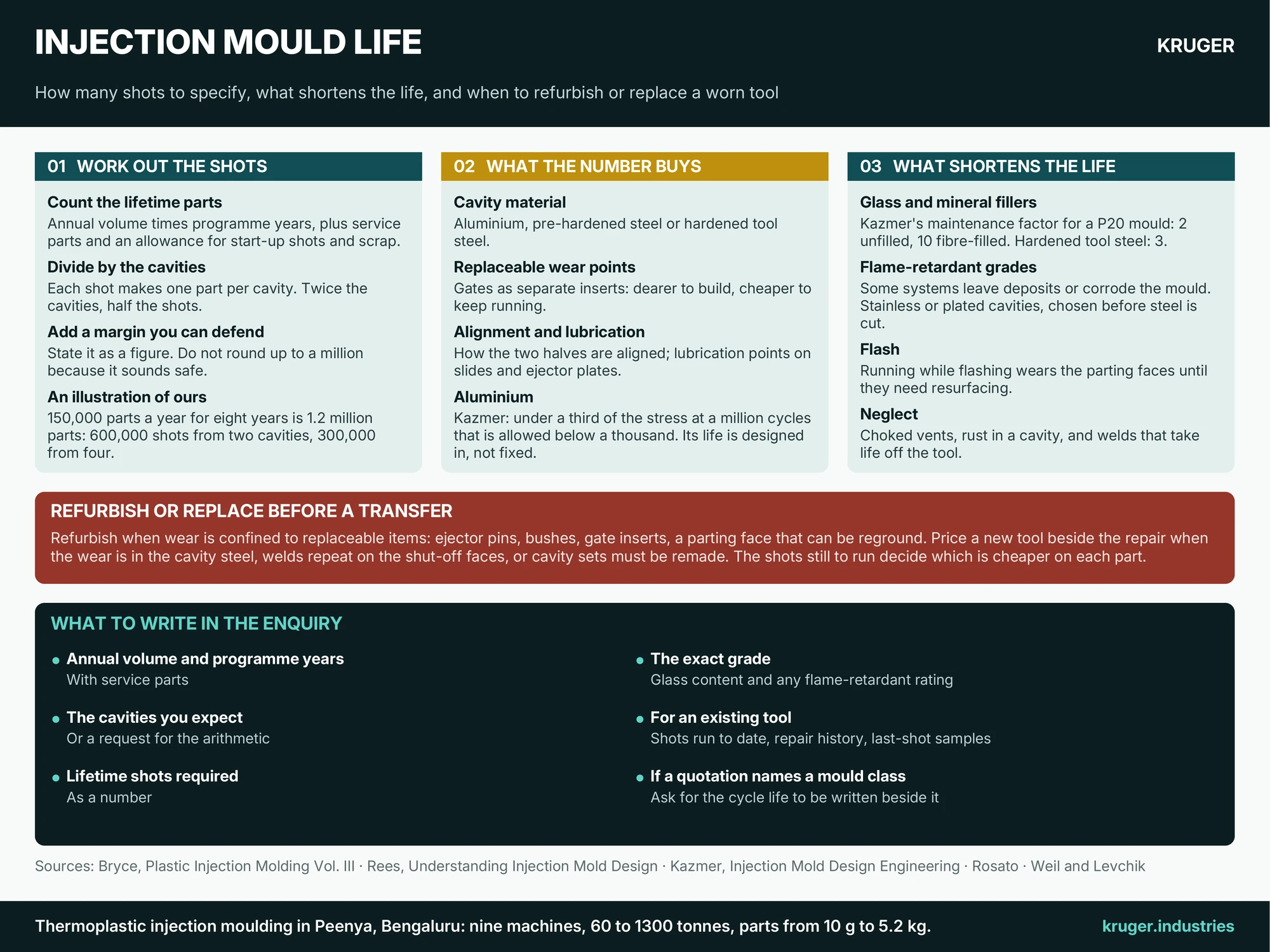
- Count the lifetime parts. Annual volume times programme years, plus service parts after production ends and an allowance for start-up shots and scrap.
- Divide by the cavities. Each shot makes one part per cavity, so the same programme needs half the shots from a tool with twice the cavities. Our cavities guide has the arithmetic for choosing the count.
- Add a margin you can defend. Forecasts slip in both directions. State it as a figure; do not round up to a million because it sounds safe.
An illustration of ours: 150,000 parts a year for eight years is 1.2 million parts. From a two-cavity tool that is 600,000 shots; from a four-cavity tool, 300,000. The two tools need not be built the same way.
What the number buys
Rees tells mould designers that a tool for a thousand parts and a tool for ten million differ in the materials chosen and in many of the features designed in. The life you state decides whether the cavities are cut in aluminium, pre-hardened steel or hardened tool steel, whether wear points such as gates are separate inserts that can be replaced, how the two halves are aligned, and whether slides and ejector plates are given lubrication points. Replaceable details are dearer to build and cheaper to keep running.
Kazmer explains that aluminium, unlike steel, has no stress level below which it never fatigues, so the designer must lower the working stress as the cycle count rises; his worked figures for one mould alloy allow under a third of the stress at a million cycles that they allow below a thousand. The life of an aluminium tool is therefore designed in, not fixed, and the plastic matters as much as the count. Our aluminium versus steel calculator finds the volume at which the dearer tool wins.
Quotations from North America often name a mould class from the Plastics Industry Association’s classification, numbered 101 to 105. If a quotation names a class, ask for the cycle life it stands for to be written beside it.
What shortens injection mould life
- Glass and mineral fillers. They stiffen the part and scour the steel. Bryce warns of reinforcements that “their abrasive nature can wreak havoc on the steel finishes of a mold.” Kazmer’s cost model puts a number on it: the lifetime maintenance factor he applies to a standard P20 mould is 2 with an unfilled, easy-flowing plastic and 10 with a viscous, fibre-filled one, against 3 for hardened tool steel.
- Flame-retardant grades. Some flame-retardant systems are known to leave deposits on the mould or to corrode it. The defence, a stainless cavity steel or a plated surface, is chosen before the tool is cut, so name the grade in the enquiry.
- Flash. A mould left running while it flashes wears its parting faces until they need resurfacing, and flash that sits on the parting line is pressed into the steel each time the mould closes.
- Neglect. Vents choked with residue push the filling pressure up and flash follows. Rust in a cavity can mean welding and refinishing, and every weld takes something off the life of the tool. The routine that prevents both is in our maintenance and storage guide.
Refurbish or replace before a transfer
A transfer is the natural moment to ask how much life is left: the tool is out of the machine and about to be proved again on a different one. Before it leaves, collect five things.
- Shots run to date, from the mould’s counter or the production records, set against the life it was built for.
- The last-shot samples. Flash at the parting line, around ejector pins and at slides shows where the steel has worn.
- The latest inspection report, read for dimensions that have crept towards a limit.
- The repair history, welds above all.
- Any cavity blocked off, and the reason.
Then set what is left against what the programme still needs. Wear confined to replaceable items, such as ejector pins, bushes, gate inserts or a parting face that can be reground, points to refurbishment. Wear in the cavity steel itself, repeated welds on the shut-off faces, or cavity sets that would have to be remade point to pricing a new tool beside the repair; the shots still to run decide which is cheaper on each part. Refurbishment is toolroom work, quoted on its own line, and should be finished before the tool is proved at its new home. Our second-sourcing guide covers the case of a tool too worn to move, and the mould transfer page sets out the survey and incoming inspection a transferred tool goes through with us.
What to write in the enquiry
- Annual volume and programme years, with service parts.
- The cavities you expect, or a request for the arithmetic.
- Lifetime shots required, as a number.
- The exact grade, with its glass content and any flame-retardant rating.
- For an existing tool: shots run to date, repair history and last-shot samples.
Send the drawing with these five lines through our RFQ page. For a new tool, a quotation should name the steel and the reason for it; for an existing one, our reply covers machine fit and the documents we need to see.
Sources quoted: D. M. Bryce, Plastic Injection Molding, Vol. III: Mold Design and Construction Fundamentals (Society of Manufacturing Engineers, 1998); H. Rees, Understanding Injection Mold Design (Hanser, 2001); D. O. Kazmer, Injection Mold Design Engineering (Hanser, 2007); D. V. Rosato, D. V. Rosato and M. G. Rosato (eds), Injection Molding Handbook, 3rd edition (Kluwer Academic Publishers, 2000); Flame Retardants for Plastics and Textiles, 2nd edition, by E. D. Weil and S. V. Levchik (Hanser, 2016).