
/ KNOWLEDGE · DESIGN
Specifying a battery container and lid for quotation: what the moulder needs on the drawing
A moulder can quote a battery container and lid from a complete drawing at once, or spend weeks asking what it left out. The difference is a dozen decisions that belong to the battery maker: size series, cell count, lid joint, bushing and vent positions, and which dimensions matter. The application’s demands are in our battery container guide, our machines on the battery containers and covers page.
The envelope, and the series it follows
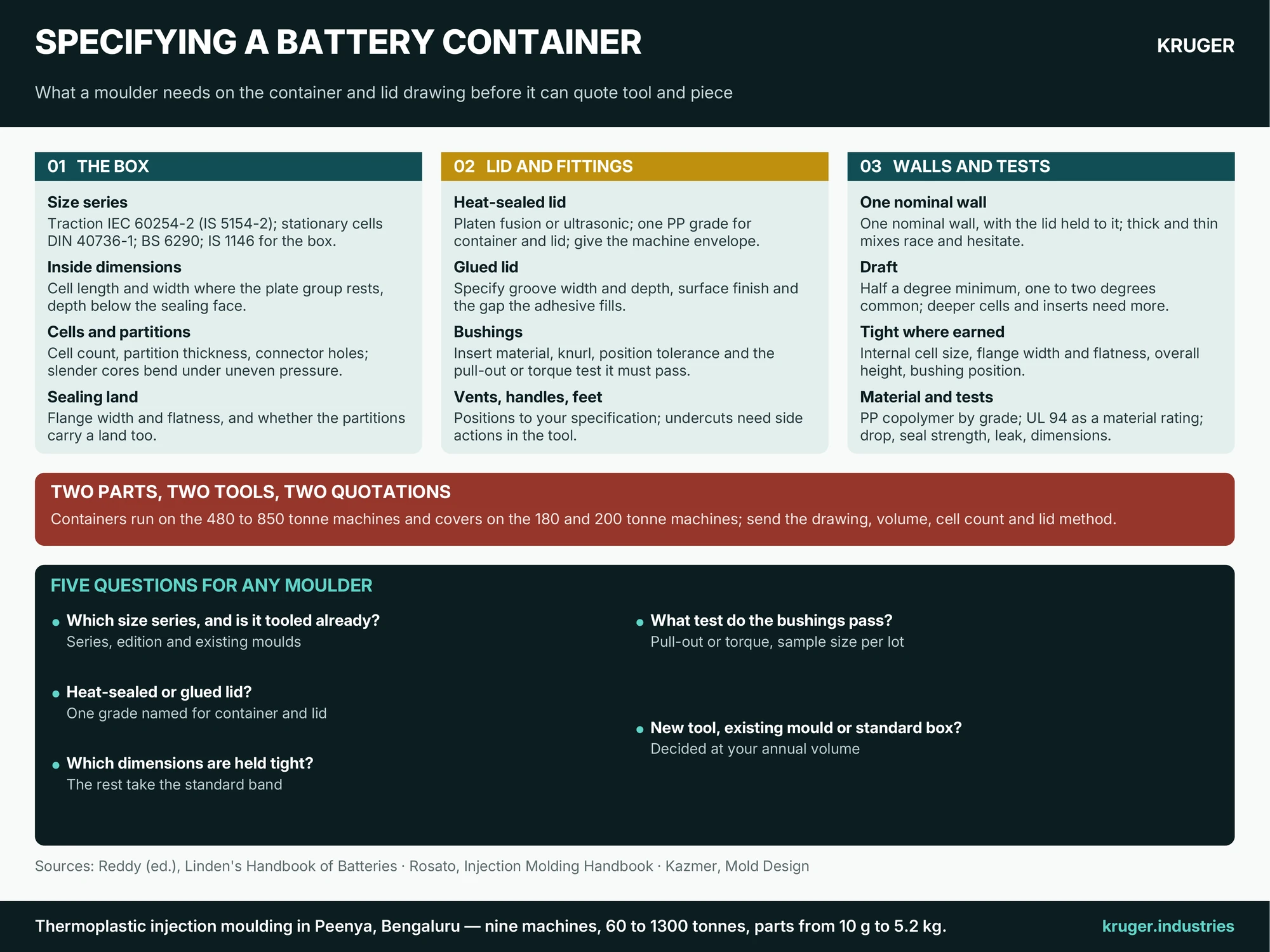
Give the outside dimensions and the series they follow, which tells a moulder whether a tooled size exists. Traction cells follow IEC 60254-2 (IS 5154 Part 2 in India) for cell and terminal dimensions; tubular-plate stationary cells in the German series follow DIN 40736-1 and their block batteries DIN 40737-3, and British-series stationary cells of the Planté and flat-plate types follow BS 6290. For the container itself, Indian specifications call up IS 1146, revised in 2026. For each of these, check which edition your specification cites. Then draw the inside: cell length and width at the plate group, and depth below the sealing face. Linden’s handbook notes that stationary cells leave the positive plates room to grow by up to a tenth over life: the inside is a battery decision, not a moulder’s inference.
Cells, partitions and the sealing land
State the cell count and partition thickness, and show the connector holes: Pavlov notes that cells are joined over the cover or through the partitions, and a connector welded through a hole must seal against the wall, so hole position and local thickness are joint dimensions. Each partition is formed between two tall cores, and Kazmer shows that a slender core bends under uneven melt pressure, the bending self-reinforcing and growing with the fourth power of core height. Finally draw the sealing land: flange width, flatness, and whether the partitions carry one too.
The lid, and how it joins
Rand records that polypropylene made heat-sealed case-to-cover assemblies possible. Linden describes two fusion routes, platen heating then pressing, or ultrasonic welding, and adds that a fusion-sealed battery is virtually beyond repair; glued lids use epoxy or solvent cement. A heat-sealed lid needs container and lid in one named polypropylene grade; a glued lid needs the mating faces specified: groove width and depth, finish, and the gap the adhesive fills. Give the sealing machine’s platen or horn envelope. Our covers run on the 180 and 200 tonne machines and containers on the 480 to 850 tonne machines: two parts, two tools, two quotations.
Bushings, vent plugs, handles and feet
Terminal bushings are insert-moulded (see our insert moulding guide): a lead or brass insert sits in the open tool and the melt locks it in. Draw it fully, with material, knurl, position tolerance and the pull-out or torque test it must pass, and mark the vent plug positions. Rosato warns that an insert must present no sharp edge to the plastic, which would act as a notch, and that the pin holding it can bend under injection pressure; an insert out of place damages the mould. Malloy adds that loading inserts lengthens and varies the cycle, which is why Bryce puts insert moulding on vertical presses. Handles, feet and stacking ribs are cheap on paper and expensive in steel where they undercut the opening direction and need a side action.
Walls, draft and the tolerances that matter
Give one nominal wall and hold the lid to it; Malloy explains that melt races along thick sections and hesitates in thin ones, leaving stress and short shots. Draft: Kazmer puts the usual minimum at half a degree, with one to two degrees common, and Rosato adds that deeper cavities and metal inserts need more. Then tolerance the function: internal cell size, flange width and flatness, overall height and bushing position earn a tight band; everything else takes the material’s standard band (our wall thickness and tolerances guides).
Material, and the tests you will apply
Name the material as a grade, not a family: polypropylene copolymer (our polypropylene guide), with the cold impact and acid resistance your market needs and a colour against a master sample. A flame-retardant grade is specified as a UL 94 rating of the material on the resin maker’s test report, not as a certification of moulder or battery. Then write the acceptance tests: drop or impact at your market’s low temperature, heat-seal strength on sealed assemblies, a leak test (Pavlov lists air-tightness as the step after lidding) and a dimensional report, with the sample size per lot.
Existing mould, new tool, or a standard box
For an existing mould, send drawings, cavity count and shot history; we check it against Rees’s machine-fit list (tie-bar clearance, platen size, shut height, ejector pattern); a tool outside our press window cannot run here. A new container tool sits at the top of the live tooling guide‘s indicative bands and timelines. At low volume the honest answer is a size already tooled, ours or a stockist’s; a new container tool does not amortise over a few thousand parts a year.
Five questions to settle with any container moulder
- Which size series, and is it tooled already?
- Heat-sealed or glued lid, and is one grade named for container and lid?
- Which of my dimensions do you hold tight, and which take the material’s standard band?
- What pull-out or torque test do you run on the bushings, and on how many per lot?
- At my volume, is a new tool, an existing mould or a standard box the right buy?
Send the drawing or a sample container, the annual volume, the cell count and the lid joining method, and we will quote the tool and the piece, or tell you which existing size fits.
Sources quoted: T. B. Reddy (ed.), Linden’s Handbook of Batteries, 4th ed. (McGraw-Hill, 2011); R. M. Dell and D. A. J. Rand, Understanding Batteries (Royal Society of Chemistry, 2001); D. Pavlov, Lead-Acid Batteries: Science and Technology (Elsevier, 2011); D. V. Rosato, D. V. Rosato and M. G. Rosato, Injection Molding Handbook, 3rd ed. (Kluwer Academic, 2000); R. A. Malloy, Plastic Part Design for Injection Molding (Hanser, 1994); D. O. Kazmer, Injection Mold Design Engineering (Hanser, 2007); D. M. Bryce, Plastic Injection Molding, Vol. II (Society of Manufacturing Engineers, 1997); H. Rees, Understanding Injection Mold Design (Hanser, 2001).