
/ KNOWLEDGE · PROCESS
Scientific moulding — the six studies behind a process you can trust
“Scientific moulding” is printed on a great many moulders’ brochures, and it means something exact: a process whose settings were found by experiment on your mould, not copied from the last job. Kulkarni, whose textbook is the standard account, credits the term to John Bozzelli and Rod Groleau and describes the aim as a process that is robust, repeatable and reproducible. He sets out six studies that find it. This page explains each study, what it produces, and what a buyer can ask to see. It follows on from our guide to the injection moulding process and sits before Cp and Cpk, which measure the result.
Two words worth defining
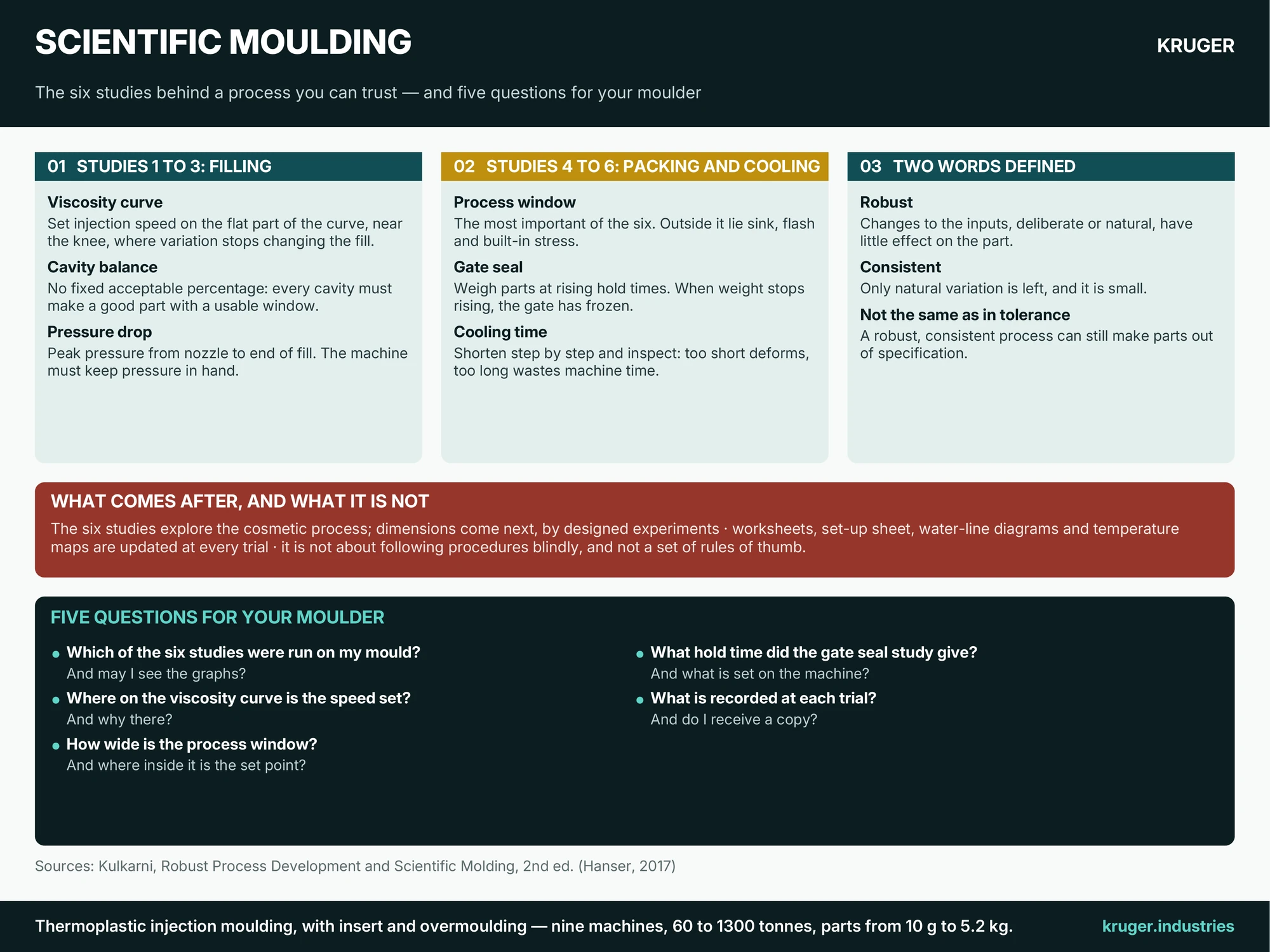
Kulkarni calls a process robust when changes to its inputs, deliberate or natural, have little effect on the part. He calls it consistent when the only variation left is natural variation and that variation is small. He adds a warning that buyers should keep: neither word means the parts are in specification. A process can be robust and consistent and still make parts that are out of tolerance, so capability has to be shown separately.
The six studies
- Viscosity curve. Plastic melt gets thinner as it is injected faster, steeply at first and then hardly at all. The study plots that curve on the actual mould. The injection speed is then set on the flat part, near the knee, where small variations no longer change how the cavity fills. Kulkarni advises against simply injecting as fast as possible, because some materials degrade under shear and because vents can only pass air so quickly.
- Cavity balance. In a multi-cavity mould, how evenly do the cavities fill? Kulkarni refuses to give a single acceptable percentage. What matters is whether every cavity makes an acceptable part with an acceptable process window.
- Pressure drop. The peak pressure is recorded as the melt reaches the nozzle, sprue, runner, gate and end of fill. The machine must keep pressure in hand, so that it can hold the chosen speed when the material varies. If the runner alone takes a large share of the available pressure, the runner sizes need investigating, which Kulkarni says is common with some hot-runner moulds. Our guide to injection pressure covers the background.
- Process window. Kulkarni calls this the most important of the six. Two settings are varied until parts fail at each edge: hold pressure against melt temperature for amorphous materials, hold pressure against mould temperature for semi-crystalline ones. Outside the window lie sink, flash and built-in stress. The wider the window, the more room the process has to drift without making scrap.
- Gate seal. Parts are weighed at increasing hold times. When the weight stops rising, the gate has frozen and no more plastic can enter or leave. Hold for less and the part is under-packed, with sinks or voids. Kulkarni says this study must be done for every mould.
- Cooling time. Parts are moulded at progressively shorter cooling times and inspected. Too short and the part deforms at ejection; too long and machine time is wasted. Our cooling time guide explains what sets the limit.
What comes after the six
Kulkarni is clear that these six steps explore the cosmetic process: whether the mould makes good-looking parts across a usable range. Dimensions come next, and for those he prescribes designed experiments, not trial and error. He also treats the paperwork as part of the method. Mould qualification worksheets, the machine set-up sheet, water-line diagrams, mould temperature maps and operator instructions should be written or updated at every trial, and a master checklist used each time. That record is what lets the same process be rebuilt months later, and it belongs with the documents described in our guide to the quality paper trail.
What scientific moulding is not
It is not a ritual. Kulkarni warns that these techniques are not about following procedures blindly, that every procedure has exceptions, and that people can become fascinated by generating graphs. It is not a set of rules of thumb either: he rejects, for example, the common habit of setting screw speed so that the screw finishes turning two or three seconds before cooling ends, because screw speed depends on the material and not on the part. For a buyer the lesson is simple. A folder of graphs is evidence only if the moulder can say what each one changed on your job.
Five questions for your moulder
- Which of the six studies were run on my mould, and may I see the graphs?
- Where on the viscosity curve is the injection speed set, and why there?
- How wide is the process window, and where inside it does the set point sit?
- What hold time did the gate seal study give, and what is set on the machine?
- What is recorded at each trial, and do I receive a copy?
Send the part drawing and we will go through these questions with you before any tooling decision is made.