
/ KNOWLEDGE · DISCIPLINE
Purging in injection moulding — the changeover discipline you never see on a quote
Before your job ran, the barrel was full of somebody else’s material in somebody else’s colour — and the only thing standing between their job and yours is a routine called purging. Rosato’s handbook defines it without ceremony: purging the plasticator, “removing all plastics from it”, done “on changing material colors (particularly going from a dark to light color) and on shutdown, at the end of a production run”. Done well, it is invisible; you will never see a line item for it. Skipped or rushed, it becomes visible in the worst place possible — as streaks, specks and off-shade parts in your cartons. This guide explains what proper purging looks like, so you can ask for it by name.
The discipline: twenty timed cycles, not a quick flush
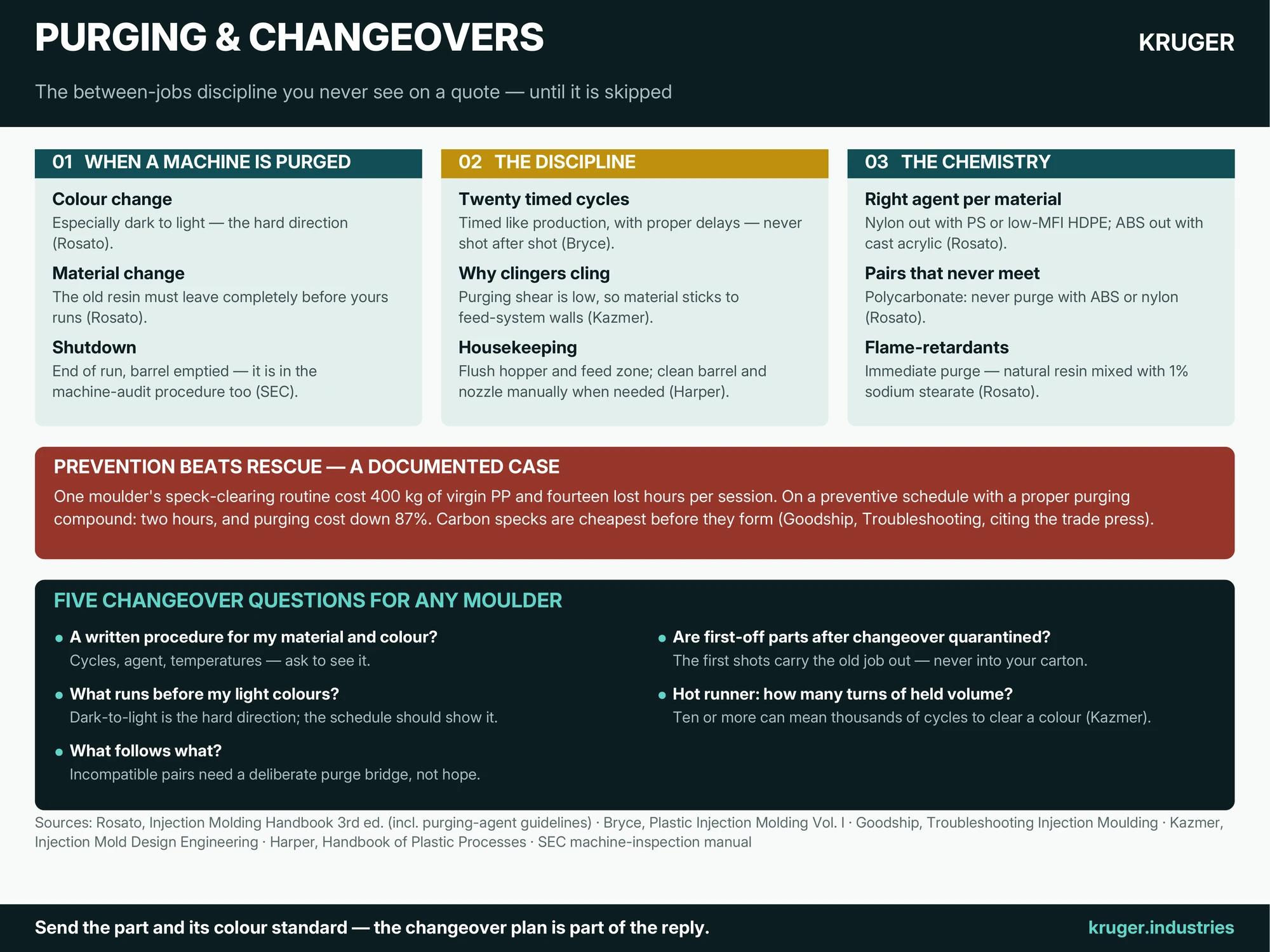
Bryce’s SME text gives changeover its number: “approximately 20 full cycles of proper purging is required before the older material is sufficiently removed” — and, crucially, “the purging cycle should be timed the same as the normal production cycle. Do not purge one shot right after the other without the proper delay between shots.” Rapid-fire flushing feels productive and cleans nothing; material clinging in dead spots needs the same heat and dwell as production to move. Kazmer explains why the clingers cling: during purging the shear stresses are low, which “allow the material to stick to the walls of the feed system”. The routine has housekeeping around it too — the primer’s advice is to flush the hopper and feed zone as a matter of course, because leftover pellets upstream re-contaminate a clean barrel; and Harper’s troubleshooting tables carry the confession the industry makes when this goes wrong: cause, “machine not completely purged”; remedy, “follow proper purge procedures and clean out barrel or nozzle manually if needed”. There is even a temperature check built on the purge itself — Bryce has the setter thrust a pyrometer probe into the centre of a purged shot, because the melt’s real temperature lives there, not on a controller display.
The chemistry: the right agent — and the pairs that must never meet
What you purge with is chemistry, not folklore, and Rosato’s handbook devotes a whole table to it. Nylon comes out with polystyrene, low-melt-index HDPE or cast acrylic. ABS comes out with cast acrylic or polystyrene. Some materials are forgiving — Rosato’s PETG example “can be removed with any material that follows it in the machine”. Others have hard rules: polycarbonate is purged with cast acrylic or its own regrind, and the table says flatly, “do not purge with ABS or nylon” — the wrong pair can react in the barrel. Flame-retardant compounds get the strictest line of all: “immediate purging with natural, non-flame-retardant resin, mixed with 1% sodium stearate”, because their additive packages do not tolerate sitting hot. And sequence is strategy: dark-to-light is the hard direction — Rosato’s “particularly going from a dark to light color” is why a disciplined shop schedules light colours first and why your natural-coloured parts should never follow black on a careless machine. The additives themselves leave evidence — Harper describes packages that “literally plate out on the internals of everything that they encounter”, the plate-out that later flakes off as specks. How colour gets into your part in the first place is the colour guide’s subject; what the material tolerates in the barrel is the residence-time calculator’s.
What sloppy changeover costs — a documented case
The trade literature has put numbers on this. In a case documented in the troubleshooting literature, a European moulder of yellow food containers had been using 400 kg of virgin polypropylene as its purging material to clear carbon specks from one machine — and losing fourteen hours of production doing it. Switching to a commercial purging compound on a preventive schedule cut the cost of purging by 87% and the lost time from fourteen hours to two. The reported moral is the buyer’s takeaway: “tackling potential carbon specks before they have a chance to form is one key in effective purging” — purging is cheapest as prevention, ruinous as rescue. Carbon comes from material cooking on barrel walls between jobs; once it is flaking into shots, every carton is a lottery, and the failure modes are all in the defects guide. Hot-runner tools raise the stakes further: Kazmer shows that a manifold with many “turns” of held volume can need “hundreds (or thousands) of molding cycles” to fully purge a low-viscosity resin on a colour change — which is why colour-change frequency belongs in the tooling conversation before the manifold is designed, not after.
Five questions to ask any moulder about changeovers
- Is there a written changeover procedure for my material and colour — and may I see it? Cycles, agent, temperatures. A shrug here predicts specks later.
- What purges the machine before my natural or light-coloured job? Dark-to-light is the hard direction; the schedule should show they know it.
- What follows what? The incompatible pairs — polycarbonate after ABS or nylon country — need a deliberate purge bridge, not hope.
- Do first-off parts after changeover get inspected and quarantined? The first shots carry the old job out; they should never carry it into your carton — the paper trail lives in the quality-documentation guide.
- On a hot-runner tool: how was colour change considered in the manifold design? Kazmer’s question, and a very revealing one.
If you came here looking for a purging calculator: there isn’t an honest one. There is a timed discipline, a compatibility table and a schedule — which is better, because those can be audited. Send us your part and its colour standard and an engineer replies within 48 hours on working days, changeover plan included — and for the full checklist on judging any moulder, take the supplier-qualification guide.