
/ KNOWLEDGE · MATERIALS
ABS injection moulding — a buyer’s guide to the workhorse terpolymer
If your part is a housing, a cover, a bezel or an enclosure, somebody has already suggested ABS — and they are probably right. Acrylonitrile-butadiene-styrene is the trade’s default technical material: tough, dimensionally well-mannered, easy to colour, easy to finish. It is also the material the reference literature reaches for first — one design handbook simply announces that wherever it describes “a specific plastic”, that plastic is ABS. This guide covers what ABS actually is, where it earns its place, and the questions that separate a disciplined ABS moulder from a careless one.
What ABS actually is — three monomers trading favours
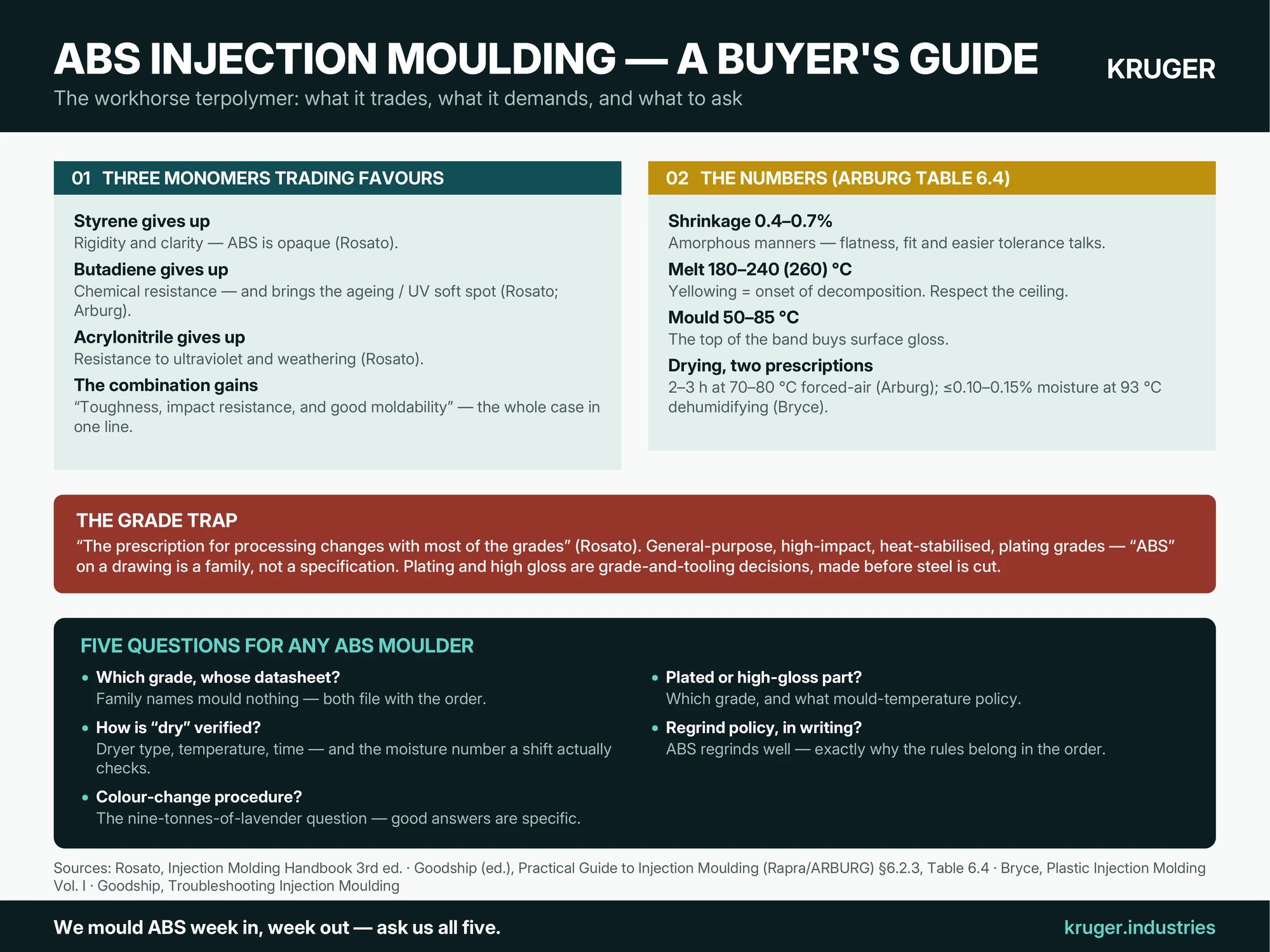
Rosato’s handbook explains ABS as a deal between three ingredients, each giving something up: combined into the terpolymer, “the styrene part of it has lost its rigidity and clarity, the butadiene has lost chemical resistance, and the acrylonitrile has lost resistance to ultraviolet rays and weathering. The combination, however, has toughness, impact resistance, and good moldability, entitling it to a vital place in the plastic family.” That sentence is the whole datasheet in miniature. The Arburg guide’s materials chapter agrees from the processing side: significantly higher impact resistance than polystyrene, opaque (the butadiene again), and — the honest entry — “more susceptible to ageing than PS” because of that same rubber phase. Outdoor, UV-loaded duty is where ABS needs either stabilised grades or a different conversation; check the claim on the grade’s own datasheet — here is how to read one.
Amorphous manners: why ABS holds its dimensions
AND is an amorphous thermoplastic, and it shows in the numbers: Arburg gives its processing shrinkage as 0.4–0.7% — a fraction of what semi-crystalline materials move. Low, fairly uniform shrinkage is why ABS parts hold flatness and fit, why textured and glossy faces come out as intended, and why tolerance conversations are easier than in polypropylene country. Run your own dimensions through the shrinkage calculator and the difference is visible immediately.
The grade trap: “ABS” is not a specification
Here is the trap in Rosato’s words: within the ABS family “the prescription for processing changes with most of the grades. Thus, it should not be taken for granted that setup conditions for similar materials apply to any grade; careful investigation is required if quality problems are to be avoided.” General-purpose, high-impact, high-flow, heat-stabilised, plating grades — the name on the drawing must be a grade, not a family. Bryce makes the same point about finishing: ABS heads his list of plateable plastics, but plated parts “usually require that a specific plating grade be used”; Arburg concurs that galvanisable types are “generally relatively problem-free” — the grade, again, doing the work. And because ABS is usually a cosmetic material, specify the colour the way batches can actually be matched.
Moisture discipline — two books, two dryers, one lesson
ABS is hygroscopic — both Arburg and Harper put it on the moisture-absorbing list. The drying prescriptions differ instructively by dryer type: Arburg’s table says forced-air cabinet, 2–3 hours at 70–80 °C, for surface moisture; Bryce specifies a moisture ceiling — “a maximum moisture content of 0.10 to 0.15 percent, by weight”, achievable at 93 °C for 2 hours in a dehumidifying dryer. Both are right; the lesson is that drying is equipment-specific and verifiable, not folklore. Wet ABS announces itself in the moulding — and overheated ABS announces itself too: Arburg gives the melt window as 180–240 °C (up to 260 °C), with the “onset of decomposition indicated by yellowing”. The full numbers live in our temperature and drying chart, and the discipline behind them in the drying guide. Mould temperature runs 50–85 °C, with the top of that band buying surface gloss.
Discipline is the margin
The troubleshooting literature keeps a cautionary tale from a UK factory where, “on one occasion nine tonnes of lavender ABS is said to have been just thrown away due to processing problems”, with half a tonne of virgin material lost weekly to colour changes done by simply stopping the machine. Nine tonnes is not a materials failure; it is a management failure — and it is priced into somebody’s parts. The buyer’s defence is paperwork: scrap rates, colour-change procedure, and a regrind policy settled in writing, all of which live in the quality paper trail a serious moulder can show you on request.
Five questions for any ABS moulder
- Which grade, and whose datasheet? Family names mould nothing — the grade and its datasheet file with the order.
- How is it dried, and how is “dry” verified? Dryer type, temperature, time — and the moisture number the shift actually checks.
- What is the colour-change procedure, and what does it cost in scrap? The lavender-ABS question. A good answer is specific.
- If the part is plated or high-gloss: which grade, and what mould-temperature policy? Both are grade-and-tooling decisions, made before steel is cut.
- What is the regrind policy, in writing? ABS regrinds well — which is exactly why the percentage and handling rules belong in the order.
We mould ABS week in, week out — enclosures, housings, covers and technical components — and every question above is one we would rather be asked. Send the drawing and an engineer replies within 48 hours on working days. For judging any moulder end to end, take the supplier-qualification guide.