
/ KNOWLEDGE · DESIGN
Sprue, runner and gate — the journey your plastic makes before it becomes a part
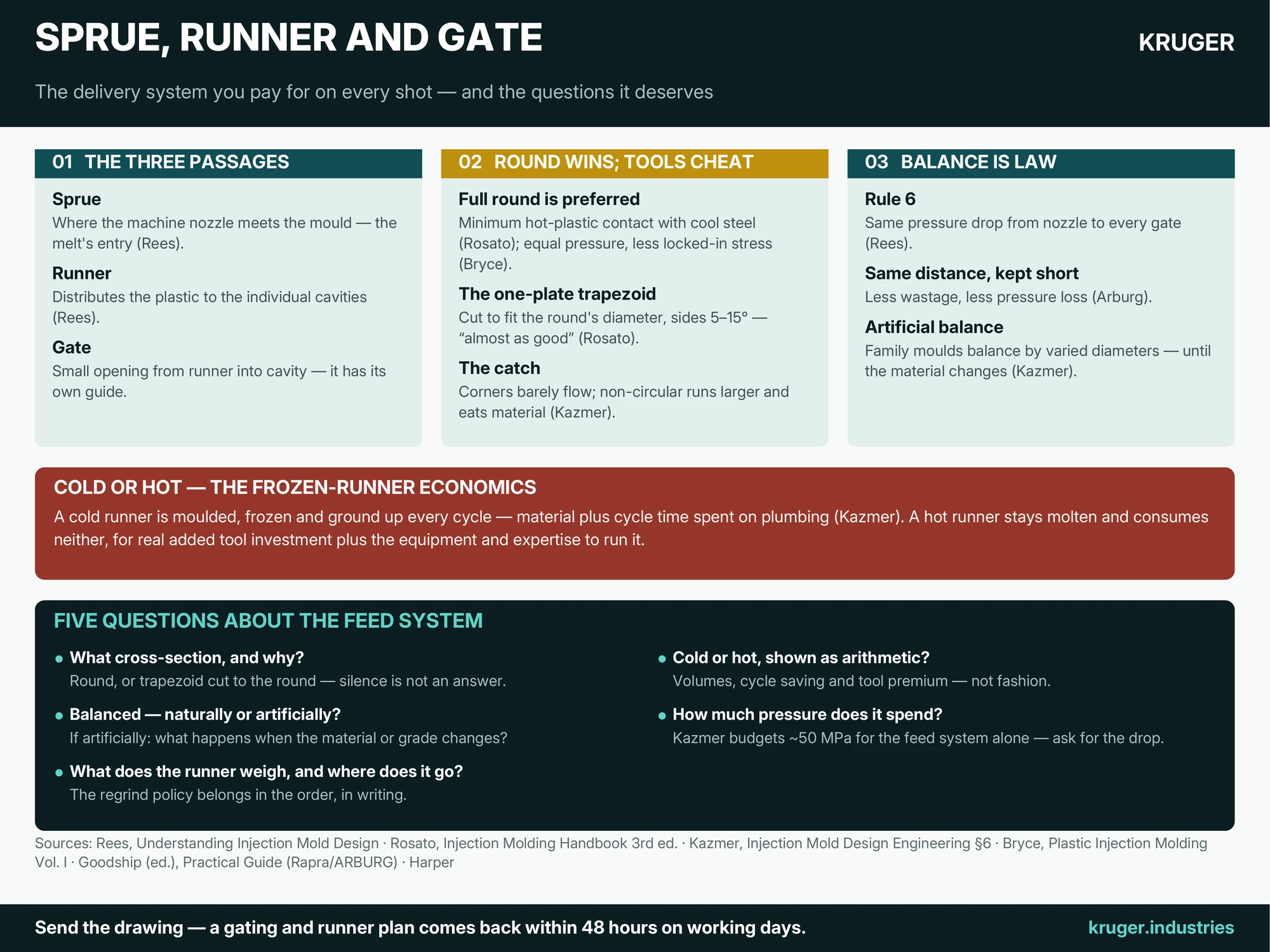
Between the machine nozzle and your part sits a small plumbing system you are paying for on every shot — and most buyers never ask a single question about it. Rees’s mould-design text names the three passages plainly: the sprue, “from where the machine nozzle contacts the mold”; the runners, “which distribute the plastic to the individual cavities”; and the gates, “small openings leading from the runner into the cavity space”. Gates have their own guide. This page is about the delivery system in front of them — because its cross-section, layout and temperature decide material waste, cycle time, pressure loss and even the stress frozen into your part.
Cross-section: why round wins, and why tools cheat
Rosato’s handbook is unambiguous: a full-round runner “is always preferred over any other cross-sectional shape, as it provides the minimum contact surface of the hot plastic with the cool mold” — the skin chills against the steel while the central core keeps flowing. Bryce adds the quality argument: a circular section presses equally on the melt in all directions, while a non-circular one distorts the molecules, and “stressed molecules are carried into the cavity, where they solidify in their stressed state”. So why machine anything else? Because a full round must be cut into both mould halves and the halves must align — Harper calls the matching “critical”. Many tools therefore carry a trapezoidal runner cut into one plate only; Rosato’s rule makes it respectable: cut so it would exactly accommodate the intended round diameter, sides tapered 5–15°, and it is “almost as good as the round runner”. Kazmer supplies the caveat that keeps everyone honest: the trapezoid’s corners “conduct very little flow”, so non-circular runners must run slightly larger — and consume more material — to deliver the same pressure drop.
Balance: every cavity gets the same journey
In a multi-cavity tool, one law governs the layout. Rees states it as his Rule 6: “In any runner system, the pressure drop from the machine nozzle to each cavity space (gate) should be the same.” Break it and the cavities fill unequally — different density, different strength, different surface — eight nominally identical parts that are not. The Arburg guide’s practical version: the distance from sprue to gate should be the same for every impression, and the whole run “as short as possible, to reduce material wastage and to reduce pressure losses”. Where equal paths are impossible — family moulds moulding a cup and its lid together — the tool is “artificially balanced” by varying runner and gate dimensions until the cavities fill together. Kazmer, who defines the trick, also flags its weakness: an artificially balanced system “may not balance the mold filling for different materials and processing conditions”. Change the grade and the balance can quietly leave.
Cold or hot: the economics of the frozen runner
A conventional cold runner freezes with the shot and comes out with it — every cycle moulds your part plus a piece of plumbing that goes straight to the grinder. Kazmer’s cold-runner cost list is blunt: material wasted in the solidified feed system, and cycle time spent plasticising and cooling it. Regrind it, and you have opened the conversation our regrind guide says must be settled in writing. A hot-runner system removes the waste at the source: the feed system “remains in a molten state throughout the entire molding cycle”, so it “does not consume any material or cycle time” moving melt to the cavities — with better pressure transmission and thinner-wall capability as side benefits. The price, per Kazmer, is real added tool investment plus the equipment and expertise to run it — the CAD-mould text adds “more sophisticated heat control and balancing”, and therefore cost and complexity. The tool structures live in the types-of-mould guide; the investment maths in the tooling guide.
What the feed system quietly costs
Three costs hide in this plumbing. Material: the runner is bought, melted and ground up every cycle — put its weight into the part-cost calculator next to your part’s and see. Pressure: every millimetre of travel spends injection pressure — Kazmer’s design default budgets around 50 MPa (7,200 psi) for the feed system alone, and Rosato sizes the smallest adequate runner against pressure drop and machine capacity. Undersize it and it freezes early: premature solidification of a channel is on Goodship’s short-shot cause list. Clamp: in high-cavitation cold-runner tools, Rosato notes the runner’s own projected area starts “reducing the effective clamping force available” beyond about eight cavities — the runner competes with your part for the machine. None of this argues against cold runners — it argues for a moulder who can show you the arithmetic, the same discipline the process guide applies to the whole cycle.
Five questions to ask about the feed system
- What cross-section, and why? “Full round” or “trapezoid cut to the round’s diameter, 5–15° walls” are both good answers. Silence is not.
- Is the layout balanced — and naturally or artificially? If artificially, ask what happens when the material or grade changes.
- What does the runner weigh against the part, and where does it go? The regrind policy belongs in the order, in writing.
- Cold or hot — shown as arithmetic? Volumes, cycle saving and tool premium, not fashion. High volumes push one way; frequent colour changes the other.
- How much pressure does the feed system spend? A moulder who knows the drop from nozzle to gate has done the maths on your part.
The feed system is decided when the tool is designed — in the conversations before steel is cut. Send the drawing and an engineer replies within 48 hours on working days with a gating and runner plan you can interrogate — and for the full checklist on judging any moulder, take the supplier-qualification guide.