
/ KNOWLEDGE · DESIGN
Specifying polycarbonate exit-sign and luminaire housings for quotation: what the moulder needs
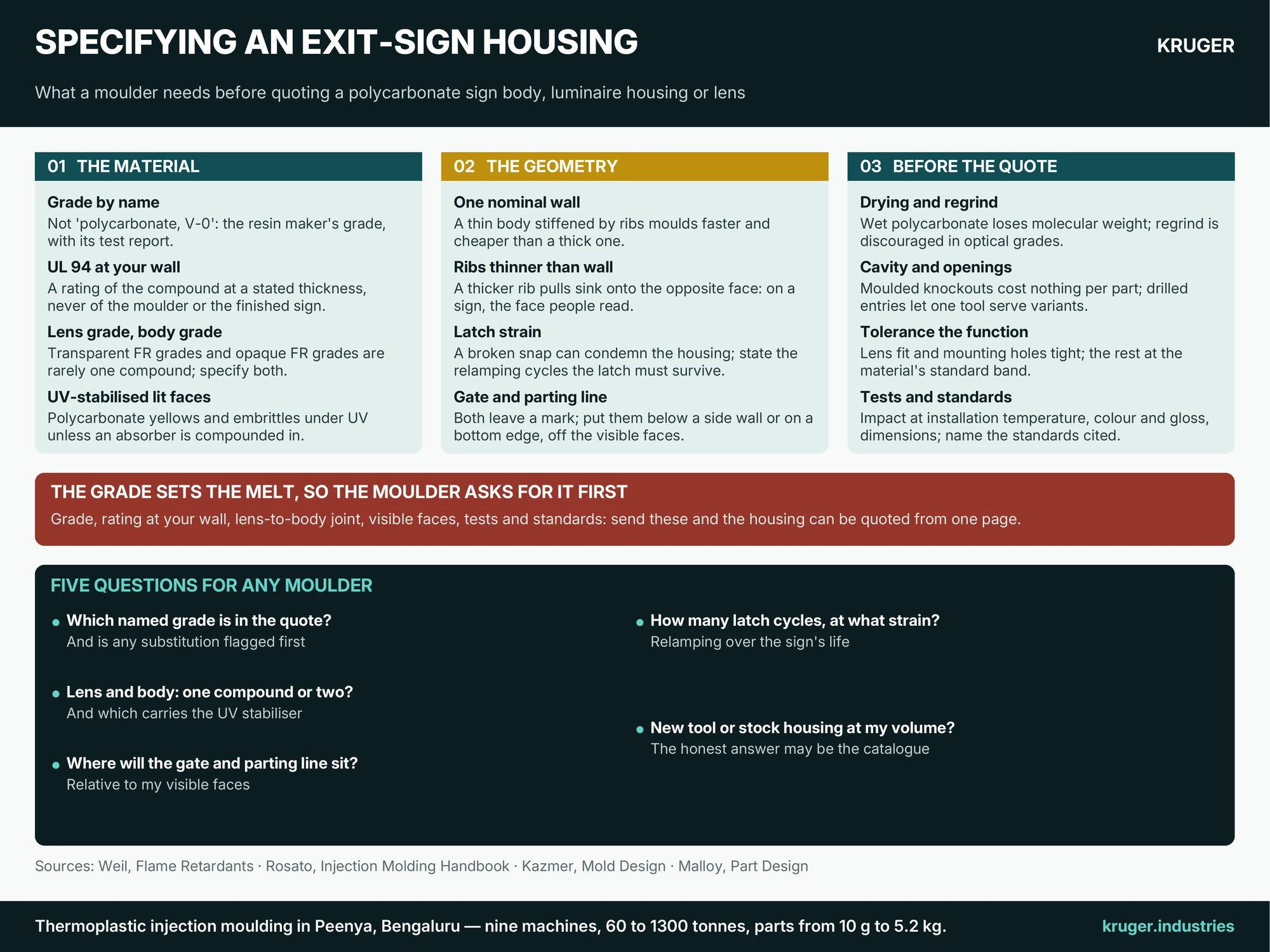
An exit-sign body, a luminaire housing or a lens can be quoted from one complete page of specification, or after a month of questions. It carries the lighting OEM’s decisions: grade, flame-retardant rating and wall, the lens-to-body joint, the faces that are seen, and the tests the tender names. Polycarbonate exit signs and coach louvers are among the parts we mould, on machines from 60 to 1300 tonnes.
The grade, and what its rating means
Name the polycarbonate grade, not the family, and give the flame-retardant class as a UL 94 rating of that material at your wall, as the resin maker’s report prints it: a property of the compound at that thickness, never a certification of the moulder or the finished sign (see our UL 94 guide). Morgan and Wilkie’s flame-retardant handbook notes that polycarbonate by itself passes little more than HB or V-2, so V-0 grades carry additives, and “polycarbonate, V-0” without a grade name cannot be quoted.
Lens grade, body grade
A lit face wants light through it; a body wants none. Weil and Levchik’s handbook describes transparent V-0 polycarbonates built on sulfonate salts, and notes that the PTFE drip suppressants in other grades favour opacity. Lens and body are therefore rarely one compound. For the lens, specify transmission or diffusion grade, colour against a master (our colour guide) and UV stabilisation for faces under a lamp or window: Fried’s polymer text notes that polycarbonate yellows and embrittles under UV without an absorber. The body takes the opaque grade, matched to the frame.
Walls, ribs and the lens-to-body joint
Give one nominal wall; ribs stiffen a thin body that moulds faster and cheaper than a thick one (our wall thickness guide). Kazmer’s mould-design text keeps each rib thinner than the wall it stands on, because a thicker rib pulls sink onto the opposite face, on a sign the face people read. The lens meets the body on snap latches or a living hinge (our snap-fit and living-hinge guide). Malloy’s design text states the risk: a broken latch can condemn the whole moulding, and the strain at its root must stay within the resin maker’s figure for the grade, lower where it is opened repeatedly. State the relamping cycles.
Visible faces, gate and parting line
Mark the visible faces and give each a finish grade or texture reference (our surface finish guide). Kazmer notes that a gate leaves a witness mark, so a moulder hides it beneath a side wall or under a texture, and that the parting line leaves a faint line, so it belongs on a bottom edge; say where both may sit. Osswald’s processing text adds that on a clear lens the flow pattern shows as birefringence.
Drying, and why the grade comes first
Polycarbonate is dried before moulding: Rosato’s handbook explains that water in the melt cuts the polymer’s molecular weight and its properties, and that the resin comes in low, medium and high molecular-weight grades of rising viscosity, so the grade sets the melt temperature and pressure the machine must deliver. Sulfonate-based flame-retardant grades, Weil and Levchik warn, lose properties if overheated. Hence the moulder’s first question; our drying guide lists the records to ask for. Rosato’s handbook discourages regrind in optical grades; write the lens’s rule down.
Cavity, cable entries and knockouts
Draw the cavity to the lamp or LED board, and decide which openings are moulded and which are secondary. A knockout moulded as a thin membrane costs nothing per part; a cable entry drilled afterwards costs an operation on every piece but lets one tool serve several variants. Say whether the legend is printed, in relief or a film; exit signs we mould are printed, assembled and packed here.
Tolerances, tests and standards
Tolerance the function: lens-to-body fit and mounting holes tight; the rest at the material’s standard band (our tolerances guide). Write the acceptance tests: impact at the installation temperature (an unheated stairwell is not a laboratory), colour and gloss against the master, and dimensions, with the sample size per lot. Name the standards the tender cites: IEC 60598-1 for luminaires and IEC 60598-2-22 for emergency luminaires, EN 1838 for the lighting application, ISO 7010 for the exit pictogram, IS 10322 (Part 5/Sec 8) in India and UL 924 in the United States; several were revised between 2024 and 2026, so check the edition. Testing and any listing of the finished sign belong to the sign maker; we mould the housing to the drawing and supply the material certificate.
When a stock housing is the better buy
Lighting-component catalogues carry bodies and lenses already tooled. For a short run, a trial market or a legend that will change next year, a stock housing with your print beats a new tool, and we will say so. A new tool earns its place when the volume is there or the form factor is yours alone; for a worn tool you own, send drawings and shot history and we check machine fit before quoting.
Five questions for any housing moulder
- Which named grade is in your quote, and will you tell me before any equivalent is substituted?
- Lens and body: one compound or two, and which carries the UV stabiliser?
- Where will the gate and parting line sit relative to my visible faces?
- How many latch cycles, at what strain?
- At my volume, is a new tool or a stock housing the right buy?
Send the drawing or the sign itself, the grade or the performance you need, the annual volume and the finish, and we quote the tool and the piece, or tell you plainly that a stock housing is the better buy.
Sources quoted: E. D. Weil and S. V. Levchik, Flame Retardants for Plastics and Textiles, 2nd ed. (Hanser, 2016); A. B. Morgan and C. A. Wilkie (eds), The Non-halogenated Flame Retardant Handbook (Scrivener/Wiley, 2014); T. A. Osswald, Understanding Polymer Processing, 2nd ed. (Hanser, 2017); J. R. Fried, Polymer Science and Technology (Prentice Hall PTR, 1995); D. V. Rosato, D. V. Rosato and M. G. Rosato, Injection Molding Handbook, 3rd ed. (Kluwer Academic, 2000); D. O. Kazmer, Injection Mold Design Engineering (Hanser, 2007); R. A. Malloy, Plastic Part Design for Injection Molding (Hanser, 1994).