
/ KNOWLEDGE · TOOLING
Mould Maker or Moulder: Who Should Build Your Tool?
Search for an injection mould manufacturer and two kinds of company answer: toolrooms that sell moulds, and moulders that sell parts and take on the mould as part of the job. Before you place a tooling order, decide which of the two you are buying from, because that choice settles who answers when the first parts are wrong. This page sets out who does what, where each route fails and what to send either way; the tool itself is explained in our tooling guide.
Three jobs behind every mould
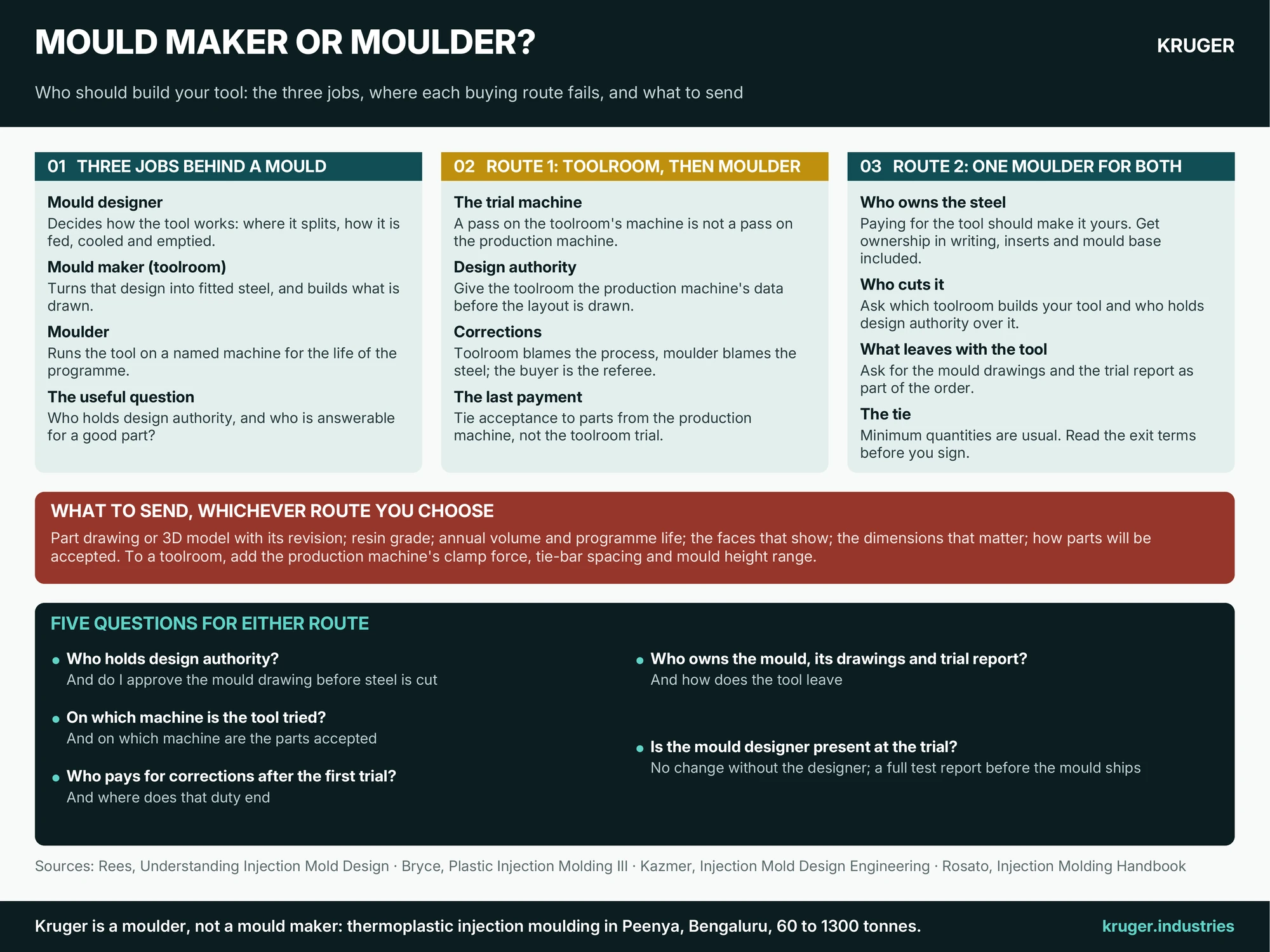
A mould needs three jobs done. The mould designer decides how the tool works: where it splits, how it is fed, cooled and emptied. The mould maker, or toolroom, turns that design into fitted steel. The moulder runs the tool on a named machine for the life of the programme. Rees traces how the trade settled into this split: the drawings became the authority, the designer answers for whether the mould works, and the toolroom builds what is drawn.
The three jobs can sit in one company, in two or in three. So the useful question is who holds design authority, and who is answerable for a good part.
Route 1: an injection mould manufacturer first, a moulder second
You buy the mould from a toolroom, then place it with a moulder of your choice or run it in your own plant. It suits a buyer who moulds the parts, needs a tool and nothing else, or has a part that calls for a specialist. Toolrooms specialise: a shop set up for large enclosure tools is rarely the right choice, or the right price, for a small gear, and the reverse is just as true. The route fails in four places.
- The trial machine. Many toolrooms try a new mould on a machine of their own, which saves sending it to the moulder and back for every adjustment. But a pass on the toolroom’s machine is not a pass on the production machine.
- Design authority. A tool designed without knowing where it will run can be a sound mould on the wrong machine. Give the toolroom the production machine’s data and the moulder’s mould standards before the layout is drawn.
- Corrections. When parts fail at the moulder, the toolroom blames the process and the moulder blames the steel. You are the referee, and usually the payer. The general rule Bryce gives is that the customer must supply a tool able to make good parts, and the moulder’s duty to maintain it begins only from there.
- The last payment. In the typical purchase agreement Kazmer describes, the final third of the mould price falls due when the quality of the moulded parts is accepted. Write into the order that acceptance means parts from the production machine, not from the toolroom trial.
Route 2: tool and parts with one moulder
One order covers the mould and the parts, and one company answers for both. The moulder designs for its own machines, tries the tool on the machine that will run it, and has nobody else to blame for a short shot. For a buyer who wants parts, not a mould, it is the shorter road. It fails in different places.
- Who owns the steel. Bryce’s starting point is that whoever pays for the mould owns it, but a tooling line on an invoice does not record that. Get ownership in writing. Ask whether your cavity inserts will sit in the moulder’s own mould base, because then the inserts are all you can take away.
- Who cuts it. Few moulders cut every tool themselves. Ask which toolroom builds yours, and who holds design authority over it.
- What leaves with the tool. A moulder building for its own floor may leave out things a mould-making business would include. Ask for the mould drawings and the trial report as part of the order.
- The tie. A combined contract usually carries minimum quantities. Read the exit terms before you sign: notice, tool release and what is owed.
Five questions for either route
- Who holds design authority, and do I approve the mould drawing before steel is cut? Our mould design review page lists what to check.
- On which machine is the tool tried, and on which machine are the parts accepted?
- Who pays for corrections after the first trial, and where does that duty end? Our guide to comparing quotations shows where the answer belongs.
- Who owns the mould, its drawings and its trial report, and how does the tool leave? Our mould transfer process shows what a receiving moulder asks for.
- Is the mould designer present at the trial? Rees insists on it, on no change to the mould during the test without the designer, and on a full test report before the mould is shipped.
Where Kruger stands
Kruger is a moulder, not a mould maker. We design the tool, partner toolrooms cut it under our design authority, and it is proved on our machines before you see a part. You pay for the mould and you own it. We do not build moulds for parts that will run elsewhere, so if you need a tool and nothing else, an injection mould manufacturer is your supplier and the list below is your brief.
What to send, whichever route you choose
To either supplier: the part drawing or 3D model with its revision, the resin grade, the annual volume and programme life, the faces that show, the dimensions that matter and how parts will be accepted.
To a toolroom, add the production machine’s clamp force, tie-bar spacing and mould height range. Rosato’s handbook lists what the written order should carry: the mould specification sheet, the total price, the payment terms and a firm shipping date. Our mould cost guide explains what moves the price.
To us, send the same pack through the RFQ page. The offer keeps the tooling price separate from the part price and states the cavitation and the steel.
Sources quoted: H. Rees, Understanding Injection Mold Design (Hanser, 2001); D. M. Bryce, Plastic Injection Molding, Vol. III: Mold Design and Construction Fundamentals (Society of Manufacturing Engineers, 1998); D. O. Kazmer, Injection Mold Design Engineering (Hanser, 2007); D. V. Rosato, D. V. Rosato and M. G. Rosato (eds), Injection Molding Handbook, 3rd edition (Kluwer Academic Publishers, 2000).