
/ KNOWLEDGE · DESIGN
Specifying low-voltage electrical enclosures and insert-moulded connector caps for a quotation
A moulder can quote an enclosure from a drawing that names the material grade, the ingress protection the assembly must pass and every insert it must hold; “polycarbonate, IP-rated, brass inserts” comes back as questions. Here is what a switchgear, metering, controls or connector OEM should put on that drawing for a body, lid, terminal cover or insert-moulded cap. Our electrical and connectors page shows what we mould for the sector; our insert moulding guide explains the process.
Material by grade, with its test values
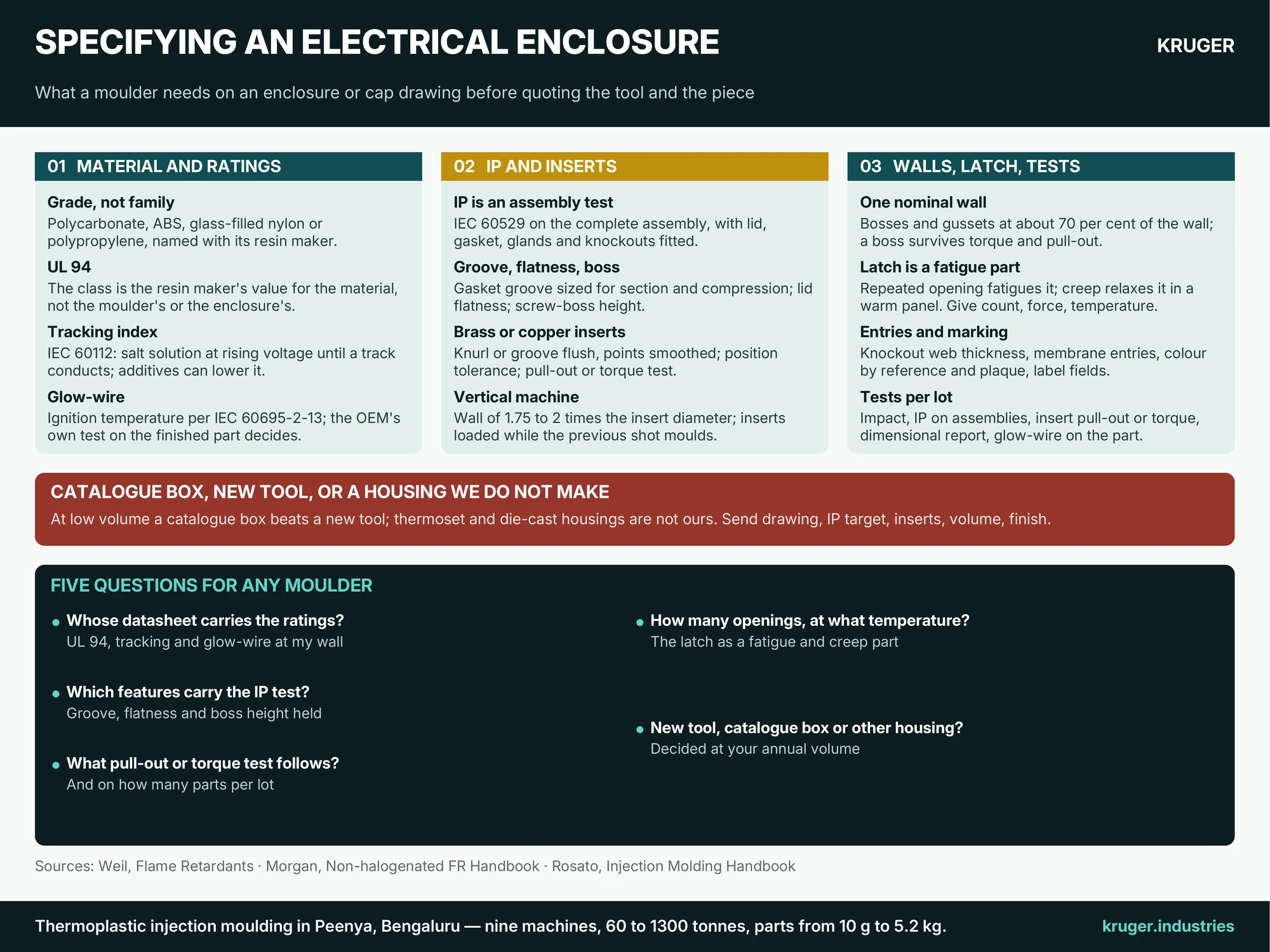
Name a grade and its maker, not a family: polycarbonate, ABS (our ABS guide), glass-filled nylon or polypropylene. Three test values travel with it, all the resin maker’s, not the moulder’s or the finished enclosure’s: the UL 94 class (our UL 94 guide), the comparative tracking index and glow-wire data. Weil’s handbook describes the IEC 60112 tracking test as a salt solution dropped at rising voltage until a track conducts, and warns that in nylons glass fibre and some flame-retardant additives can lower it. Glow-wire ignition temperature comes from IEC 60695-2-13; Morgan’s handbook adds that the glow-wire flammability test is run on the finished part, with results differing by up to 150 °C between operators and rigs: the rating an OEM certifies against is its own test.
Ingress protection is an assembly test
Name the IP code as a test under IEC 60529 on the complete assembly, lid, gasket, glands and knockouts fitted; a moulded body alone has no IP rating. For every standard, check which edition your specification cites. The code fixes three features: the gasket groove, sized for gasket section and compression; lid flatness, since a lid bowing between screws opens the gasket; and screw-boss height, which sets that compression.
Terminal and earthing inserts
Brass or copper inserts for terminals and earthing are placed in the open tool and locked in by the melt. Malloy’s part-design text prefers brass, and softer metals, because a misplaced one damages the tool less. Draw the insert fully: the knurl or groove that anchors it, flush so it cannot jack out, its points smoothed because Rosato’s handbook warns a sharp edge acts as a notch; its position tolerance; and the pull-out force or torque it must survive. As it cools the plastic shrinks onto the insert and a thin wall around it cracks, so Rosato’s rule of thumb is a wall of 1.75 to 2 times the insert diameter. Insert moulding usually runs on a vertical machine, ours included: Bryce explains inserts are loaded while the previous shot moulds.
Walls, ribs, bosses and latches
Give one nominal wall (our wall thickness guide) and hold the lid to it. Stiffen with ribs, not mass, sized as that guide says. Kazmer’s mould-design text sizes screw bosses and gussets at about 70 per cent of the wall, and asks that a boss survive driving torque and pull-out without a thick section that sinks. A latch on a lid opened for inspection is a fatigue part: Malloy warns that snap joints assembled repeatedly can fail by fatigue, especially in filled grades, and that creep rises with stress and temperature, so a latch holding a gasket compressed in a warm panel relaxes with time. Specify opening count, holding force and temperature; our snap fits guide covers the geometry.
Entries, colour and marking
Mark every cable entry as moulded through, a knockout for site, or a membrane to pierce, and give the knockout web thickness: the mould must fill it and the fitter break it cleanly. Colour by a named reference and master plaque, with UV stability from the datasheet for outdoor boxes. Reserve flat fields for labels and the rating plate.
Tolerances that matter
Kazmer’s advice is one general tolerance and a few tight ones where function demands. For an enclosure those are lid-to-body fit, gasket groove, DIN-rail or panel-mounting features and insert positions; give rail profile and hole pattern as the datum. Our tolerances guide carries the bands.
Tests and sample size
Write the acceptance tests: impact at your market’s low temperature, IP test on assembled samples, pull-out or torque on inserts, dimensional report, and flammability or glow-wire test on the finished part, with sample size per lot. The moulder supplies material certificate, inspection report and certificate of conformance for an empty enclosure in the sense of IEC 62208; verification under the IEC 61439 series stays with the assembly maker, any listing with the product owner.
Catalogue box, new tool, or a housing we do not make
Below the minimum our quote form prints for the part’s weight, a catalogue enclosure beats a new tool; a tool pays when volume, or a feature the catalogue lacks, justifies it. Some duties want a housing we do not make: a thermoset body where a cured resin’s arc or heat resistance is specified, or a die-cast body for heavy mechanical or screening duty. Morgan’s handbook expects low-voltage protection parts to move from thermoset to thermoplastic once standards admit halogen-free grades. We mould thermoplastics only and say so in the first reply.
Five questions for any enclosure moulder
- Whose datasheet carries the UL 94, tracking and glow-wire values for my grade at my wall?
- Which features carry the IP test, and how are groove, flatness and boss height held?
- What pull-out or torque test follows moulding, and on how many parts?
- How many openings, at what temperature, is the latch designed for?
- At my volume, is a new tool, a catalogue enclosure or a different housing the right buy?
Send the drawing, material or performance class, IP target, insert drawings, annual volume and finish, and we quote the tool and the piece, or tell you which route fits.
Sources quoted: E. D. Weil, S. V. Levchik, Flame Retardants for Plastics and Textiles, 2nd ed. (Hanser, 2016); A. B. Morgan and C. A. Wilkie (eds), The Non-halogenated Flame Retardant Handbook (Scrivener/Wiley, 2014); D. V. Rosato, D. V. Rosato and M. G. Rosato, Injection Molding Handbook, 3rd ed. (Kluwer Academic, 2000); R. A. Malloy, Plastic Part Design for Injection Molding (Hanser, 1994); D. O. Kazmer, Injection Mold Design Engineering (Hanser, 2007); D. M. Bryce, Plastic Injection Molding, Vol. II (Society of Manufacturing Engineers, 1997).