
/ KNOWLEDGE · MATERIALS
Polyethylene (HDPE and LDPE) injection moulding — a buyer’s guide
Polyethylene is cheap, tough, chemically resistant and almost indifferent to water, which is why it fills crates, caps, covers, containers and household goods. It is a poor choice for anything that must hold a tight dimension, and a buyer who knows that before the drawing is signed saves a tooling iteration. Bryce calls it a crystalline commodity resin with excellent chemical resistance and a slippery, non-stick surface, and Arburg says plainly that it is not used for precision components because of high shrinkage and after-shrinkage. This page covers the grades, how polyethylene behaves in the machine, why tolerances must be loose, and five questions for any moulder. It follows our materials guide.
Which polyethylene?
Arburg separates low-density polyethylene (LDPE, 0.91 to 0.94 g/cm³, strongly branched molecules) from high-density polyethylene (HDPE, 0.94 to 0.96 g/cm³, few branches), and adds that properties depend on density and on molecular length. As density and molecular weight rise and melt flow index falls, hardness, rigidity and the upper operating temperature rise, brittleness at low temperature and the tendency to stress cracking fall, and the material becomes harder to injection-mould because flow is reduced. So “HDPE” on a drawing is not a specification: the grade, its flow index and its stabilisation are. Arburg notes that polyethylene becomes brittle under UV unless it is stabilised, so an outdoor part needs that stated. Its list of injection-moulded uses is plain: drain lugs, covers, containers, bottle crates, household articles and toys. Bryce adds laboratory ware and chemical apparatus, where the chemical resistance and non-stick surface earn their keep.
Water is not the problem
Polyethylene absorbs no water, so Arburg says pre-drying is generally not required, apart from a short period if surface moisture has built up in an unsealed container after long storage. The same low surface energy that gives chemical resistance makes gluing, printing and lacquering possible only after pre-treatment (Arburg), a point to settle before a decoration or bonding step is planned. Arburg also notes high gas permeability compared with many plastics, though very low steam permeability. Our guide to drying covers the materials that do need it.
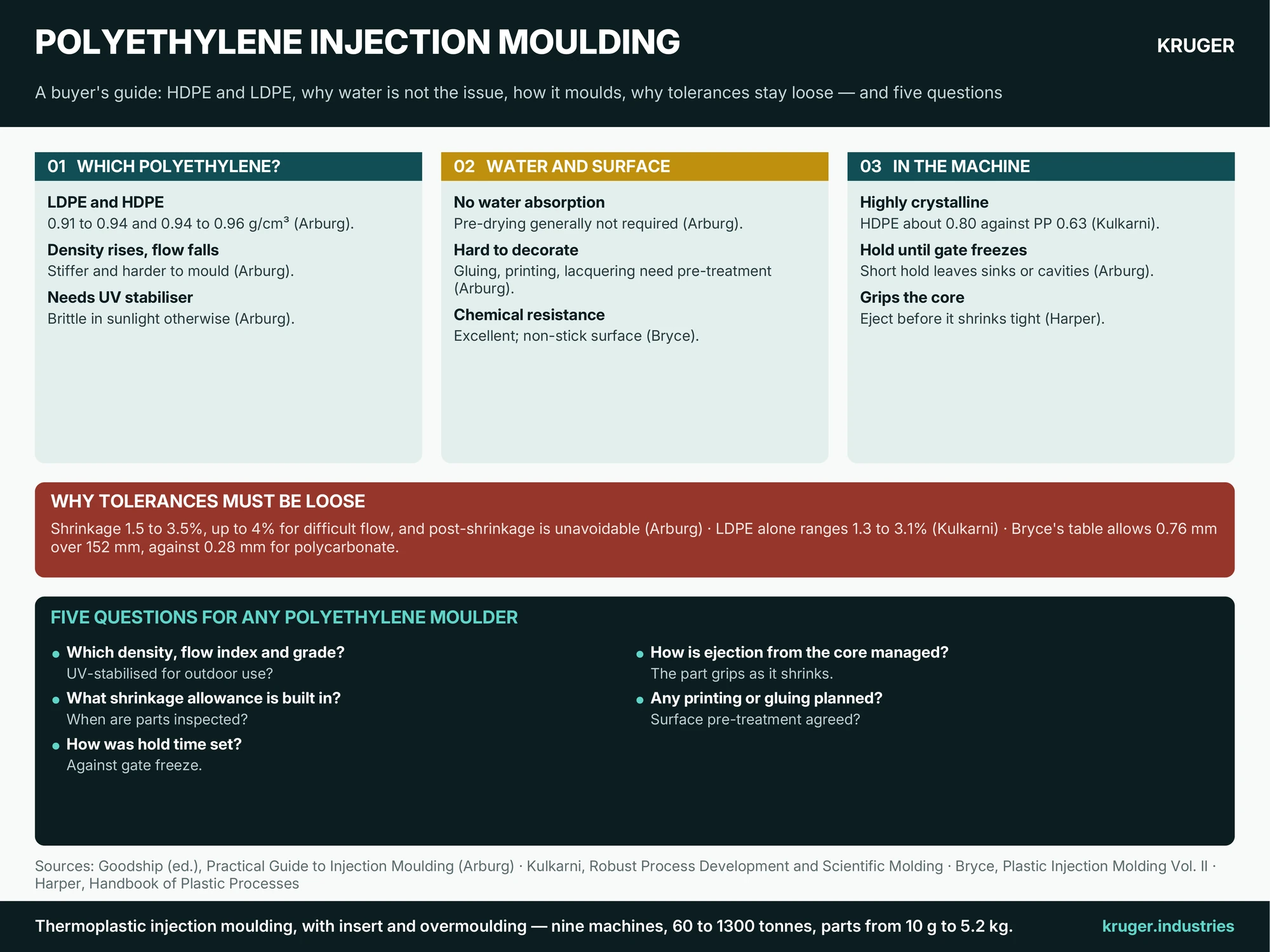
How polyethylene behaves in the machine
- Crystalline. Kulkarni’s table gives high-density polyethylene a degree of crystallinity of about 0.80, higher than isotactic polypropylene at 0.63; Arburg ties polyethylene’s unavoidable post-shrinkage to crystallisation that cannot finish in the tool.
- A warmer mould helps appearance. Arburg: higher mould temperature gives more gloss and more crystallisation, so less after-shrinkage, but too hot a mould brings ejection difficulty because the compound sticks. The range is in our temperature chart. Low melt temperatures leave dull points on the part.
- Pressure. Arburg gives about 500 bar for LDPE up to 1,200 bar for HDPE.
- Hold time matters. If the holding-pressure time ends before the gate freezes, Arburg warns, the high shrinkage leaves sink marks or cavities. See our guide to sink marks.
- Ejection from cores. Harper notes that high-shrinkage materials such as polypropylene and polyethylene grip the core as they shrink, so ejection force climbs if the part is left too long.
Why tolerances must be loose
Arburg gives processing shrinkage of 1.5 to 3.5% for easy-flowing types and 2 to 4% for difficult ones, and says post-shrinkage is unavoidable, because even with a warm mould cooling is too fast for crystallisation to finish in the tool. Kulkarni puts LDPE alone at 1.3 to 3.1%, “a wide range” that makes life hard for the mould maker, and Harper lists 0.010 to 0.030 in/in. Bryce’s tolerance table shows the result: 0.76 mm preferred over a 152 mm dimension for polyethylene, the loosest of any material in the table, against 0.28 mm for polycarbonate. Read our guides to tolerances and the shrinkage calculator before asking for more. Bryce adds the commercial point, that tighter tolerances cost more money to produce, so a tolerance a polyethylene part cannot naturally hold is paid for in tooling iterations, sorting and rejects.
Five questions for any polyethylene moulder
- Which density, which melt flow index, which named grade, and is it UV-stabilised if the part lives outdoors?
- What shrinkage and post-shrinkage allowance is built into the tool, and when are parts inspected after moulding?
- How was hold time set against gate freeze?
- How is ejection from the core managed when the part grips as it shrinks?
- Is any printing, gluing or lacquering planned, and has the surface pre-treatment been agreed?
Send the part drawing and the duty it must survive, and we will go through these questions with you.