
/ KNOWLEDGE · DESIGN
Metal to Plastic Conversion: Which Parts Are Worth It?
A metal part is worth converting to plastic when a moulding designed for plastic can carry its load, at its temperature, for its whole service life, and when the annual quantity repays a mould. Below are five screening questions for any metal to plastic conversion, the parts that should stay in metal, and what to send for a conversion review.
Redesign the part, do not copy it
Malloy’s part-design text makes the point with two all-plastic garden hose nozzles. One looks much like the die-cast nozzle before it, its designer plainly led by the metal shape. The other does the same job by different means and looks nothing like it. Only what a standard fixes, such as the inlet thread, has to carry over. So in a conversion the interfaces stay and everything between them is open. Walls, ribs, bosses and draft follow our design for mouldability rules, and several metal pieces with their fasteners can often become one moulding. That consolidation, more than the price of the material, is usually where the saving sits.
1. Load and creep
Every structural material cares how long a load acts, and plastics care more. A thermoplastic under steady load goes on deforming slowly, which is creep, and after long loading it can break at a stress below its short-term strength. So the tensile strength on a datasheet is not the design figure: ask for creep data for the named grade at your temperature and service life. A press fit or a clamped joint loses grip as the stress relaxes, which is why converted parts so often carry metal inserts at the fixing points. Fibre reinforcement resists creep better than a particulate filler does, and glass-filled nylon is the usual first candidate; our glass-filled nylon specification guide covers what to put on that drawing.
2. Temperature
A plastic part loses stiffness and creep resistance as it warms and toughness as it cools, so state the whole range. Thermoplastics also move more than metals as the temperature changes: in Rosato’s worked example a long thermoplastic section of high expansion, fixed to a heavy steel member, shrinks roughly ten times as far as the steel does, so a plastic cover on a metal frame needs slotted holes or floating fixings. And plastics insulate. Low thermal conductivity becomes a problem in an enclosure whose contents generate heat, so a die-cast housing that doubles as a heat sink is a poor candidate.
3. Stiffness
As materials, thermoplastics are far less stiff than steel or aluminium. The stiffness of a part, though, is the modulus of the material multiplied by a property of its shape, so what the material lacks the section can supply: ribs, curvature and deeper sections in place of thick walls. This is also where the weight saving comes from. Stiffness at a low density, set against metals, is the main reason for choosing reinforced plastics. Our polymer composites guide sets out what reinforcement costs in return.
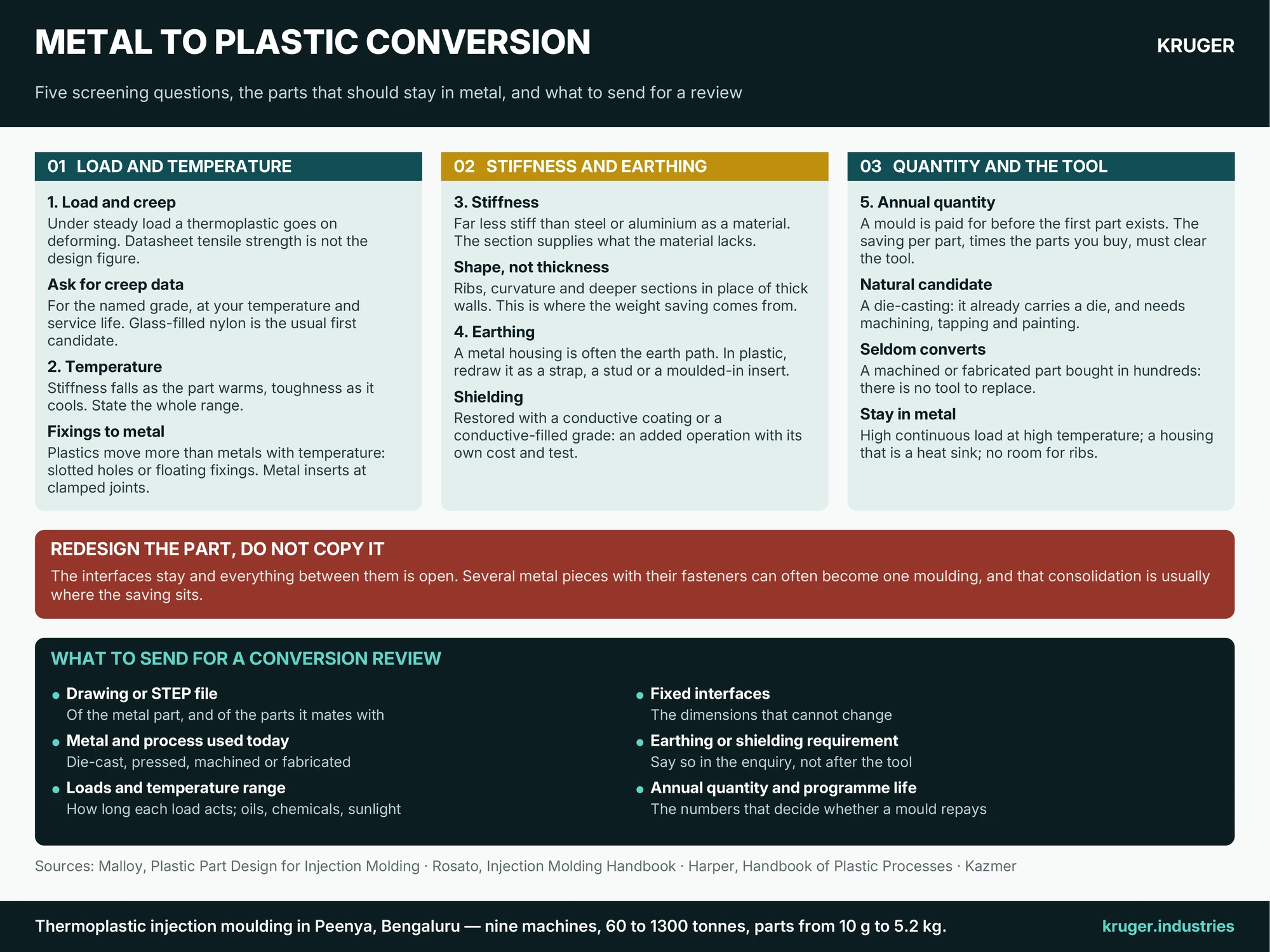
4. Earthing and shielding
A metal housing conducts, and it often does two unwritten jobs: it is part of the protective earth path, and it screens the electronics inside from interference. A thermoplastic housing does neither by itself. Sometimes the insulation is the gain. Otherwise the earth path has to be redrawn as a strap, a stud or a moulded-in insert, and the screening restored with a conductive coating or a conductive-filled grade. Interference shielding is one of the main uses of plated and metallised plastics. Either route is an added operation with its own cost and test, so the requirement belongs in the enquiry.
5. Annual quantity against tool cost
A mould is paid for before the first part exists. The arithmetic is simple: total cost is the fixed cost of the mould plus the quantity multiplied by the cost of each further part. A conversion pays only when the saving on each part, multiplied by the parts you will really buy, clears the tool. A die-casting already carries a die, and usually needs machining, tapping and painting that a moulding can deliver finished, so it is the natural candidate. A machined or fabricated part bought in hundreds has no tool to replace and seldom converts. Our mould cost guide explains what drives the tool price, and the RFQ page publishes our usual minimum annual quantity by part weight.
Parts that should stay in metal
- High continuous load at high temperature, where no grade has creep data that covers the duty.
- A housing whose main job is to carry heat away.
- No room for ribs or section depth inside the envelope.
- Quantities too small to repay a mould.
What to send for a conversion review
- The drawing or STEP file of the metal part, and of the parts it mates with.
- The metal and the process used today: die-cast, pressed, machined or fabricated.
- The loads, and how long each one acts.
- The operating temperature range and the surroundings: oils, chemicals, sunlight.
- The fixed interfaces: the dimensions that cannot change.
- Any earthing or shielding requirement.
- Annual quantity and programme life.
Five questions for any moulder
- Which features would you redesign, and which interfaces stay as drawn?
- Which creep data, at my temperature and service life, are the walls and ribs sized from?
- Where does the part meet metal, and how is the difference in expansion taken up?
- How is earthing or shielding restored, and who tests it?
- At what annual quantity does the mould pay for itself against my metal price?
Our HVAC and refrigeration page carries a standing offer: a free review of up to ten parts you buy in metal today. For any other sector, send the drawings through the RFQ page with the list above. We mould thermoplastics only, and the reply says which parts can move as drawn, which need redesign first, which need a metal insert and which should stay in metal.
Sources quoted: R. A. Malloy, Plastic Part Design for Injection Molding (Hanser, 1994); D. V. Rosato, D. V. Rosato and M. G. Rosato, Injection Molding Handbook, 3rd ed. (Kluwer Academic, 2000); C. A. Harper (ed.), Handbook of Plastic Processes (Wiley, 2006); V. Goodship, ARBURG Practical Guide to Injection Moulding (Rapra Technology, 2004); D. O. Kazmer, Injection Mold Design Engineering (Hanser, 2007).