
/ KNOWLEDGE · MATERIALS
Acetal (POM) injection moulding — a buyer’s guide
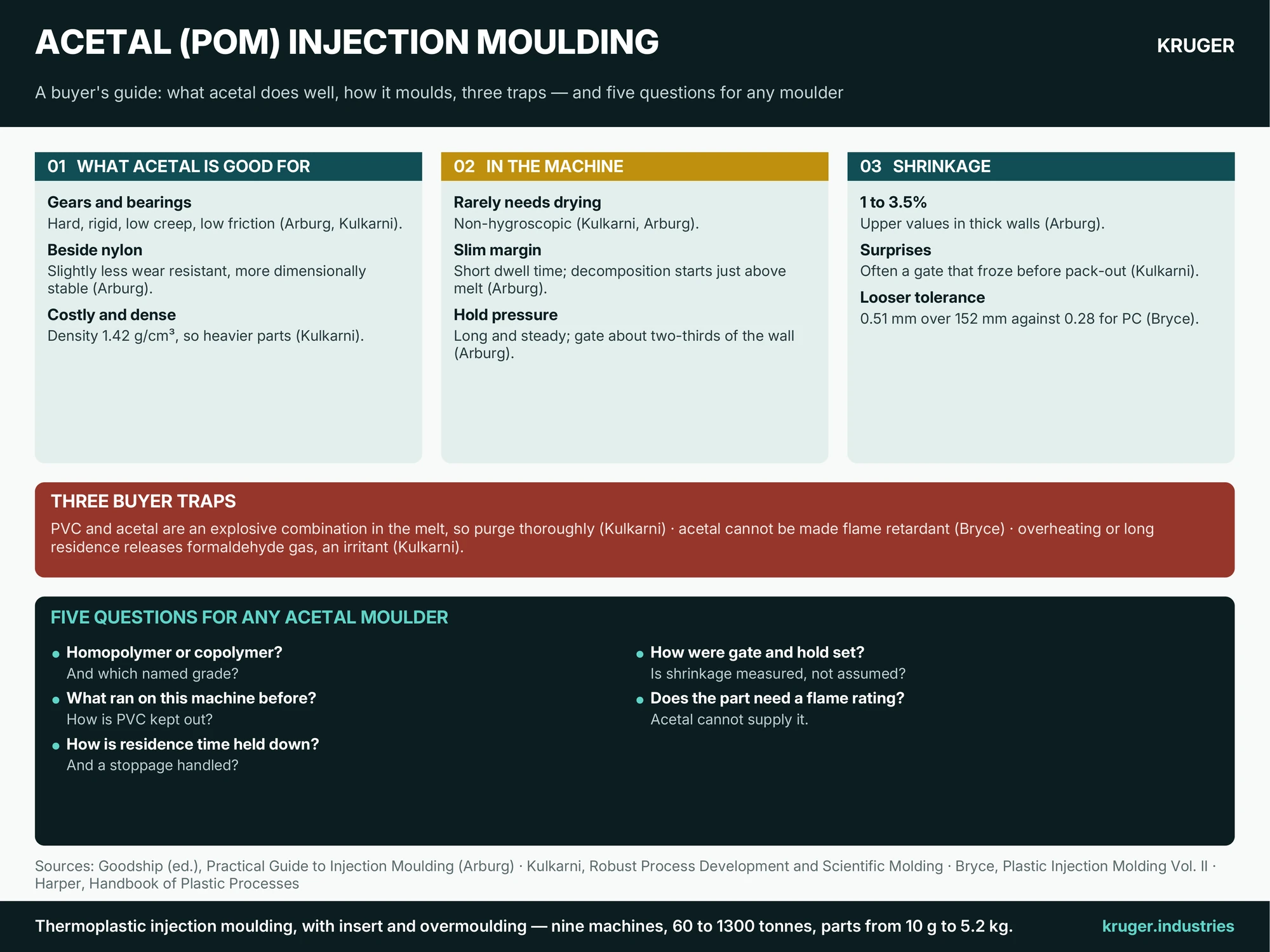
Acetal, properly polyoxymethylene or POM, is the material engineers reach for when a part must slide, wear and hold its shape: gears, bearings, bushings, conveyor parts. Its weak spots are not obvious from a datasheet: little margin before the melt degrades, a dangerous reaction with PVC, and a shrinkage that surprises people who trust the published figure. Arburg lists high hardness and rigidity, low creep, good friction and wear properties and low moisture absorption; Bryce adds ease of machining and resistance to most solvents. This page covers what acetal is good for, how it behaves in the machine, three buyer traps, and five questions for any moulder. It follows our materials guide.
What acetal is good for
Arburg places acetal beside the nylons for friction and wear parts but with better dimensional stability: wear resistance slightly below PA 66, with a lower coefficient of friction. It is cold resistant, resistant to petrol, oil and many solvents, and practically free of stress cracking in air. Copolymers also resist alkali solutions (Arburg). Kulkarni points to gears, bearings and conveyor parts as natural candidates, and says the cost of acetal is fairly high; with a density of 1.42 g/cm³, much higher than olefins or nylons, a part also weighs more, which counts against acetal when it competes with other materials. Our nylon guide covers the main alternative. Arburg gives the upper operating temperature as 100 °C, or 150 °C for brief periods, and notes that natural acetal is strongly whitish-opaque, which matters for colour matching (see our colour guide). Kulkarni reports excellent resistance to organic solvents at moderate temperature, but some phenolic materials react with it at higher temperature and its resistance to inorganic chemicals is low, so list every fluid the part will meet.
How acetal behaves in the machine
- Drying is usually unnecessary. Arburg says pre-drying is generally not required, and Kulkarni calls acetal non-hygroscopic, though surface drying helps in humid weather. Arburg recommends vacuum drying only for microcomponents or very moist material.
- Flow is very good, and Kulkarni calls melt processing fairly easy.
- The margin before degradation is slim. Arburg asks for the shortest possible dwell time in the cylinder, says decomposition starts only a little above the melt temperature, and recommends open nozzles where possible. Copolymers are somewhat less sensitive to overheating than homopolymers. Kulkarni adds that degradation releases formaldehyde gas, an irritant. Working ranges are in the temperature chart.
- Holding pressure must be sufficient and last, with no pressure jumps during the hold, so that crystallisation is uniform. For precision parts Arburg asks for gates of around two-thirds of the maximum wall thickness, so the pressure can act for as long as possible.
Shrinkage that surprises
Arburg gives processing shrinkage of 1 to 3.5%, with the upper values for thick walls, and Harper lists 0.020 to 0.035 in/in. Post-shrinkage falls as processing shrinkage rises, and Arburg says it can be forestalled by re-heating. Kulkarni reports a typical complaint, that parts show shrinkage far from the published values, and traces it usually to the gate freezing before the part is packed out; enlarging the gate helps. In Bryce’s tolerance table acetal needs a looser band than polycarbonate: 0.51 mm preferred over 152 mm against 0.28 mm. Our guides to tolerances and the shrinkage calculator show how to use these figures.
Three buyer traps
- PVC contamination. Kulkarni warns that acetal and PVC are a known explosive combination in the melt, so any chance of mixing must be avoided and PVC must be thoroughly purged before an acetal run. Ask what ran on the machine before and how the changeover was recorded, and read our guide to purging and changeovers.
- No flame-retardant grade. Bryce states that acetal cannot be made flame retardant. If a part needs a UL 94 rating, acetal is out; see our UL 94 guide.
- High density. Part weight, and so material cost, is higher than the same volume in an olefin or nylon (Kulkarni).
Five questions for any acetal moulder
- Homopolymer or copolymer, and which named grade?
- What ran on this machine before, and how is PVC kept out of the barrel?
- How is residence time held down, and what happens to the melt at a stoppage?
- How were gate size and hold time set, and what shrinkage will be measured, not assumed?
- Does the part need a flame rating? If so, acetal cannot supply it.
Send the part drawing and the duty it must survive, and we will go through these questions with you.