
/ KNOWLEDGE · DESIGN
DIN Rail Enclosure: Specifying a Custom Moulded Housing
A DIN rail enclosure is the one plastic housing whose outside is decided by other people: the rail it clips to, the cover it sits behind and the devices on either side. This page is for the maker of a relay, meter, power supply or IoT module choosing between a catalogue module and a custom moulded one, and then writing the drawing.
Catalogue module or custom DIN rail enclosure
A catalogue module comes in fixed widths with fixed terminal positions, with no tool to pay for. A custom housing costs a tool first, then arrives with your terminal pitch, light positions and brand already in it. Our guide to a custom enclosure for a PCB works out where the two routes cross. Most rail module bodies fall in the two lightest bands of our published minimum: about 100,000 parts a year under 50 g and 50,000 from 50 g to 250 g. Below that, buy the catalogue module; our reply will say so.
What the housing must match: two standards
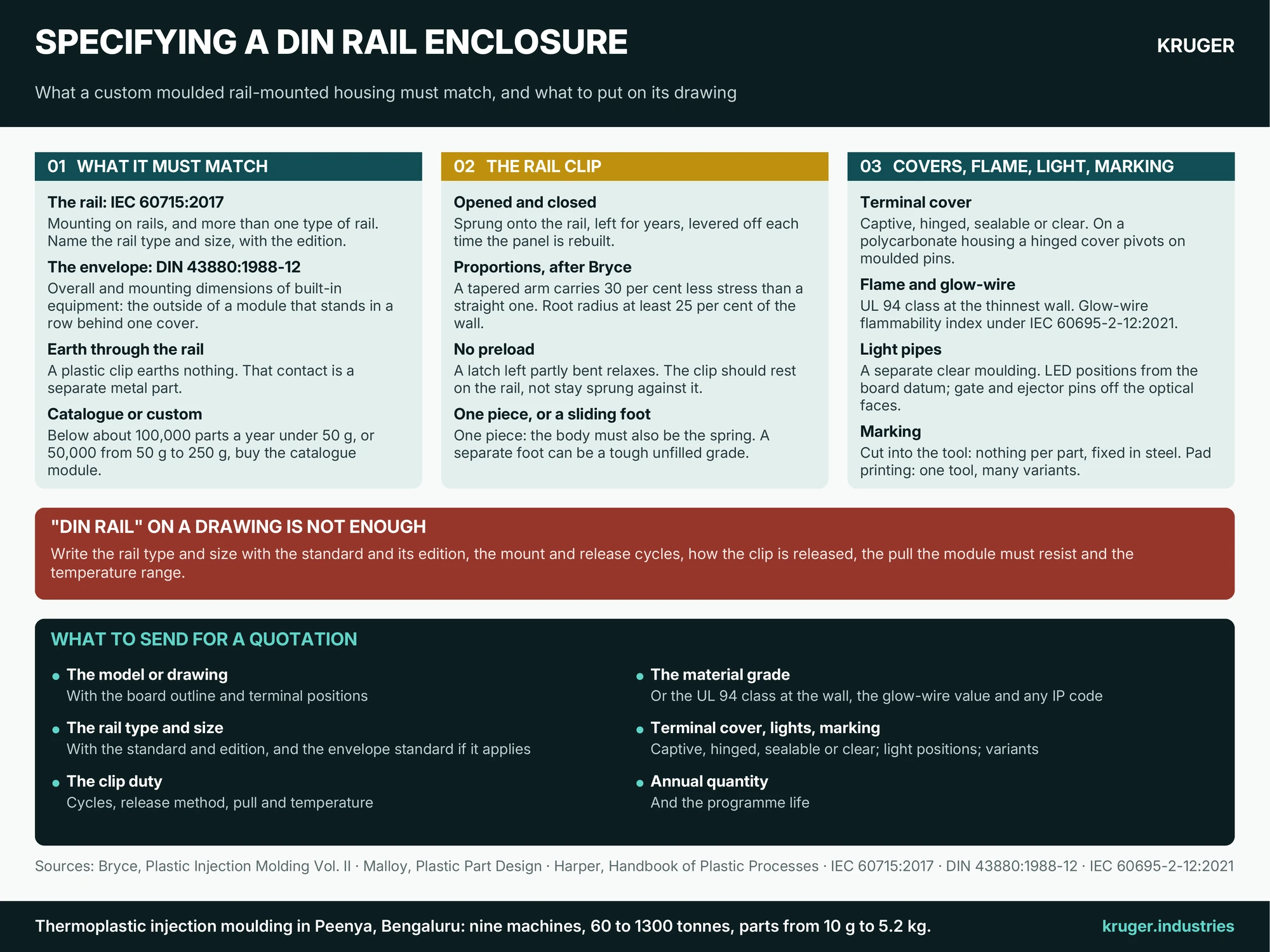
The rail. IEC 60715:2017 sets the dimensional and functional requirements for mounting switchgear, controlgear and accessories on rails, and it covers more than one type of rail. So “DIN rail” on a drawing is not enough. Name the rail type and size, and cite the standard and edition as the datum for the clip. The 2017 edition leaves the rail’s role as a protective earth to each product standard. A plastic clip earths nothing, so if your product earths through the rail, that contact is a separate metal part.
The envelope. DIN 43880:1988-12 gives the overall dimensions, and the mounting dimensions that go with them, of built-in equipment for electrical installations. If your module must stand in a row with other makers’ devices behind one cover, its outside comes from this document, not from your board. We print no dimensions: read them in the documents.
The rail clip is a snap fit that is opened and closed
A lid snap may close once. A rail clip is sprung onto the rail, sits there for years, and is levered off each time the panel is rebuilt. Bryce’s product-design volume gives the proportions: a tapered arm carries 30 per cent less stress than a straight one, and the root radius should be at least 25 per cent of the nominal wall. He also warns against a latch left partly bent to grip harder, because the plastic relaxes and the grip fades. A clip should rest on the rail, not stay sprung against it.
Malloy’s part-design text adds that snaps worked repeatedly can fail by fatigue, a particular risk in brittle, filled or fibre-reinforced grades, and that a latch released by hand wants a moulded stop to limit how far it bends. Two ways to build the clip:
- Moulded in one piece with the body. No extra part, but the body material must also be the spring, and the hook is an undercut the tool has to release.
- A separate sliding foot. A second small tool, yet the foot can be a tough unfilled grade under a glass-filled or flame-rated body, and a broken foot does not scrap the housing.
On the drawing: mount and release cycles, release method, the pull to resist and the temperature range. Hook geometry is in our snap fits guide.
Terminal covers
The cover keeps fingers and stray wire off live screws. Say whether it is captive, hinged, sealable or clear. A living hinge belongs to polypropylene, not to a stiff flame-rated body, so a hinged cover on a polycarbonate housing pivots on moulded pins or snaps on as a separate part. If you need an IP code under IEC 60529, write it for the module with its covers fitted: it is a test of the assembled product, as our enclosure specification guide explains. We mould the body, the clip and the terminal cover from one source, as our electrical enclosures page shows.
Flame class and glow-wire
“FR grade” settles nothing. Write the UL 94 class at the housing’s thinnest wall. Then write the glow-wire flammability index under IEC 60695-2-12:2021, a materials test on standard specimens that finds the highest wire temperature at which the material either does not ignite or goes out soon after the wire is withdrawn. It is the resin maker’s value, used to preselect a material. The finished module is judged under the end-product glow-wire test your product standard calls up, and that result is yours. Tracking index is covered in our connector housing guide.
One UL 94 V-2 polypropylene copolymer grade has run here. No V-0 polycarbonate or glass-filled nylon grade has run yet, so we quote one with a trial.
Light pipes and marking
A light pipe is a separate clear moulding that carries each LED’s light from the board to the front face. Give the LED positions from the board’s own datum, and mark the optical faces so that the gate and the ejector pins are kept off them.
Legends can be made two ways. Cut into the tool, terminal numbers cost nothing per part but are fixed in steel. Pad printing, an inked silicone pad pressed onto the part, lets one tool serve many variants. Say which legends change between variants.
What to send for a quotation
- The model or drawing, with the board outline and terminal positions.
- The rail type and size, with the standard and edition, and the envelope standard if it applies.
- The clip duty: cycles, release method, pull and temperature.
- The material grade, or the UL 94 class at the wall, the glow-wire value and any IP code.
- The terminal cover: captive, hinged, sealable or clear.
- Light positions, marking method and variants.
- Annual quantity and programme life.
Send these through our RFQ page. Madhusudhan, our Head of Production, replies with DFM feedback within 48 hours on working days. The tools are built by a partner toolroom under our design authority and stay your property.
Sources quoted: D. M. Bryce, Plastic Injection Molding, Vol. II: Material Selection and Product Design Fundamentals (Society of Manufacturing Engineers, 1997); R. A. Malloy, Plastic Part Design for Injection Molding (Hanser, 1994); C. A. Harper (ed.), Handbook of Plastic Processes (Wiley, 2006). Standards named: IEC 60715:2017, Dimensions of low-voltage switchgear and controlgear: Standardized mounting on rails for mechanical support of switchgear, controlgear and accessories; DIN 43880:1988-12, Built-in equipment for electrical installations; overall dimensions and related mounting dimensions; IEC 60529, Degrees of protection provided by enclosures (IP Code); IEC 60695-2-12:2021, Glow-wire flammability index (GWFI) test method for materials; UL 94. Check the current edition of each before relying on it.