
/ KNOWLEDGE · MATERIALS
Polypropylene injection moulding — a buyer’s guide
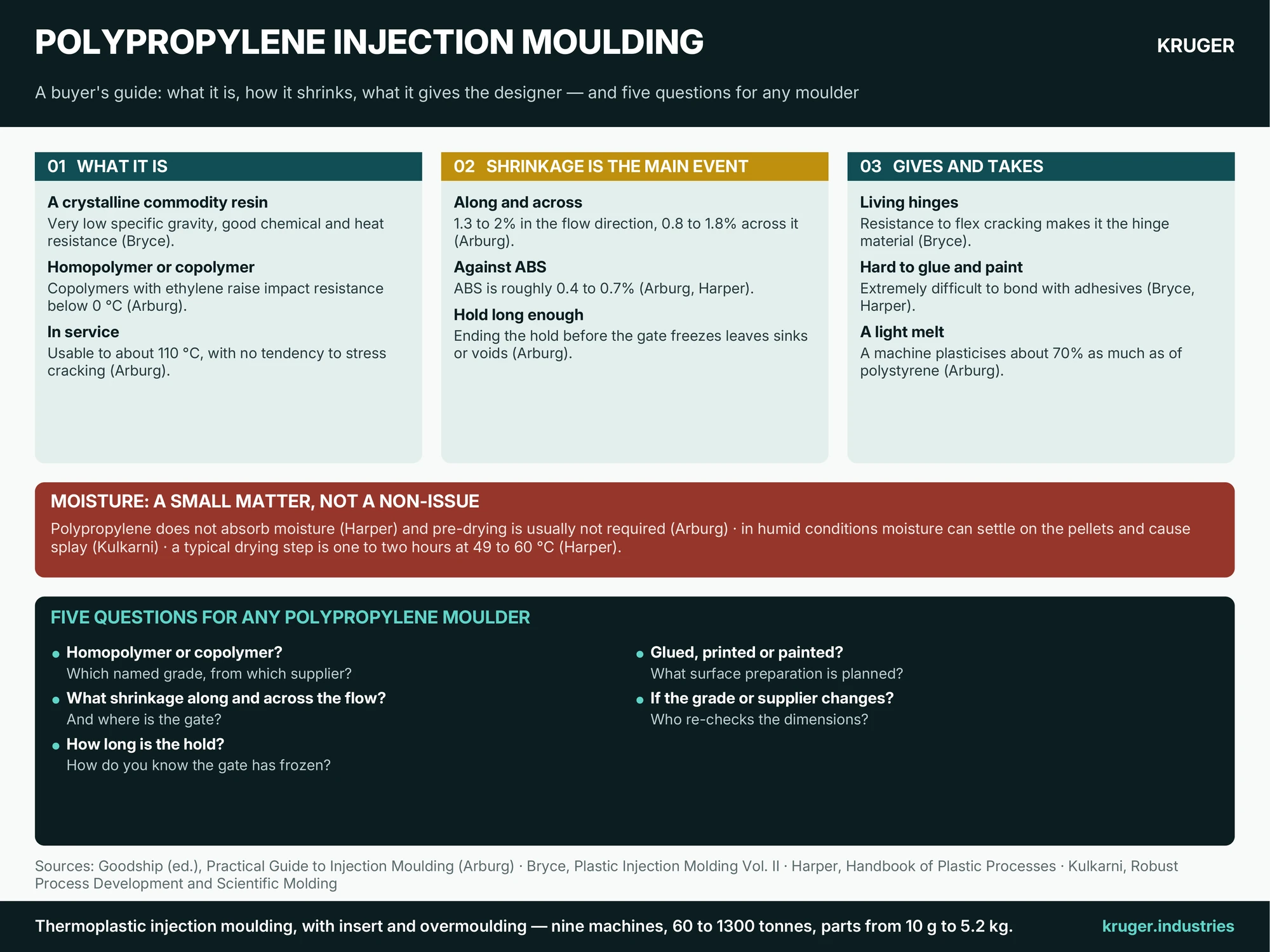
Polypropylene is light, cheap, chemically tough and easy to mould, and it shrinks three or four times as much as ABS. Those two facts explain most of what goes right and wrong with a polypropylene (PP) part. Bryce describes it as a crystalline commodity resin with a very low specific gravity, good chemical and heat resistance, and excellent resistance to flex cracking. This page covers what PP is, how its shrinkage behaves, where it helps and hinders the designer, and five questions for any moulder. As our materials guide says, “polypropylene” is a family name, not a specification.
What polypropylene is
The Arburg guide explains that PP’s properties depend on how regularly its side groups are arranged along the chain. The regular (isotactic) form crystallises well and has a density of about 0.90 g/cm³. Copolymers with ethylene exist to raise impact resistance below 0 °C, which is why the first question to ask is homopolymer or copolymer. Arburg lists PP as more rigid and harder than polyethylene, usable to about 110 °C, with no tendency to stress cracking, and names typical parts: fan wheels, vehicle heating ducts, washing-machine internals, transport cases and containers with film hinges. It also flows more easily than polyethylene, which helps thin walls and long flow paths to fill.
Shrinkage is the main event
Arburg puts PP’s processing shrinkage at 1.3 to 2% along the direction of flow and 0.8 to 1.8% across it. Harper’s table gives a wider band of 0.8 to 3.0%. For comparison, both books put ABS at roughly 0.4 to 0.7%. Three consequences follow.
- Shrinkage differs with direction, so gate position decides how a part shrinks and whether it stays flat. See our guide to warpage.
- Tolerances are wider. A band that ABS holds easily may be unrealistic in PP; our tolerances guide gives the bands by material.
- The grade moves the dimension. Harper notes that the rate of crystallisation affects shrinkage and that nucleated grades behave differently, so a change of grade or supplier can shift a part that was in tolerance.
Holding pressure has to last. Arburg’s advice for PP is a sufficiently long holding time, as for polyethylene, where it warns that ending the hold before the gate freezes leaves sink marks or voids because the shrinkage is so high. Harper adds an ejection risk: high-shrinkage materials grip the core, and ejector pins can then mark the part or push into it.
Moisture: a small matter, not a non-issue
Harper lists PP among the polymers that do not absorb moisture, and Arburg says pre-drying is usually not required. Kulkarni adds the caveat: in humid conditions moisture can settle on the surface of the pellets and cause splay, so a short drying step may still be needed. Harper’s table gives one to two hours at 49 to 60 °C. Processing temperatures are in our temperature chart, and the wider subject in our guide to drying plastics.
What PP gives the designer, and what it takes away
- Living hinges. Bryce credits PP’s resistance to flex cracking for its popularity in hinges moulded as part of the component. See snap fits and living hinges.
- Parts that strip off the mould. Harper allows flexible materials such as PP an undercut of 5 to 10%, but warns that above 5% risks permanent damage, particularly in polypropylene.
- Chemical resistance, with a price. The resistance that suits PP to containers also makes it hard to glue and paint. Bryce calls PP and polyethylene extremely difficult to bond with adhesives and prefers mechanical fixing; Harper says the same of painting semi-crystalline materials. Harper also records polypropylene copolymer in battery applications; our guide to battery containers covers that duty.
- A light melt. Because PP’s density is low, Arburg notes that a machine plasticises only about 70% as much of it as of polystyrene. A machine’s shot capacity, usually quoted in polystyrene, must be corrected; our shot-size calculator does the arithmetic.
Five questions for any polypropylene moulder
- Homopolymer or copolymer, and which named grade from which supplier?
- What shrinkage is assumed along and across the flow, and where is the gate?
- How long is the hold, and how do you know the gate has frozen?
- If the part must be glued, printed or painted, what surface preparation is planned?
- If the grade or supplier changes, who re-checks the dimensions?
Send the part drawing and the duty it must survive, and we will go through these questions with you.