
/ KNOWLEDGE · QUALITY
Stress cracking in moulded plastics — why a part that passed inspection cracks in the field
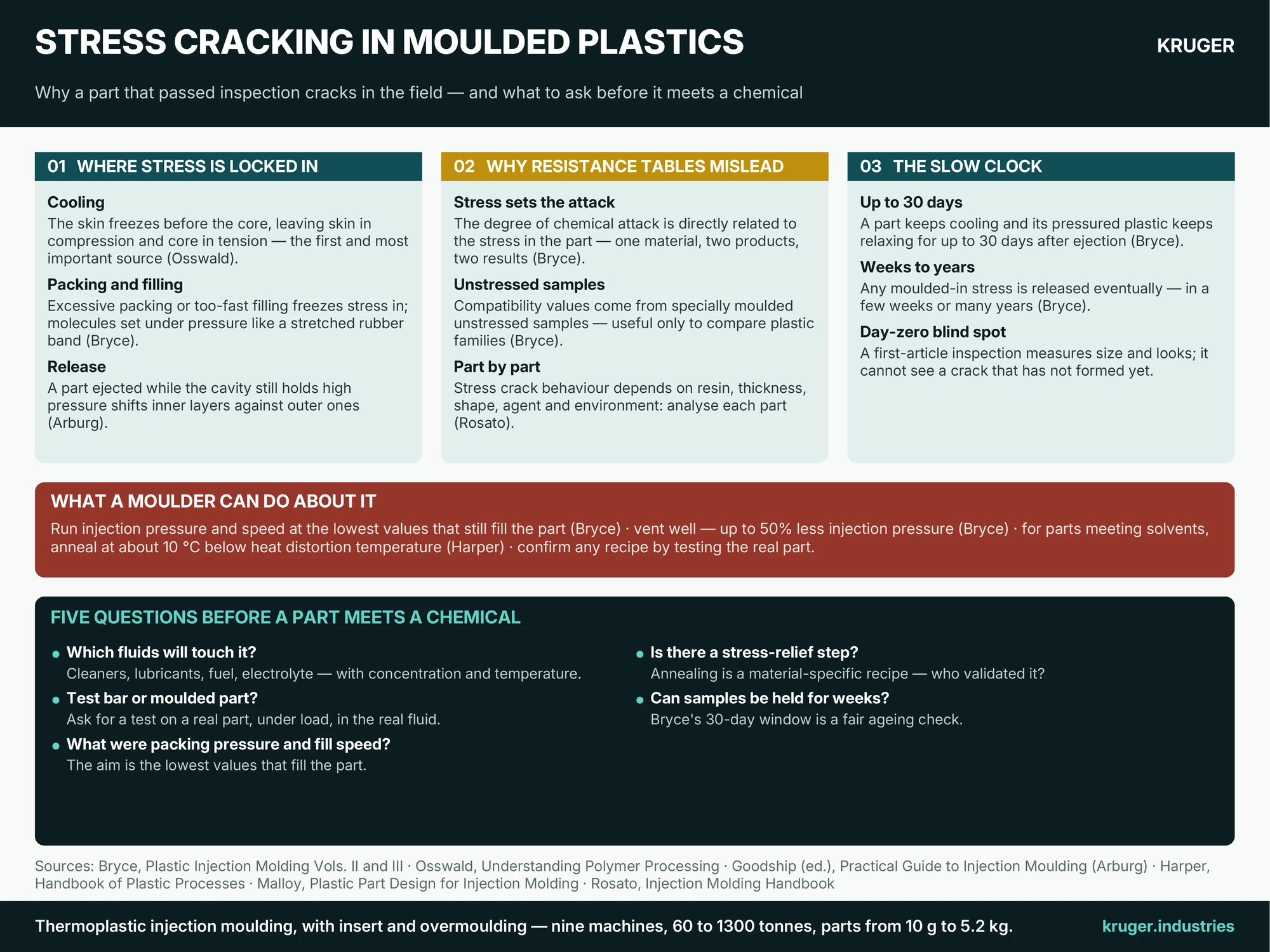
A moulded part rarely cracks because the plastic was wrong; it cracks because stress was frozen into it at the press and something in its working life found it. Bryce ranks moulded-in stress as “the single most significant cause of field failure” of an injection moulded product, contamination aside — and it fails slowly, weeks after the delivery was signed off, in contact with a cleaner, a lubricant or an acid. This page covers where the stress comes from, why a chemical-resistance table does not protect you, and what to ask a moulder before a part meets a chemical.
Where the stress is locked in
Osswald traces residual stress to two coupled sources, cooling and flow, and ranks cooling first. The skin of a part freezes before the core, so as the core contracts it leaves the skin in compression and itself in tension. Bryce’s picture of the second source is vivid: injection lines the molecules up like strands of spaghetti, and they freeze under pressure before they can relax, like a rubber band frozen mid-stretch. Machine settings add to it. Bryce names excessive packing and too-fast filling; Arburg adds a part released while the cavity still holds high pressure, which shifts the inner layers against the outer ones. Bryce also warns that ejecting a part with too little draft, or over a rough cavity surface, can crack it outright.
Why the resistance table misleads
Bryce states the key fact plainly: the degree of chemical attack on a thermoplastic is directly related to the stress in the part, so one material can behave differently in two products. Published compatibility values come from specially moulded, conditioned, unstressed samples, which makes them useful only for comparing plastic families. Malloy adds that stressed parts may craze or crack at low stress levels in a hostile chemical environment. Arburg notes that alkali solutions or grease often cause cracks only after a very long time in service, and Rosato warns that excessive frozen-in stress does most damage where chemicals or heat are present. There is no tidy rule by polymer family either: Bryce says amorphous materials resist stress cracking better than crystalline ones, while Arburg flags polycarbonate and polystyrene as susceptible with certain media. Rosato’s conclusion is the practical one — each part must be analysed in its own right.
The slow clock
The stress does not announce itself. Bryce notes that a part keeps cooling, and its pressured plastic keeps relaxing, for up to 30 days after ejection, and that any moulded-in stress will be released eventually, in a few weeks or many years. A first-article inspection on day zero measures dimensions and appearance; it cannot see a crack that has not formed. That is why in-process records, not only a first-article report, belong in the quality paper trail.
What a moulder can do about it
Bryce’s first remedy is the plainest: run injection pressure and speed at the lowest values that still fill the part. Venting helps too — he reports that a well-vented mould can need up to 50 per cent less injection pressure, reducing moulded-in stress with it. For a part that will meet solvents, Harper describes annealing: heating the part to about 10 °C below its heat distortion temperature to relieve internal stress before contact, and he singles out acrylic and polycarbonate as the plastics where solvent attack on stressed regions shows most. Arburg gives a polystyrene example of the same idea — a post-cure just under the deformation temperature, cooled slowly, for parts that will meet stress-cracking media. These are material-specific recipes, not a universal step, and only a trial on the real part will confirm that one works.
Five questions before a part meets a chemical
- Which fluids will touch it, at what concentration and temperature? Cleaners, lubricants, fuel and electrolyte all count; say so before the tool is cut.
- Is the resistance data from a test bar or from a moulded part? Bryce says the tables come from unstressed samples, so ask for a test on a real part, under load, in the real fluid.
- What were the packing pressure and fill speed? The aim is the lowest values that fill the part.
- Is there a stress-relief step, and who validated it? Annealing is a material-specific recipe with its own cost.
- Can samples be held for weeks before release? Bryce’s 30-day relaxation window is the length of a fair ageing check.
Our battery container guide shows one application where acid, load and heat meet in a moulded box; how to read a plastics datasheet explains why a test bar is not your part; the defects guide places stress whitening and cracks among the defect families; and the injection pressure guide shows where the pressure behind moulded-in stress is spent. Send the drawing and tell us which chemicals the part will meet.
Sources quoted: D. M. Bryce, Plastic Injection Molding, Vol. II (Society of Manufacturing Engineers, 1997).