
/ KNOWLEDGE · MATERIALS
Flame-retardant plastics and UL 94 — what a buyer must verify before specifying one
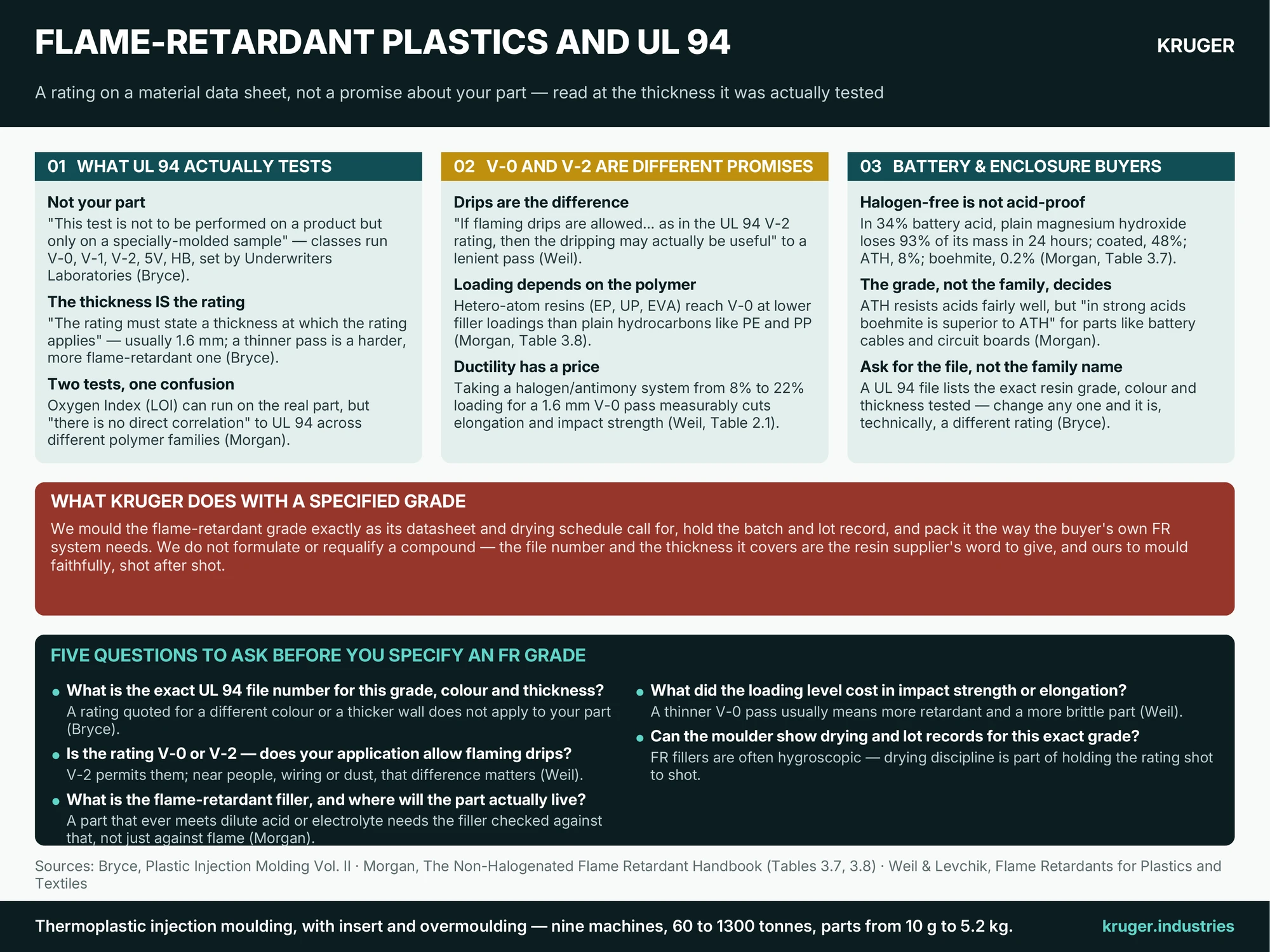
A UL 94 rating belongs to a material at a stated thickness and colour — never to your finished part. Underwriters Laboratories’ flammability classes (V-0, V-1, V-2, 5V, HB) sit on almost every datasheet for an electrical enclosure, a connector housing or a battery-adjacent part, and are almost as often misread. Bryce’s plastics-industry handbook is blunt about the gap between the test and the product: the class is earned by purpose-made laboratory specimens, and in his words it “may not reflect the actual response of a molded product to a given situation.” Our materials guide covers the resin families; this page covers the one rating buyers most often accept without checking.
What the test actually measures
The method, run under Underwriters Laboratories’ own guidelines, exposes a specimen to a flame, removes it, and records the afterburning time, any dripping, and how far any flame travels; the numbers are totalled into a class. Bryce draws two boundaries around the result. First, the test is never run on a finished product — only on a sample of the specific material, moulded for the purpose. Second, and this is the detail most datasheets bury in a footnote, every rating has to carry the wall thickness it was earned at. The customary figure is 1.6 mm (0.062 in), though other thicknesses are permitted, and Bryce’s rule of thumb is that “the lower the thickness mentioned in the rating, the more flame retardant the plastic material.” A V-0 rating at 3.2 mm and one at 1.6 mm are not the same promise, and an untested thinner wall carries no rating at all.
V-0 and V-2 do not mean the same thing
The descending scale — V-0, V-1, V-2, then unclassified — hides a real difference in what the material is allowed to do while it burns. Weil and Levchik’s flame-retardant handbook, discussing styrenic polymers, explains that at fire temperatures these resins break back down towards their monomers, while the melt softens, flows and falls away in drops — and, as the authors warn, “the drips may be capable of igniting other flammable objects.” They then point out the awkward corollary: where a test standard permits flaming drips, as the UL 94 V-2 class does, “the dripping may actually be useful to meet lenient flame retardancy requirements,” because material that falls away takes flame with it. A V-2 grade can be a legitimate, cheaper choice for the right part — never near wiring, dust or people, where a flaming drip matters.
The loading level is a trade-off, not a free upgrade
How much flame retardant a resin needs to reach V-0 depends on the base polymer, not only on the additive. Morgan’s non-halogenated flame-retardant handbook shows that resins with oxygen or nitrogen already built into the backbone — epoxies, unsaturated polyesters, EVA — need less mineral filler to pass than plain hydrocarbon chains do; in Morgan’s phrasing, the hetero-atom polymers come out “classified V0 already at lower filling levels than the hydrocarbons PE and PP.” Pushing any system to pass at a thinner wall costs something. Weil’s own side-by-side data for a brominated polypropylene system shows it: at 8% flame retardant and 3% antimony trioxide, the compound reached only V-2 at 3.2 mm, with 5.5% elongation at yield and 42.7 J/m Izod impact strength; raised to 22% flame retardant and 6% antimony trioxide to reach V-0 at the thinner 1.6 mm wall, elongation fell to 4.0% and Izod impact strength roughly halved, to 21.4 J/m. A thinner, more impressive rating on the datasheet can arrive with a part that cracks more easily in the hand.
A note for battery and enclosure buyers specifically
Flame retardancy and chemical resistance are not the same property, and assuming “halogen-free FR” means “acid-proof” is choosing the wrong filler for the wrong reason. Morgan’s own solubility data, run in battery-strength 34% sulphuric acid for 24 hours, shows how far apart common metal-hydroxide flame retardants sit: uncoated magnesium hydroxide lost 93% of its mass; coated, 48%; aluminium hydroxide, 8%; boehmite, just 0.2%. Morgan’s verdict is short — “in strong acids boehmite (AOH) is superior to ATH” — and he names battery cables and printed circuit boards as exactly the kind of application where that difference earns its keep. The lesson for anyone specifying a flame-retardant battery-adjacent enclosure or a housing for an electrical connector is that the family name on a datasheet — “mineral filled,” “halogen-free,” “non-halogen FR” — tells you almost nothing about acid resistance. The actual filler chemistry does.
Five things to get from your resin supplier before you sign off an FR grade
- The exact UL 94 file number, for this grade, this colour, at this thickness. A rating quoted for a different colour or a thicker wall does not cover your part.
- Whether the rating is V-0 or V-2 — and whether your application can tolerate a flaming drip. Near wiring, dust or people, it usually cannot.
- What the flame-retardant filler actually is, and where the part will live. A part anywhere near acid, electrolyte or a caustic cleaning agent needs the filler checked against that environment, not only against flame.
- What the loading level did to impact strength and elongation. A thinner-wall V-0 pass is rarely free, as the numbers above show.
- Whether the moulder can show drying and lot records for that exact grade. Flame-retardant fillers are frequently hygroscopic; our drying guide and quality paper trail cover what that record should look like.
Kruger moulds thermoplastic flame-retardant grades exactly as their datasheet and drying schedule specify. We mould the compound; we do not formulate or requalify one, and the UL 94 file for a given grade, colour and thickness is the resin supplier’s document to provide, not ours to infer. What we do own is traceability — batch and lot records, and the machine-health and drying discipline set out in our quality paper trail. Send us the datasheet and the UL 94 file for the grade you are specifying, and we will tell you plainly whether it is one of ours to run.
Sources quoted: D. M. Bryce, Plastic Injection Molding, Vol. II (Society of Manufacturing Engineers, 1997); E. D. Weil and S. V. Levchik, Flame Retardants for Plastics and Textiles (Hanser, 2016); A. B. Morgan and C. A. Wilkie (eds), The Non-halogenated Flame Retardant Handbook (Scrivener/Wiley, 2014).