
/ KNOWLEDGE · SPECIFYING COLOUR
Colour in injection moulding — how to specify it so every batch matches
Colour is the first thing your customer sees and often the last thing specified properly. “Match this,” plus a photograph taken under office lighting, is how colour disputes are manufactured. Colour in moulding is chemistry, process control and measurement — which means it can be specified like any other engineering requirement. This guide explains how colour gets into a part, why it drifts between batches even when nobody changed anything, and what a colour specification that prevents arguments contains.
Three routes to a coloured part
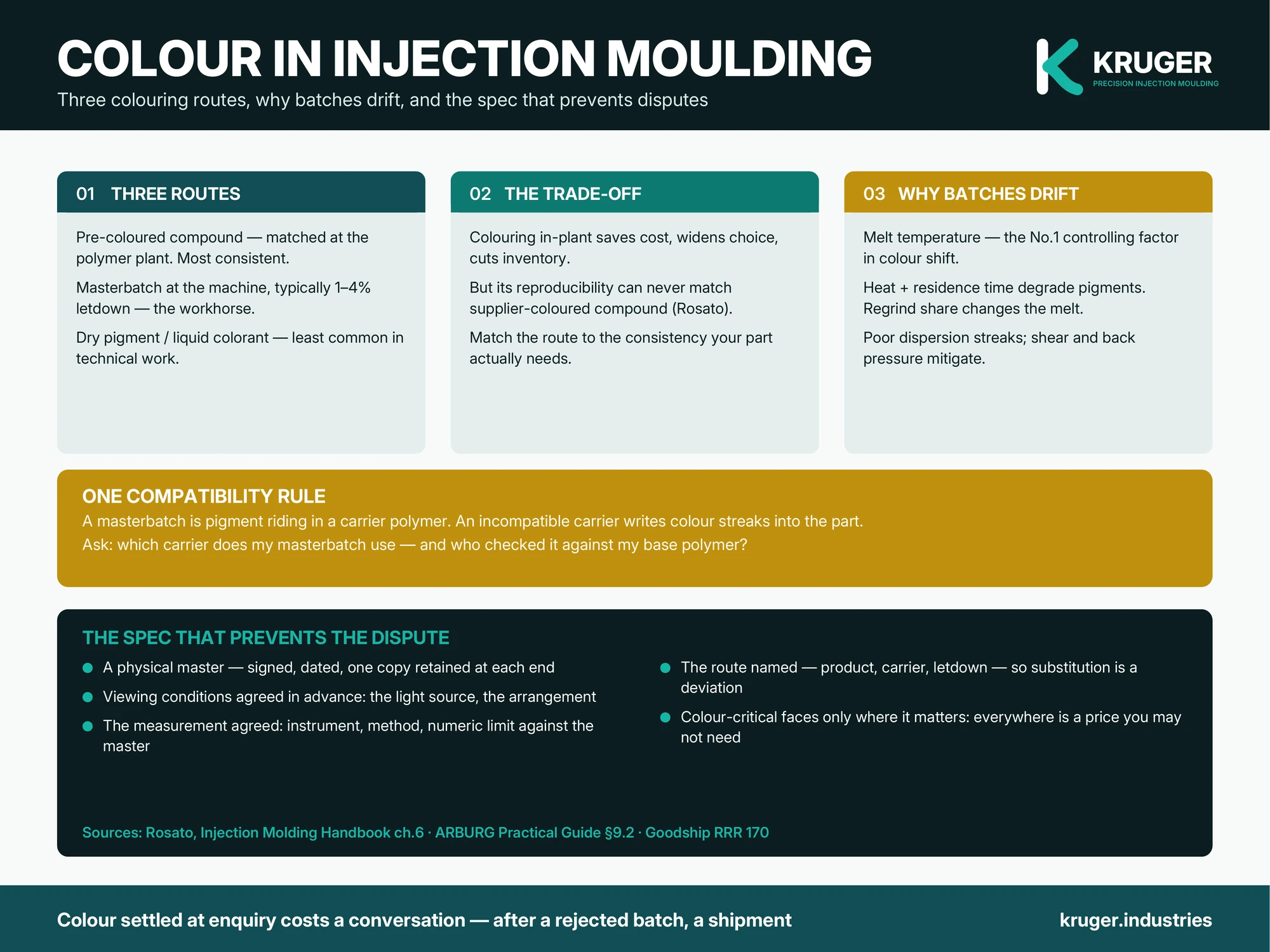
The colour arrives one of three ways. Pre-coloured compound: the polymer maker delivers granules already coloured, matched and quality-controlled at the compounding plant. Masterbatch (concentrate): a carrier polymer densely loaded with pigment, metered into natural material at the machine — typically at about 1 to 4 per cent (Rosato) — the workhorse of technical moulding. Dry pigments and liquid colorants: dosed directly, least common in engineering work. The trade-off is honest and documented: colouring at the machine saves the premium on coloured grades, widens the colour range, and cuts inventory — but the handbook is blunt that the reproducibility demanded of shades coloured in-plant “can never be so severe” as that of compound coloured by the raw-material manufacturer, and the process can shift cycle and shrinkage besides (Rosato). Neither route is wrong. The question is which consistency your part actually needs — a hidden bracket and a customer-facing housing deserve different answers, and different prices.
One compatibility rule buyers should know
A masterbatch is pigment riding in a carrier polymer — and the carrier must be compatible with the plastic being coloured. An incompatible masterbatch produces colour streaks in the finished part; the machine-maker’s guide photographs the result (Arburg). It is a fair audit question: which carrier does my masterbatch use, and who checked it against my base polymer?
Why colour drifts when nobody changed anything
Batch-to-batch drift has named causes, and most of them live in the process, not the pigment tin. The handbook’s finding is specific: the single most significant controlling factor in colour shift is melt temperature, with melt flow rate and pressure playing lesser roles (Rosato). Pigments and dyes are themselves sensitive to excessive temperature and residence time — overheat them long enough and the result is classed with burnt streaks, not colour streaks (Arburg). Poor pigment distribution shows as streaking that extra shear and back pressure can mitigate (Goodship). The share of regrind changes what the melt is made of — impurities and high reclaim content are a documented cause of dark spots and colour faults, which is one more reason regrind belongs in writing. Even moulded-in stress can read as a colour difference, because deformed areas bend light differently (Arburg). The lesson for a buyer: stable colour is evidence of a stable process — temperatures, residence time and regrind ratio held and logged, the same discipline the quality paper trail guide teaches you to demand.
What a colour specification contains
- A physical master. An approved plaque or part, signed and dated, one copy retained at each end. Photographs and screen renders are not masters.
- The viewing conditions. Colour changes with the light it is judged under — agree the light source and viewing arrangement in advance, or every dispute becomes unwinnable.
- The measurement. Instruments — colorimeters and spectrophotometers — make colour judgement consistent, though the handbook’s caution stands: they supplement experienced eyes rather than replace them (Rosato). Agree the instrument, the method and the numeric limit against the master with your moulder. The exact number matters less than everyone measuring the same way against the same master.
- The route, named. Pre-coloured or masterbatch, and if masterbatch: which product, which carrier, what letdown ratio — fixed in the specification so a cheaper substitution is a deviation, not a discretion.
- Where it matters. If only the visible faces are cosmetic, say so — colour-critical everywhere is a price you may not need to pay.
Four questions that reveal a colour system
- Which colouring route do you propose for my part, and why that one for this consistency requirement?
- How are melt temperature and residence time controlled and recorded on the machine that will run my part?
- What is your regrind policy on coloured jobs, and is it written into my order?
- How is colour approved at start-up and checked through the run — against what master, under what light, measured how?
Put colour in the RFQ, not in the dispute
Colour settled at enquiry stage costs a conversation; colour settled after a rejected batch costs a shipment. Send the master, the route and the acceptance method with your drawing. Request a quote; an engineer replies within 48 hours on working days.