
/ KNOWLEDGE · MATERIALS
Thermosetting plastics — what they are, and when your part needs one
A thermosetting plastic is one that cures: heat triggers a chemical reaction that permanently links its molecular chains together, and once set it cannot be melted again. That single sentence explains everything else about thermosets — why their moulds are heated rather than cooled, why their scrap cannot be reground, why they hold their shape at temperatures that would soften a thermoplastic, and why they are chosen for electrical parts that must never soften in service. Here is the honest engineering picture, and a straight answer about what we do and don’t mould.
Straight answer first: Kruger runs injection moulding of thermoplastics. We do not mould thermosets. If your part genuinely needs one, we will tell you so rather than talk you into the wrong material — and this page is here so you can tell the difference before you ask anyone for a price.
One irreversible reaction is the whole difference
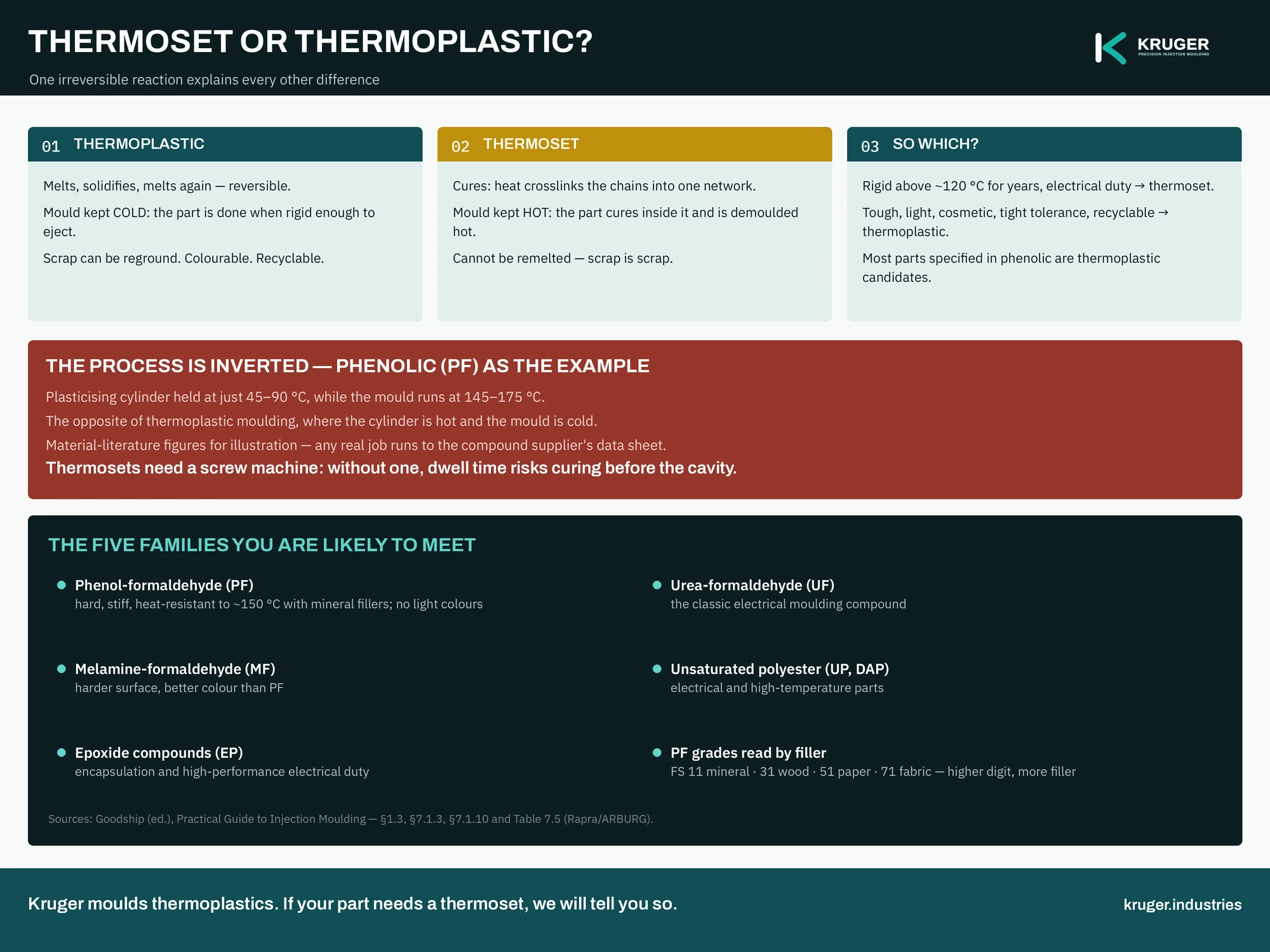
Thermoplastics melt, solidify and melt again. Heat them and the chains slide past one another; cool them and they lock; reheat them and they slide again. That reversibility is why thermoplastic scrap can be reground and why the injection moulding cycle keeps the mould cold — the part is finished the moment it is rigid enough to eject.
Thermosets do something else entirely. Under heat they crosslink: chemical bonds form between the chains, building one continuous network through the whole part. The reaction runs one way. The finished part cannot be melted, only degraded — so the mould is deliberately held warm enough for crosslinking rather than cool enough for solidifying (Goodship, §1.3), and the part is demoulded hot, already cured.
Follow that one fact and the consequences fall out in order: heat resistance is high because there is nothing to soften; creep is low because the network resists slow deformation; and there is no such thing as thermoset regrind — runners and rejects cannot be melted back into the process, so scrap is scrap. Regrind discipline, and the cost saving that comes with it, belongs to thermoplastics alone.
The five thermosets you are most likely to meet
The process literature groups the commonly moulded thermosets as phenol-formaldehyde (PF), urea-formaldehyde (UF), melamine-formaldehyde (MF), unsaturated polyester (UP, DAP) and epoxide compounds (EP) — Goodship, §7.1.10.
Phenolic (PF) is the one an industrial buyer meets most often, and it is worth understanding as the archetype. Its grades are classified by what fills the resin — mineral, wood flour, paper or fabric — and in the standard designation a higher first digit means a higher proportion of filler (FS 11 mineral, FS 31 wood, FS 51 paper, FS 71 fabric). The properties come as a package: hard and stiff, good long-term heat resistance (up to around 150 °C for mineral-filled resins), low creep — but no light colours, meaningful water absorption in the organically filled grades, and often unsuitable for food contact. Its classic applications are electrotechnical: housings, switch and relay sockets, connectors (Goodship, §7.1.10.1).
That list of applications is the real clue to when a thermoset is the right answer. If a part must carry current, resist heat over years, and never soften — a switch body, a relay socket, a commutator, a brake component — a thermoset earns its place. If it must be tough, light, cosmetic, colourable or recyclable, an engineering thermoplastic will usually beat it on every count including cost.
How thermosets are actually moulded
Three processes compete, and the trade-offs are instructive even if you never buy one.
Compression moulding is the classic: a pre-weighed blank is laid in an open mould and pressed under high pressure. The literature is blunt about its drawbacks — long cycle times, high material consumption, considerable additional finishing, parts that are not accurate, and only semi-automatic operation (Goodship, §7.1.3.1).
Transfer moulding sits in between, with a separate plasticising chamber feeding the cavities; in practice it is used for thermosets almost exclusively.
Injection moulding of thermosets is the economical modern route, and it needs a screw machine — without a screw the dwell time is too long and the material risks crosslinking before it reaches the cavity. The gains over compression are considerable: much shorter cycles, homogeneous plasticising, high precision, less wasted material, and minimum flash because the material is injected into a closed mould (Goodship, §7.1.3.2). And there is one elegant detail that mirrors thermoplastic moulding exactly — dosing and plasticising for the next shot happen while the current part is still crosslinking in the mould, so the cure time is not dead time.
How inverted the process is shows up in the numbers. For phenolic compounds the material literature gives a plasticising cylinder held at only 45 °C to 90 °C while the mould runs at 145 °C to 175 °C (Goodship, Table 7.5) — the opposite of the thermoplastic arrangement, where the cylinder is hot and the mould is cold. Those are the material maker’s figures for illustration, not settings: any real thermoset job is run to the compound supplier’s data sheet.
Thermoset or thermoplastic? A short honest test
- Must it stay rigid above about 120 °C, for years? Thermoset territory — or a high-temperature engineering thermoplastic, which is worth pricing first.
- Is it an electrical insulator carrying real current and heat? Thermosets have owned this ground for a century.
- Does it need to be tough, light, colourable, or recyclable? Thermoplastic, almost always.
- Do you need tight tolerances and fine detail at volume? Thermoplastic injection moulding, on the evidence of what tolerance grades each process actually holds.
- Will there be regrind, or a recycling requirement? Thermoplastic — thermoset scrap cannot be remelted.
- Is the driver “it must not melt in a fault condition”? Say so explicitly in your enquiry; it changes the whole material conversation.
Most parts that arrive here specified in phenolic turn out, on examination, to be candidates for a glass-filled engineering thermoplastic — cheaper per part, faster to mould, better tolerances, and colourable. Some genuinely are not. Both answers are useful to know before tooling money is committed.
What we run — plainly
Kruger Industries moulds thermoplastics by injection moulding in Bengaluru: polypropylene and PPCP, 20 per cent glass-filled polypropylene, polycarbonate, nylon 6 and 6/6 in unfilled, 15 and 30 per cent glass-filled grades, ABS, HDPE and PET — on nine machines from 60 to 1300 tonnes, ISO 9001:2015, parts from 10 g to 5.2 kg. We do not mould thermosets, and we will not pretend otherwise to keep an enquiry alive.
What we will do, gladly, is read your drawing and tell you honestly which family your part belongs in. If the answer is a thermoplastic — as it usually is — we can quote it. If it is a thermoset, you will have saved yourself a wrong tool. Our materials guide covers the full landscape of thermoplastics, thermosets, blends, alloys and composites, and reinforced and filled polymers are often the honest middle answer. Send the part and the duty it must survive — an engineer replies within 48 hours on working days, and you can run your own first numbers in the engineering tools before you do.